


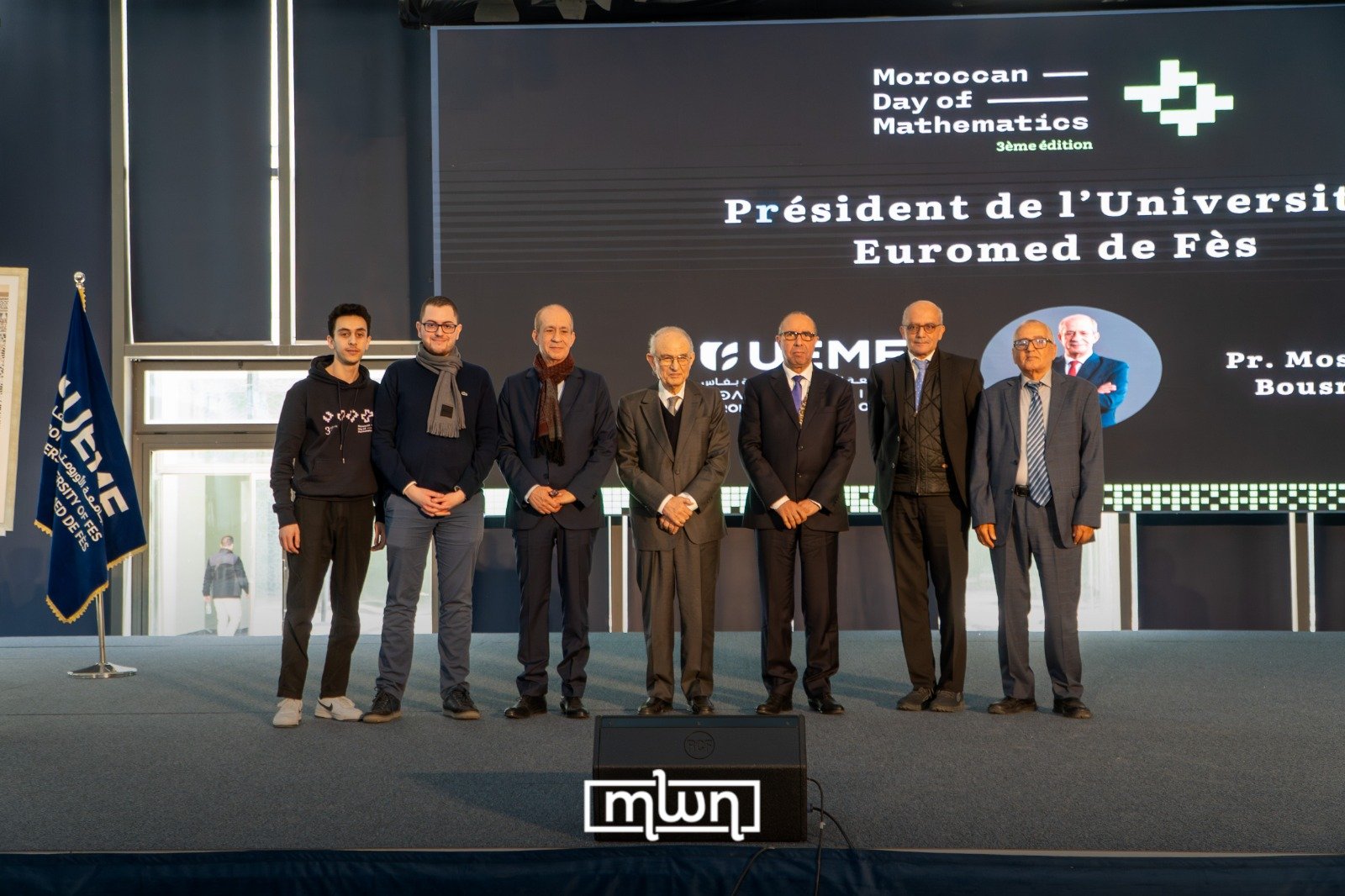
Fez — The Euromed University of Fez hosted today the third edition of the Moroccan Day of Mathematics, convening around 2,000 participants for a full program of lectures, parent workshops, thematic stands, and student competition centered on the power of mathematics in education and society.
Organized with Math&Maroc and the Hassan II Academy of Science and Technology, the large-scale event was designed as a public-facing mathematics gathering rather than a closed academic conference. From the morning welcome session to the afternoon “Math Sprint” and closing results announcement, the day moved between institutional speeches, scientific reflection, and direct engagement with students of different ages.

Mostapha Bousmina, President of the Euromed University of Fez, said the university had opened its doors to students and alumni from schools across the country so they could attend mathematics conferences and take part in the competition. “The laureates of this competition, three firsts among them, will be given a full scholarship here at the University, including also catering and including residences for students,” Bousmina told Morocco World News (MWN).
He said the scholarship package represents between MAD 110,000 and MAD 150,000 per year and would cover the students throughout their years at the university. Bousmina added that mathematics remains essential for preparing the engineers Morocco needs to support development across industry, infrastructure, and services. “We are very happy to receive all this young generation which are the future of our country,” he said.
A day built around mathematics for everyone
The event’s program reflected that broad ambition. Organizers scheduled high-level conferences in the morning, followed by parallel sessions in the afternoon, including the “Math Sprint” for middle and high school students, workshops for parents and scientific audiences, stand visits, a mobile mathematics museum, orientation sessions for high school students, and Olympiads for younger participants.

Math&Maroc President Mohamed Ali Benchekroun said the idea was to make the day accessible to as many people as possible. He told MWN that the event welcomed middle school students, high school students, university students, parents, and the general public, while also featuring conferences by high-level speakers and an afternoon competition involving around 500 students.
That open spirit could also be heard in the reactions of participants. Hiba Elazzouzi, a second-year middle school student from Khemisset, said she was proud to be part of the event and described mathematics as something deeper than calculation. “It’s not just about numbers. It’s about thinking, discovering, solving each problem,” she told MWN.

Hadil Belhaj, a high school student at Manarat Al Ferdaous in Khemisset, described the day as an opportunity to solve mathematical problems, attend conferences, and experience mathematics in a more exciting environment. She said she hoped more students from future generations would get the chance to come and live the same experience.
Bousmina turns mathematics into a civilizational story
If the scholarship announcement gave the day one of its most concrete headlines, Bousmina’s conference gave it one of its broadest intellectual frames. His remarks did not stay limited to university admissions or academic opportunity. Instead, he offered a sweeping reflection on how mathematics shaped humanity’s understanding of the world, moving from counting and measuring to abstraction, equations, and prediction.
Bousmina argued that mathematics allowed human beings to move beyond observing nature and toward modeling it. He invoked Galileo’s idea that the “book of nature” is written in mathematical language and returned repeatedly to the almost mysterious power of equations to describe physical reality with precision. In his telling, mathematics is what makes the world legible, what allows science to connect the past, present, and future, and what makes prediction itself possible.

The central thread of his conference was the number zero. Bousmina described the number as one of the most powerful and revolutionary ideas in the history of knowledge, far from the notions of absence or lack with which it is generally associated. He reflected on how zero was misunderstood, resisted, and philosophically rejected in parts of history before becoming indispensable to mathematics, scientific notation, coordinates, calculus, and computing. In doing so, he turned a familiar symbol into a narrative about how human thought evolves.
His lecture moved across civilizations and scientific milestones, touching on Mesopotamian number systems, Greek philosophical debates, Indian mathematical advances, and later developments in Europe. From there, he linked zero to the Cartesian plane, differential calculus, Newtonian mechanics, relativity, and modern digital systems built on binary code. His message was clear: zero sits quietly at the heart of the sciences and technologies that define modern life, from physics and engineering to artificial intelligence.
He also used mathematical history to make a broader point about imagination. Scientific breakthroughs, in his account, were not only technical achievements but acts of intellectual courage. Equations, he suggested, often reveal realities before they are observed, whether in planetary motion, modern physics, or technological design. That perspective gave his talk an unusually expansive tone, treating mathematics not only as a school subject or professional tool, but as one of humanity’s deepest ways of making sense of existence.
Mathematics, youth, and Morocco’s future
Other opening speakers grounded that philosophical message in national priorities.

The remarks delivered at the opening framed mathematics as a discipline that trains rigor, logic, and critical thinking while also helping Morocco prepare more engineers, researchers, specialists, and scientists.
Speakers also linked mathematics to large contemporary challenges, including resource management, climate issues, and data-driven decision-making.
That made today’s event feel larger than a one-day competition.
