


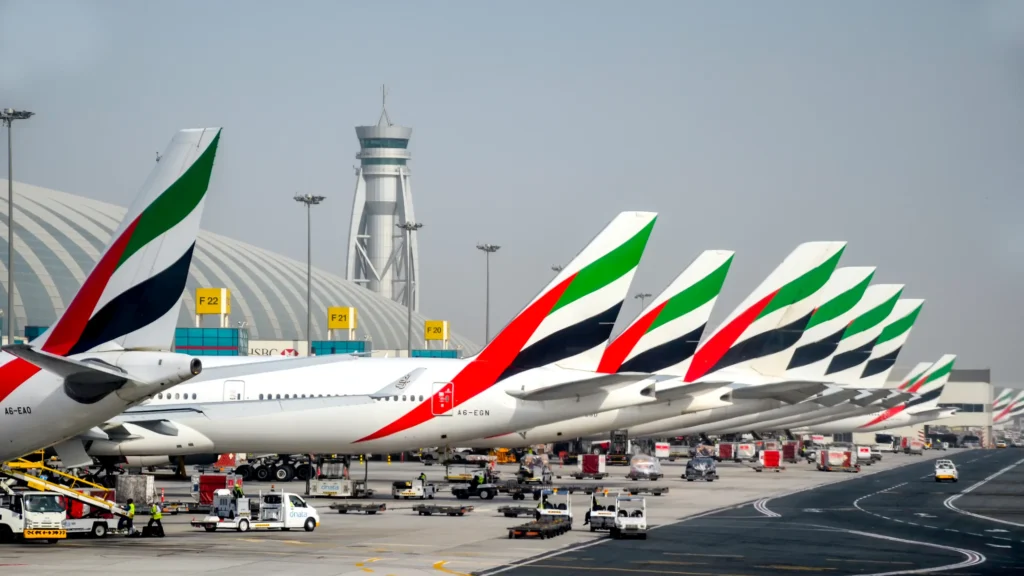
Marrakech – The United Arab Emirates announced on Saturday the full resumption of air traffic operations, lifting all precautionary measures that had been in place since the outbreak of the US-Iranian conflict on February 28.
The General Civil Aviation Authority (GCAA) confirmed the decision followed a “comprehensive evaluation of operational and security conditions” conducted in coordination with relevant national entities. “Continuous real-time monitoring remains in place to ensure the highest levels of aviation safety,” it stressed.
The GCAA also expressed appreciation for the cooperation of passengers and airlines throughout the disruption period. It reaffirmed the readiness of its technical and operational teams to respond to any future developments, urging the public to rely on official sources for updates.
The move makes the UAE the latest Gulf state to restore normal flight operations. Bahrain, Iraq, Kuwait, and Jordan had previously reopened their airspace in the weeks following a ceasefire agreement between Washington and Tehran.
Qatar Airways is operating a limited schedule from Hamad International Airport and plans to have 120 routes operational by mid-May. Israel’s Ben Gurion Airport has also slowly resumed international flights.
Iran’s airspace remains partially open but is largely avoided by international carriers. Lebanon’s airspace is technically operational but could close at short notice due to the ongoing threat of Israeli attacks.
The conflict erupted on February 28 when the United States and Israel launched wide-ranging strikes on Iran, killing the country’s supreme leader. Tehran retaliated with attacks on Israel and US-allied Gulf states, prompting sweeping airspace closures across the region.
No further large-scale attacks have been reported since a conditional ceasefire took effect on April 8, allowing authorities to gradually restore operations before confirming a full return to normal traffic.
Hostilities had been ‘terminated’
The ceasefire, however, has not produced a lasting resolution. Iranian state news agency IRNA reported on Friday that Tehran had sent a new negotiation proposal to Washington via Pakistani intermediaries. President Donald Trump said he had “a conversation with Iran” but added he was “not happy” with the progress of talks.
On the same day, Trump wrote to congressional leaders arguing that hostilities had been “terminated” and that the 60-day War Powers Resolution deadline no longer applied.
Under US law – specifically the 1973 War Powers Resolution – a president can send troops into combat without Congress’s approval, but only for a limited time. After 60 days, the president must either get formal authorization from Congress to continue the war or pull the troops out.
This law was passed during the Vietnam War era to prevent presidents from waging endless wars without congressional oversight.
Trump notified Congress about the Iran strikes on February 28. That started the 60-day clock. By May 1, those 60 days were up. At that point, Trump was legally required to either stop military operations or get Congress to vote in favor of continuing them.
Instead, Trump argued that because he ordered a ceasefire on April 7, the hostilities had been “terminated” – meaning the clock no longer applies. His administration is effectively arguing that, since no formal war is currently taking place, congressional authorization is not required.
Critics, including Democrats and legal scholars, say that’s not how the law works. A ceasefire is temporary, not a permanent end to the conflict. The military is still enforcing a blockade on the Strait of Hormuz, which is itself considered an act of war under international law. So in their view, the 60-day obligation still stands, and Trump is dodging it.
War powers analyst Katherine Yon Ebright pushed back on the claim, stating that “nothing in the text or design of the War Powers Resolution suggests that the 60-day clock can be paused or terminated.”
The Strait of Hormuz remains effectively closed, and the US Treasury has warned that any entity paying Iran a toll for passage through the channel risks violating American sanctions.
Despite the reopening, European carriers including British Airways, KLM, and Lufthansa continue to suspend routes to the region. Gulf airlines are rebuilding capacity gradually, operating at between 35% and 75% of pre-war levels.
Read also: Kuwait Airways Restores Direct Link Between Kuwait and Casablanca