


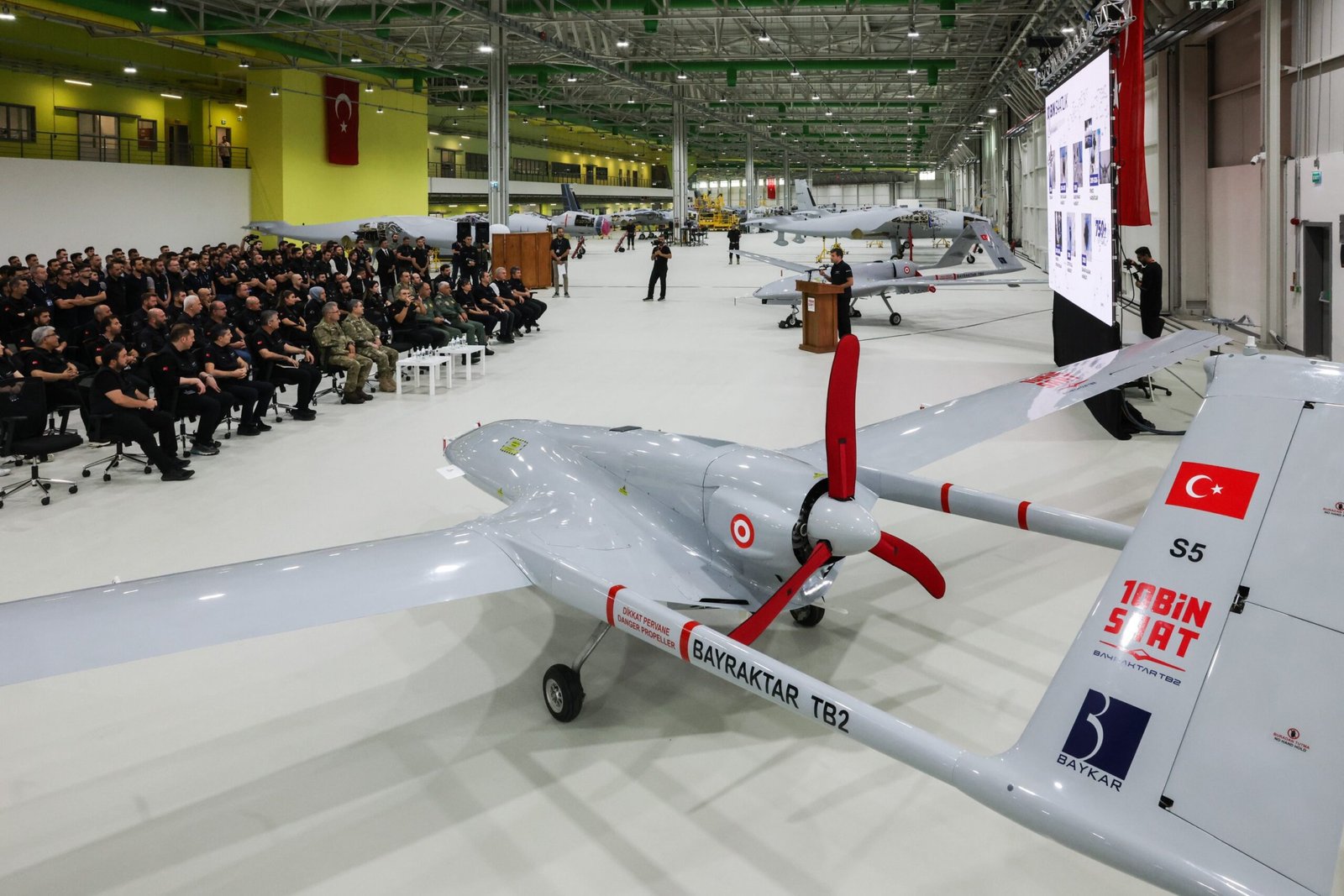
Beni Melllal – Turkey’s leading drone manufacturer Baykar has launched recruitment for five technical positions at its Moroccan subsidiary, Atlas Defense, signaling concrete progress on its planned UAV facility in Benslimane – even as sources remain divided on the true scope of the project.
The open roles include a Mechanical Technician, Structure Technician, Painting Technician, Electronics Technician, and a Test Pilot – all based in Benslimane and centered on UAV maintenance, repair, overhaul, and flight testing operations.
Atlas Defense was officially registered with the Moroccan Trade Registry on December 5, 2024, and confirmed through the Official Bulletin No. 5857 published on January 29, 2025. The Rabat-based subsidiary carries a paid-up capital of MAD 2.5 million ($250,000).
Its activities formally cover drone design, manufacturing, maintenance, spare parts production, and technological systems for the defense industry.
The company is jointly owned in equal shares by Lutfu Haluk Bayraktar and Selçuk Bayraktar – the latter being the son-in-law of Turkish President Recep Tayyip Erdoğan.
Its establishment was also driven by Moroccan regulations requiring foreign companies to create local entities before providing maintenance and spare parts services on Moroccan soil.
Sources, however, diverge sharply on what Atlas Defense will ultimately deliver. A source familiar with the matter told Middle East Eye (MEE) that Baykar set up the subsidiary primarily to service the drones it already sold to Morocco, noting that the company’s relatively modest capital makes a full production line unlikely.
Turkish defense experts, the same source claimed, do not view Morocco as a strategic market large enough to justify major manufacturing investment.
Other sources tell a different story. Reports citing sources close to the file describe plans for a facility dedicated to producing a high-value “tailored product” designed specifically for Morocco’s needs – a system that can be deployed through either the TB2 or the Akinci drone platform and reportedly involves an explosive payload.
The subsidiary’s creation is the culmination of a partnership that goes back several years. In September 2021, Morocco received its first batch of 13 Bayraktar TB2 armed drones in a deal reportedly worth $70 million.
A further delivery followed in August 2024, as confirmed by Baykar on its social media channels. The TB2 drones have proven operationally significant for the Royal Armed Forces, particularly in monitoring and containing Polisario militia activity along the buffer zone east of the Berm in the Sahara.
Morocco’s Royal Armed Forces (FAR) also announced the acquisition of Baykar’s more advanced Akinci combat drones in 2025. The Akinci represents a significant upgrade over the TB2, offering greater autonomy, stealth capabilities, and a higher payload capacity.
Moroccan military personnel had already undergone specialized training at Baykar’s industrial facilities in Turkey, with photos and videos of those sessions circulating months earlier.
The facility will be located in Benslimane, roughly 50 kilometers southeast of Casablanca, near the Royal Air Force’s logistics support base – a proximity that offers clear operational and supply chain advantages.
The same industrial zone hosts Lockheed Martin’s planned maintenance and modernization center for Morocco’s F-16 and C-130 Hercules fleet, making Benslimane an increasingly significant node in Morocco’s defense infrastructure map.
Atlas Defense will not be the only foreign drone manufacturer with a production presence there. Israeli company BlueBird Aero Systems broke ground on its own facility in April 2024, though construction slowed following the outbreak of the Gaza war.
BlueBird recently hosted a Moroccan technical team at its Israeli facilities for hands-on training ahead of launching a local manufacturing line for its Spy-X kamikaze drone – the first of its kind in Morocco. Both the Baykar and BlueBird projects are expected to serve domestic FAR requirements while targeting the broader African export market.
Morocco’s defense ambitions extend beyond these two partnerships. The country also maintains active industrial cooperation with Thales and Lockheed Martin. In November 2023, Minister Delegate for Defense Abdellatif Loudiyi publicly indicated Morocco’s ambition to develop a domestic military industry, including drone production.
The dual partnerships with Turkey and Israel – two countries with advanced but distinct drone technologies – reflect Rabat’s deliberate strategy of diversifying its defense partnerships while building toward greater technological self-reliance.
