


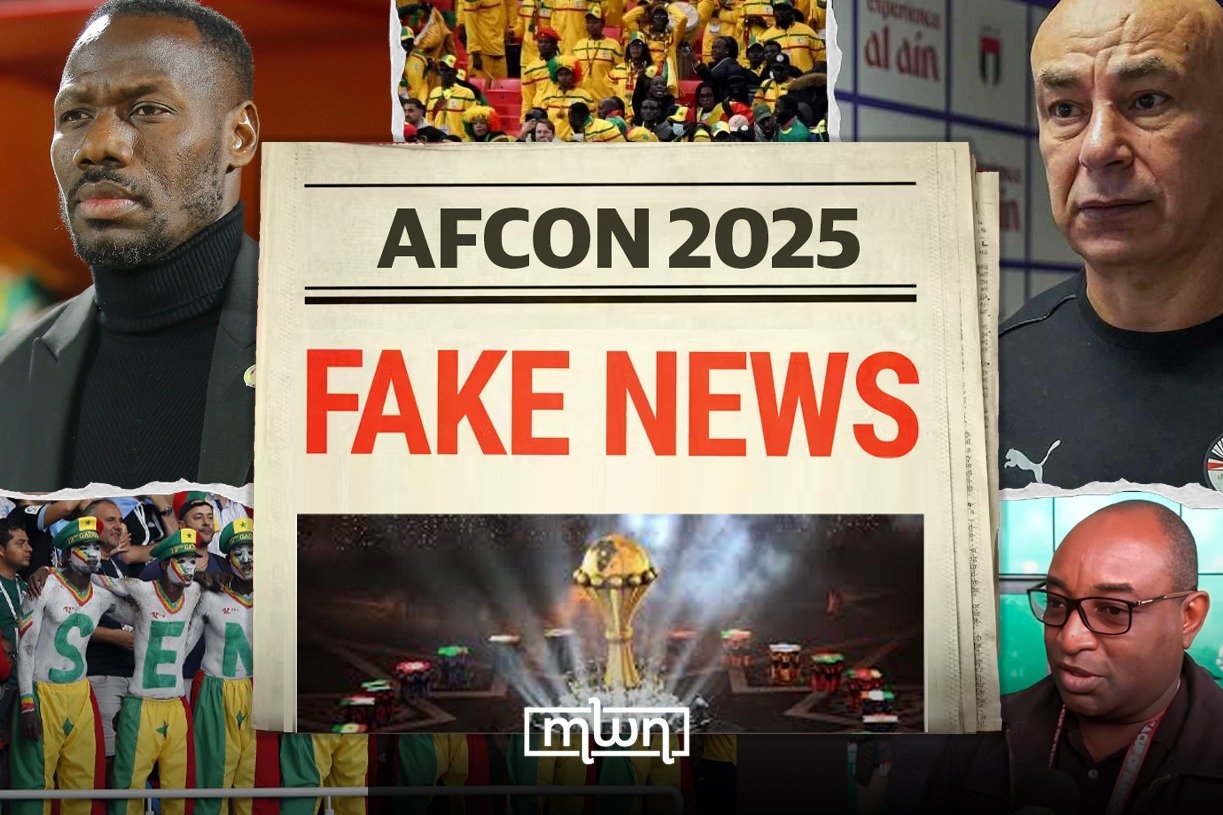
Rabat – The Africa Cup of Nations 2025 brought not only joy to the continent but also a platform that some media, social media accounts, and trolling pages exploited to disseminate fake news and disinformation.
Some platforms frequently seize every opportunity, whether a smallest incident or a major event like the AFCON, to exploit the situation and spread fabricated narratives.
Fake news is not a new phenomenon in Morocco. The rise of social media and mobile technology, in addition to the expansion of AI, has massively amplified its impact.
Platforms digging for sensationalism exploit every moment to chase and stir emotions, deepening divisions and controversies.
Repeated endlessly, they create an atmosphere in which disinformation thrives. When a false report goes viral, many respond by assuming it must hold some truth, precisely because “everyone online” seems to say the same thing.
In this way, loosely grounded claims become the raw material from which fake news draws its “credibility,” and end up blurring the line between rumor, opinion, and fact, which in turn results in eroding any shared basis for a fair assessment of the tournament.
The damage extends beyond misinformation itself. For media outlets, even indirect participation in this dynamic, through uncritical reporting, sensational framing, or selective amplification, undermines journalistic responsibility and public trust.
This pandemic has surged again during the continental tournament with pages on social media accounts and even some media, which used viral videos that sometimes date back to other events – exploiting the tournament’s visibility for virality.
After the AFCON, several pieces of misinformation have stood out, among the most widely circulated and most damaging.
Fake News #1: The security guard hit by Senegalese fans in the stadium died
One of the stories comes from rumors alleging the death of a stadium staff member.
The rumors emerged during moments of chaos and vandalism inside the Prince Moulay Abdellah stadium during the Morocco vs Senegal AFCON final. Some Senegalese fans tore out seats as they attempted to storm the pitch, sparking outrage across social media.
In the middle of the frustration, fake news quickly found space to spread fuel to the fire, leading in some cases to hateful commentary online. One staff member was visibly struck during the disorder and was immediately transferred for medical care. Barely an hour later, several pages and accounts began falsely claiming he had died.
The rumor spread at high speed, shared by both lesser-known pages and even some well-trusted commentators. Within minutes, the source vanished in the noise, overshadowed by the viral pace at which fake news travels.
This particular storm of fake news only ended after Morocco’s General Directorate of National Security (DGSN) released a statement refuting the rumor that had started it all.
On January 20, DGSN firmly confirmed no death was recorded among security staff or ball boys, emphasizing that the facts were verified after checking with different health institutions.
Fake News #2: A Senegalese fan was violently assaulted and killed in Morocco after the match
The second claim that rapidly traveled to every house in Morocco through social media is the death of a Senegalese fan as a result of a violent assault.
Senegalese media, including the generally reliable website Senenews, picked up the false rumors. “The celebration of the historic triumph of the Teranga Lions at the 2025 Africa Cup of Nations, won against Morocco, was overshadowed by a tragedy on Moroccan soil,” the website wrote. “A Senegalese national, identified as Cheikh Diouf, reportedly lost his life after being violently assaulted.”
Senenews cited “information” circulating on social media, amplifying the message that Moroccan security was not strong enough to save the individual. In reality, the host country had done everything possible to ensure the tournament’s safe success, deploying tens of thousands of security personnel both inside and outside the stadium to safeguard public safety.
Morocco’s police denied these claims in a statement on December 20, stressing that they found no record of any murder or fatal assault in their investigations. Police emphasized that the only valid fact was that a body was found of an unidentified sub-Saharan man in Sale, but the cause of death is unknown.
Police said the body smelled of alcohol and showed no clear signs of violence or resistance, except for minor bite marks that were linked to the presence of stray dogs where the body was found.
Fake News #3: A Malian journalist covering AFCON in Rabat was killed under suspicious circumstances
The dangerous fake death claims are not just limited to fans, with yet another claim that Malian journalist Sumare Mohamed Cheikh Tidiane was killed. One again, this unverified rumor spread quickly on social media and even within some media outlets.
One YouTube channel running under the name of “3 eme mi-temps” created a sensational headline under “WE KNOW THE CAUSE OF DEATH OF THE MALIAN JOURNALIST IN MOROCCO.”
The video shows a journalist from Algerian news outlet 24 News, reportedly complaining about an “unawarded penalty” to the Malian team when they played Morocco in a Group A match.
The video included a montage of multiple clips stitched together, displaying social media influencers. Most comments on social media appeared to link the Malian journalist’s death to his criticism of AFCON refereeing. In a thinly veiled attempt to accuse Morocco of having a hand in the journalist’s “suspicious death,” waves of conspiratorial commenters rushed to recall, with leading contextualization, that the journalist “was found dead in mysterious circumstances after he had criticized the refereeing of the Morocco vs Mali game.”
Malian media, notably the news outlet La Depeche, embraced this shameful game of weaponizing fabricated outrage to court clicks. The website reported on the news with a sensationalist headline: “Immense shock:… A well-known consultant was found dead in his hotel room in Rabat while covering AFCON 2025.”
On January 15, the news outlet said the circumstances of the journalist’s death “are, for now, unclear,” but that Yet it added, ever suggestively, that “several local media outlets described his death as a ‘shockwave’ for his colleagues.”
Through the noise, the truth eventually came out.
On January 20, the Attorney General at the Rabat Court of Appeal dismissed the claims circulating online alleging the death of Sumare Mohamed Cheikh Tidiane was suspicious or linked to his support for an Arab team during AFCON.
An investigation confirmed that he in fact died of natural causes. The results specifically concluded that the freelance journalist, who was found at his residence on January 14, died of pulmonary embolism related to high blood pressure.
In other words, he had died of a heart attack. And comments by friends and acquaintances, including colleagues who had met him days earlier, indicated the journalist was very ill and was always carrying a batch of medicines for his heart and other related health issues.
Fake News #4: Referees apologized to team members for bad calls and officials accused the hosts of favoritism
Beyond false claims surrounding individual deaths, the tournament also saw a surge in digitally manipulated content, including AI-generated videos – sometimes deepfakes – that circulated widely online.
Several of these AI-generated videos targeted refereeing decisions and Morocco as host nation, falsely showing referees apologizing, as well as players and officials accusing the hosts of favoritism.
Investigations by RFI (Radio France Internationale), a French public radio station, identified the clips as artificial, with visual flaws in faces, logos, flags, and crowd movement exposing their use of AI.
However, the damage had already been done as these AI-generated clips spread to channels such as Barry TV on Dailymotion, contributing to online tensions and amplifying misinformation during the tournament.
Fake News #5: Senegalese players were poisoned ahead of the final
Another claim that gained traction online concerned allegations that three Senegalese players were deliberately poisoned ahead of the final.
Krépin Diatta, Pape Matar Sarr, and Ousseynou Niang were forced to withdraw shortly before kick-off after feeling unwell, prompting speculation on social media that they had been intoxicated.
The rumor was amplified by online commentary and vague post-match remarks from Ismaïl Jakobs. “A lot of things happened before the match. I think many things will come out after the match. You will discover them,” Jakobs said in a conspiratorial statement.
The news spread rapidly despite the absence of any medical findings, official statement, or evidence. The players were later discharged from the hospital after examinations, with no indication of poisoning.
Fake News #6: Sub-Saharan businesses in Morocco were targeted during the AFCON
In a similar wave of fear-mongering, in an effort to paint the picture that Morocco is an unsafe place for fellow Africans from across the continent, French weekly Le Point, falsely claimed that businesses owned by Sub-Saharan Africans were attacked or set ablaze during the Africa Cup of Nations (AFCON) final.
Morocco’s General Directorate of National Security (DGSN) has issued a strong condemnation de-basing these claims. In its statement, the DGSN emphasized that no criminal incidents targeting Sub-Saharan businesses occurred anywhere in Morocco during or after the AFCON final.
“These allegations are entirely fabricated and contradict the reality on the ground,” the authority noted.
Through its fact-checking, DGSN proved that throughout the tournament, Moroccan authorities actively monitored digital platforms to identify and debunk false information, issuing official statements to clarify the situation.
Yet, these verified sources were apparently ignored by Le Point, among other media outlets, which chose to push forward the sensationalist claims over accuracy. These incidents are not isolated, but merely part of a larger campaign of foreign journalists, including from Algeria and Egypt who have attempted to tarnish Morocco’s security reputation throughout the tournament.
Fake News #7: Arsene Wenger quote saying the entire continent was against Morocco
In addition, many news outlets and pages shared a quote claiming former Arsenal and FIFA technical director Arsene Wenger had said: “How can you succeed when an entire continent stands against you? Congratulations to Morocco for the sportsmanship it showed throughout the tournament.”
This quote was widely circulated on Facebook and Instagram pages, both in Morocco and elsewhere. However, there is no credible source, official interview, or verified news report proving Wenger ever said this. The phrase only appears on user-generated social posts and not in any reputable sports media files.
While the quote seems to be lauding Morocco and its organization of the AFCON, it also suggests that the whole African continent was united against Morocco, a narrative that fueled hostility, resentment, and hate speech online. The fake quote also reinforced the idea that Morocco was isolated and targeted, which could deepen divisions among fans and teams in the already acrimonious aftermath of a tense tournament.
Fake News #7: CAF was giving away free tickets to fans to support specific teams
Another piece of misinformation that circulated widely on social media claimed that CAF or AFCON organizers were giving away free stadium tickets to fans, especially suggesting these were being handed out to supporters of specific teams.
The rumors spread mainly after one of Egypt’s Group Stage games in Agadir, with several social media users saying that fans were able to get in for free or that they were handed in tickets.
CAF reportedly denied these claims in a statement, saying that “reports of free entry are false,” encouraging prospective fans to buy tickets on official channels.
It is a common practice to allow fans free entry into stadiums, which is what reportedly happened during Egypt’s early games, especially when attendance is low. This usually happens during matches that do not involve the host nations in order to fill empty seats and improve the atmosphere.
However, this practice was wrongly used to justify false claims, which is a clear example of how fake news spreads by mixing half-truths with assumptions.
In most cases, what followed was not merely criticism, but a discursive escalation – a rapid hardening of narrative into insinuation. Segments of the international media seized upon the controversy to imply backstage engineering, recasting Morocco not simply as fortunate or efficient, but as covertly manipulating outcomes to secure silverware. Victory was rendered suspect by default, excellence translated into intrigue.
Fake News #9: Morocco plans on leaving CAF to join UEFA
Looking forward past the AFCON, another recurring false claim that originated in Moroccan social media, alleged that Morocco had formally requested to leave CAF and join UEFA, despite no statement or process from CAF, UEFA, FIFA, or the Moroccan federation.
Some false claims went further, asserting that Morocco would participate in UEFA Euro 2028. Such scenarios are unfounded, particularly as Morocco is preparing to co-host the 2030 World Cup with Spain and Portugal, a project built on its role as a bridge between Africa and Europe and a long-term strategy centered on African football development.
Fake news in this context has largely been driven by conspiracy-driven narratives, which thrive precisely because they do not require verification to circulate.
Such claims rely on emotional readiness rather than evidence, and in moments of collective catharsis gain traction not through credibility but through emotional resonance, as frustration, grievance, and disappointment lower the threshold for acceptance and scrutiny following the AFCON final.
Fake News #10: Senegalese team faces multi-million dollar fines, risk a stripped trophy, and citizens face visa bans
Numerous other voices within Morocco’s ecosystem began circulating speculative scenarios about alleged behind-the-scenes CAF investigations, despite the absence of any official confirmation.
Rumors ranged from claims that CAF would impose multi-million-dollar fines on Senegal, to assertions of lifetime bans for the Senegalese coach, proposals to replay the final in Qatar behind closed doors, or even suggestions that the trophy would be stripped from Senegal and the 2025 title left vacant.
Other unfounded claims extended beyond football governance. Some posts alleged that Morocco would impose visa restrictions on Senegalese nationals, while others hinted at broader diplomatic or sporting reprisals across Africa.
None of these scenarios were supported by official statements or institutional processes, yet they spread rapidly, illustrating how emotionally charged environments allow speculation to harden into perceived truth in the digital age.
AFCON shaming and circulating reputational damage
More than the sheer volumes of specific stories are outside reputation jabs. These take shape in a surge of unfounded claims circulated with striking confidence alleging that Morocco “rigged” games, manipulated the organization of the tournament to its own benefit, or failed to offer a welcoming environment. More often than not, these assertions are presented as self-evident truths rather than mere opinions.
Although these narratives do not qualify as fake news in a strict and technical sense, they attempt to debase Morocco’s role as host, reduce a complex sporting event to conspiracy-laden shorthand, and entrench polarized readings that leave little room for nuance or evidence. The result is a structured media failure, where speed, engagement, and outrage heavily outweigh verification, context, and ethical restraint.
Why is this happening now?
This framing did not emerge in a vacuum. It intersected with a deeper unease surrounding Morocco’s expanding strategic visibility beyond football – economic, diplomatic, infrastructural, and cultural. Such an ascent has proven particularly unsettling for former colonial powers, France foremost among them, now witnessing influence recede across arenas long presumed to be their natural preserve.
Spanish media, for instance, has instrumentalized the controversy to advance rival ambitions by amplifying the significance of the horrific scenes from the AFCON drama – namely clashes between some pitch-invading Senegalese fans and security officials. From these scenes, positioning-minded Spanish media has naturally concluded that while Morocco may be ready to co-host the 2030 World Cup, Camp Nou or the Bernabéu as more “appropriate” venues for the final of that jointly organized World Cup. Here, outrage is neither innocent nor principled; it is a tool for benchmarking and positioning. Layered atop this was a strain of performative liberal ethics, hastily mobilized by sections of the media left. Among certain Arab and African outlets, the hostility was equally legible. And it was rooted in intra-continental competition, wounded Pan-African imaginaries, or a perception of Morocco as an outsider challenging established hierarchies.
Under the guise of justice and solidarity, familiar neo-colonial tropes were revived and repackaged: Morocco cast as insufficiently African, or worse, as a paternalistic and arrogant half-sibling intent on fawning its success by “teaching” the rest of the family order, efficiency, and success.
Crucially, this distorted discourse was not merely imported from the West. It was first echoed – and in several cases initiated – by segments of Arab and African media that might have been expected to exercise solidarity, but instead internalized and reproduced the very tropes that have historically undermined them. In doing so, they furnished Western outlets with ready-made frames later weaponized against Morocco. This episode once again sheds light on a reality long acknowledged in media and cultural studies: the media is not a neutral observer but an instrument of power. It is a tool of soft diplomacy no less consequential than embassies or trade agreements.
Faced with this complex amalgam of rivalry, guilt, ideology, and power projection masquerading as objective, neutral reporting or ethical analysis, Morocco’s challenge going forward is to cut through this tsunami of disinformation with truth, clarity and stability.
Read also: Beneath Painful AFCON Drama, Morocco Set the Standard for the Future
