


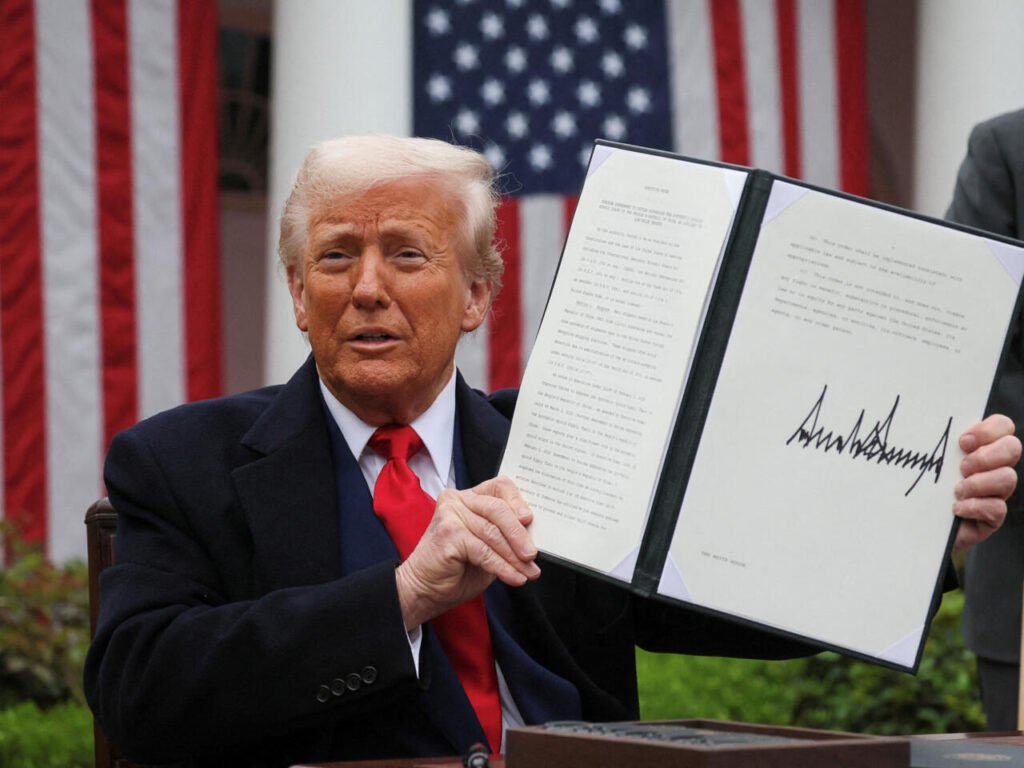
Marrakech – The US Treasury Department announced on Thursday that President Donald Trump’s signature will appear on all new US paper currency, marking the first time a sitting president’s name will be printed on American banknotes.
The first $100 bills bearing Trump’s signature alongside that of Treasury Secretary Scott Bessent will be printed in June. Other denominations will follow in subsequent months.
The change will end a 165-year tradition. Since 1861, US paper currency has carried the signatures of the Treasury secretary and the US treasurer. Under the new plan, the treasurer’s signature will be dropped entirely.
‘Appropriate and deserved’
“There is no more powerful way to recognize the historic achievements of our great country and President Donald J. Trump than US dollar bills bearing his name, and it is only appropriate that this historic currency be issued at the Semiquincentennial,” Bessent said in a statement.
The Treasury framed the move as part of celebrations marking the 250th anniversary of American independence on July 4.
US Treasurer Brandon Beach, whose signature will not appear on the redesigned notes, expressed support for the decision. “Printing his signature on the American currency is not only appropriate, but also well deserved,” Beach stated.
Lynn Malerba, who served as treasurer under former President Joe Biden, will be the last in an unbroken line of treasurers whose signatures appeared on federal currency since 1861. She declined to comment on the change.
The announcement drew immediate criticism from Democrats. “Now Americans will know exactly who to blame as they’re paying more for groceries, gas, rent, and health care,” California Governor Gavin Newsom said in a social media post.
‘Vanity project’ and a ‘gross and un-American’ plan
Representative Shontel Brown, a Democrat from Ohio, called the plan “gross and un-American,” adding that it “will remind us who to thank when we pay more for gas, goods, and groceries.”
Senator Jeanne Shaheen, a New Hampshire Democrat, indicated the move “flies in the face of our country’s ideals” and called it “yet another vanity project for the sitting president.”
The currency change is part of a broader pattern. Trump has renamed the US Institute of Peace, the Kennedy Center for the Performing Arts, and a new class of battleships after himself. Earlier this month, a federal arts commission approved a commemorative 24-karat gold coin bearing Trump’s image, despite federal law prohibiting depictions of living presidents on circulating currency.
Michael Bordo, director of the Center for Monetary and Financial History at Rutgers, acknowledged the move will face political pushback but added, “I do not know if he has crossed any legal red lines,” remarking that the Treasury secretary may have the authority to decide who signs the currency.
Douglas Holtz-Eakin, a Republican economist who served under former President George W. Bush, questioned whether adding Trump’s signature to the currency served the national interest. Noting that fewer Americans use cash, he called it “the ultimate act of futility.”
Larry Felix, former director of the Bureau of Engraving and Printing, noted the bills could become collectibles, calling them a potential “numismatic rarity.”
Whether the signature survives future administrations remains uncertain. Future Treasury secretaries hold the discretion to reverse the change. For now, however, Trump’s name is set to join the faces of past presidents already printed on the dollar, adding yet another layer to an already contentious legacy debate.
Read also: Trump Shifts From Ultimatum To Diplomacy In Iran Conflict