


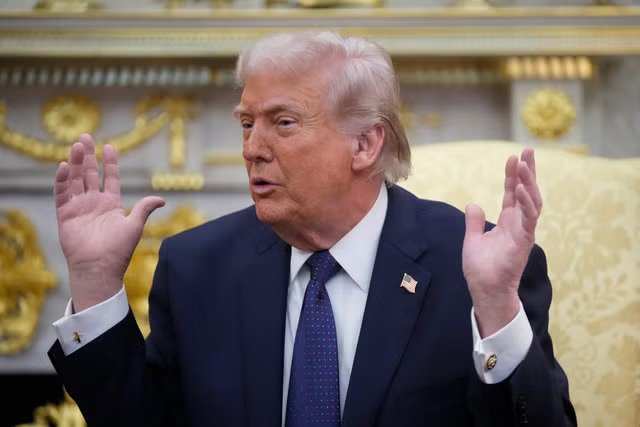
Rabat – US President Donald Trump has escalated tensions with Spain, declaring today that Washington could sever trade ties after Madrid refused to authorize the use of American military bases for missions linked to strikes on Iran.
Speaking during a meeting with German Chancellor Friedrich Merz, Trump accused Spain of obstructing US security priorities. He said he had instructed Treasury Secretary Scott Bessent to halt commercial dealings with the European country,
“Spain has been terrible,” Trump told reporters. “We’re going to cut off all trade with Spain. We don’t want anything to do with Spain.”
The confrontation follows Spain’s decision not to allow US forces to use Naval Station Rota and Morón Air Base in operations connected to Iran. In response, Washington relocated 15 aircraft, including refueling tankers, from the two facilities in southern Spain.
Madrid explained its refusal by stressing legal and political boundaries. Foreign Minister José Manuel Albares said the US is neither using nor expected to use joint military facilities on Spanish soil for operations against Iran.
He clarified that any deployment beyond the scope of existing bilateral agreements, or outside the framework of the UN, would not receive authorization.
The facilities at Naval Station Rota and Morón Air Base operate under joint-use arrangements, yet remain under Spanish sovereignty, a point Madrid has firmly reiterated.
Prime Minister Pedro Sánchez described the recent US and Israeli strikes on Iran as an “unjustified” and “dangerous military intervention” outside international law, signaling a clear policy divergence from Washington.
Defense Minister Margarita Robles added that the bases would only provide support in strictly humanitarian circumstances.
Spain also condemned Iran’s retaliatory attacks on Gulf countries, presenting its stance as grounded in legal principles rather than alignment with any side in the conflict.
Trade leverage and legal grounds
Trump described the dispute as both a military and economic disagreement. He said he has the authority to impose sweeping restrictions, including a possible embargo.
Although the US Supreme Court recently curtailed parts of his tariff authority under the International Emergency Economic Powers Act, Trump argued that the ruling confirms his power to impose a full trade embargo under the same statute.
The 1977 law has served as a central instrument for US sanctions policy, particularly against Iran, Russia, and North Korea.
Bessent said the administration will ask the Office of the US Trade Representative and the Department of Commerce to examine potential penalties against Spain.
Spain’s government responded with a measured statement. It said any US action must respect international law, private sector autonomy, and trade agreements between Washington and the European Union.
Officials in Madrid stated that Spain has the financial and institutional tools to absorb the impact of possible restrictions and to assist sectors that could face disruption.
Merz acknowledged that European partners have pressed Spain to raise defense spending to levels agreed within NATO frameworks. He said discussions aim to bring Madrid closer to allocating between 3% and 3.5% of GDP to defense. Spain has resisted the US call for 5%.
The latest exchange places NATO unity under scrutiny. This prospect of trade retaliation adds another layer to an already fragile transatlantic relationship, lending to what began as a dispute over base a decisive economic and diplomatic weight.
