


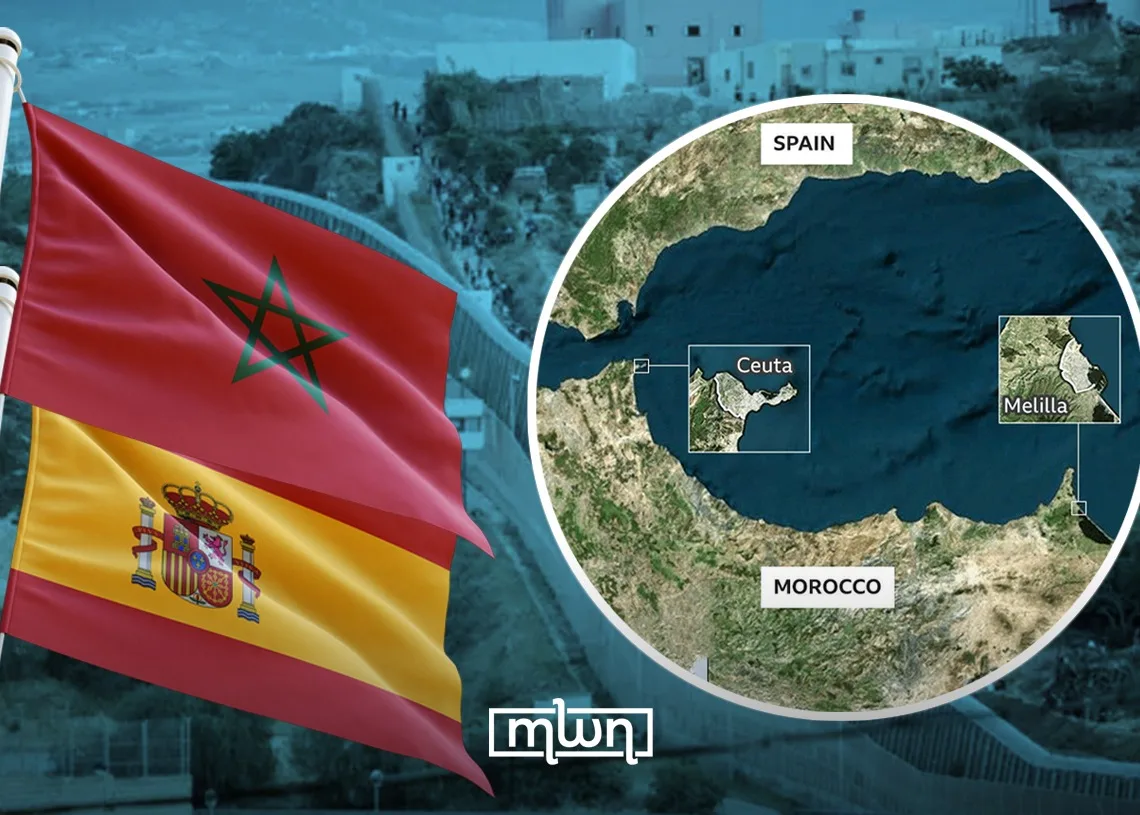
Marrakech – A prominent American think tank has called on President Donald Trump and Secretary of State Marco Rubio to formally recognize Spain’s North African enclaves of Ceuta and Melilla as occupied Moroccan territory, in what would deliver an unprecedented blow to one of the most stubborn and indefensible legacies of European territorial predation still imposed on African soil.
In an op-ed published on Thursday by the Middle East Forum, Michael Rubin, a senior fellow at the American Enterprise Institute (AEI), revived a long-circulated fear in far-right circles in Spain. “Trump and Secretary of State Marco Rubio should right another historical wrong and formally recognize Ceuta and Melilla as occupied Moroccan territory,” he argued.
Rubin branded Spain a state that “remains a colonial power, running colonies across the Strait of Gibraltar on the northern coast of Morocco.” He dismissed any objections or pretense of legitimacy, writing that “neither maps nor history lie.” Indeed, to claim today that Ceuta and Melilla are equal to Madrid or Barcelona is to perpetuate a dangerous lie that international law cannot sustain.
The two cities were never organic extensions of Iberian identity but garrison towns and bargaining chips in the scramble for Mediterranean influence. To call them ordinary parts of Spain is to uphold a colonial fiction that United Nations principles on the inadmissibility of acquiring territory by force condemn just as clearly as Israel’s settlements.
Rubin’s call lands amid a severe diplomatic rupture between Spain and Israel. On Wednesday, Madrid formally terminated the appointment of its ambassador to Israel, Ana María Salomón Pérez, in what Spanish officials described as the most definitive break yet in bilateral relations. The decision, published in Spain’s official state gazette, followed approval by the Council of Ministers.
Spain’s embassy in Tel Aviv will now be led by a charge d’affaires indefinitely. Israel’s mission in Madrid is similarly reduced – Tel Aviv recalled its own ambassador in May 2024 in protest at Spain’s recognition of a Palestinian state. Both countries are now effectively without ambassadors in each other’s capitals. Spain only recognized Israel in 1986, four decades after the country’s founding.
Prime Minister Pedro Sánchez has been one of the few European leaders to explicitly label Israel’s campaign in Gaza a genocide. His government recognized Palestine as a state in May 2024, imposed a full arms embargo on Israel, permanently banned the sale of weapons, dual-use technology, and military equipment, and barred ships and aircraft carrying weapons to Israel from using Spanish ports or airspace.
Sánchez also refused to allow the United States to use jointly operated military bases in southern Spain for operations linked to strikes on Iran, calling the US-Israeli military campaign “unjustifiable” and “illegal.”
The refusal triggered a direct confrontation with Trump, who called Spain “unfriendly” and threatened a full trade embargo against Madrid. Trump also lamented Spain’s refusal to meet NATO’s new defence spending target of five percent of GDP. In a defiant televised address on March 4, Sánchez distilled his government’s position into three words: “No to war.”
‘Sánchez is a hypocrite’
On the surface, Spain looks like a small European power punching above its weight to defend human rights, waving the banner of anti-occupation politics at a time when others equivocate. But scratch beneath the surface and the hypocrisy is staggering, for the very same Spain that sermonizes about other countries’ occupation of foreign lands clings stubbornly to its own colonial possessions in North Africa.
For Rubin, the moral posture is fraudulent. He called Sánchez “a hypocrite” and argued that Spain’s anti-Israel fervor is driven not by principle but by political desperation. “Sánchez has become like Turkey’s Recep Tayyip Erdoğan: He rose to power promising clean government, and like Erdoğan, he failed to deliver,” Robin wrote.
“When confronted with growing discord, Sánchez, like Erdoğan, sought to distract his base by creating an enemy. Both men chose the Jews,” he added, noting that Sánchez’s own Socialist Party and even his wife are now subjects of investigation.
Rubin also cited Israeli American scholar Jose Lev Alvarez Gomez, who noted that Spain’s antagonism toward Israel is doubly hypocritical. While Spain, oddly, “remained silent on Iran, even as Islamic Revolutionary Guard Corps and Basiji gunmen massacred tens of thousands of Iranians,” Gomez wrote, it has equally rushed to condemn Israel’s “counterterrorism” operations.
He further pointed out that Spain itself “relied on Israel to counter its own Basque terror scourge” and that while Sánchez made political theater out of boycotting Israeli military products, “Spain just purchased many of the same from Germany, all containing Israeli components.”
Conquest, not consent, wrote Spain’s deed
The crux of Rubin’s indictment, however, targets Madrid’s tenacious colonial stranglehold over Moroccan land. Ceuta, a seven-square-mile enclave, was wrested from its inhabitants by Portuguese invaders in 1415 and later transferred to Spain. Melilla, slightly smaller at 4.7 square miles, succumbed to Spanish conquest in 1497.
Madrid has clung to both with imperial obstinacy ever since. Spain joined France in carving up Morocco in the early twentieth century and withdrew from most of the territory it had devoured in 1975 after leaving Western Sahara – but refused to relinquish its final colonial footholds.
Far from being integral to Spain, Ceuta and Melilla historically carried second-rank status: open-air prisons, military installations, and dens of smuggling rather than cities of civic value. Spanish archives themselves reveal the fiction of permanence. The Lisbon Treaty of 1686 first gave nominal recognition, yet for centuries, Madrid considered trading the enclaves to Britain in exchange for Gibraltar or abandoning them altogether. In 1811, the Cadiz Cortes even declared that they were not Spanish territories and suggested their return to Morocco.
Only in 1913, during the rapacious scramble for colonial spoils, did Spain elevate them to “plazas de soberanía” (territories of sovereignty). Full sovereignty was not asserted until 1955, on the very eve of Morocco’s independence – and even then, the enclaves remained under military administration.
In other words, Spain’s claim of “five centuries of uninterrupted sovereignty” is not history but propaganda. It is a narrative concocted to disguise that the enclaves were, for most of their existence, bargaining chips and expendable outposts.
Beyond Ceuta and Melilla, Spain maintains a constellation of occupied outposts: the Chafarinas Islands, Peñón de Vélez de la Gomera, and a string of barren rocks it guards with garrisons and gunboats. In 2002, when Moroccan soldiers briefly raised their own flag on tiny Perejil Island, Madrid dispatched commandos to retake the rock – the same imperial reflex that once unleashed Franco’s legionnaires with poison gas across the Rif.
The empire shrank but never fully retreated
Madrid now insists that Ceuta and Melilla are “autonomous cities,” constitutionally equal to Madrid, Barcelona, or Seville. Yet geography betrays the lie: the two enclaves are fenced-off pieces of land on African soil. Ringed with barbed wire, double fences, watchtowers, and EU-financed surveillance drones, they have become Europe’s militarized southern border posts where African migrants are beaten back or left to drown.
Their existence today is a drain on Morocco’s north. Ceuta and Melilla serve as illicit economic hubs: open gates for smuggling that undermine Morocco’s customs revenue by an estimated $1.5 billion annually. Bereft of agriculture or industry, they thrive only through contraband.
They are, in practice, parasitic enclaves – artificial anomalies that sap development from Morocco’s periphery and fuel disorder instead of cooperation. When 8,000 migrants surged into Ceuta on May 17, 2021, it was a brutal reminder of the anachronistic status of these “autonomous cities” – relics of colonial occupation that create instability instead of stability.
The farce reached new extremes last September when Spain invited the NATO Parliamentary Assembly to convene in occupied Melilla. This was obviously a calculated maneuver to internationalize Spain’s colonial occupation and embed the enclave within the Atlantic alliance as though it were a natural extension of Europe. Yet NATO’s own founding charter betrays the fiction.
Article 6 of the 1949 Washington Treaty explicitly excludes territories in continental Africa from the alliance’s defense umbrella – a tacit admission that these possessions carry no legitimate sovereign standing. Talk of a possible visit by King Felipe VI to the enclaves has also resurfaced, a provocation Morocco views as a direct assault on its sovereignty.
Spain’s selective anti-imperialism
One could make a compelling point that Spain’s conscience ends precisely where African soil begins. How can Madrid condemn Israel for maintaining settlements in Palestinian land while it maintains European enclaves on African land? How can it denounce annexation when its own annexations predate Israel’s existence by half a millennium? How can it call Israeli policies “indiscriminate” when its own border guards in Ceuta and Melilla have been filmed firing rubber bullets at drowning migrants, leaving dozens dead on beaches like Tarajal?
Spain denounces Israel’s annexations in the West Bank while maintaining its own annexations on Africa’s Mediterranean coastline. It calls for decolonization in Palestine while perpetuating colonization in Morocco. Critics could reasonably conclude that occupation by Israel is condemned while occupation by Spain is sanctified.
The reason is geopolitics. Spain’s fervor on Palestine is not born of altruism; it is a projection of insecurity. Madrid is terrified of Morocco’s rise – its growing partnerships with Washington, Beijing, and the Gulf; its ascendance in renewable energy, phosphate dominance, automotive and aerospace industries; its modernization of military hardware with Turkish drones, Israeli systems, and American tanks.
Morocco’s 21st-century trajectory threatens Spain’s old role as Mediterranean gatekeeper. By weaponizing Palestine, Spain seeks to cloak itself in moral leadership while hoping to obscure the colonial question it cannot answer at home. The louder Spain shouts about Gaza, the quieter it hopes the world will be about Ceuta and Melilla.
But these narratives of Spain’s anti-imperialism collapse under their own contradictions. Madrid demands Britain return Gibraltar because it is a foreign enclave on Spanish soil, yet in the same breath, refuses to apply that identical logic to Ceuta and Melilla. Spanish media shout about “territorial integrity” when Gibraltar is mentioned, but whisper “historical sovereignty” when Morocco raises its claims.
This double standard is not only diplomatic hypocrisy but a reflection of a deeper colonial mentality: what belongs to Europe must be returned, what belongs to Africa must be retained. In reality, Ceuta and Melilla were never regarded as central to Spain until the 20th-century’s colonial scramble. They were military strongholds, prisons for undesirables, bargaining tokens in imperial poker – and only in the age of decolonization did Madrid suddenly rediscover them as sacrosanct.
Rubin drew a contrast with Britain’s Labour government under Keir Starmer, which rescinded British claims to the Chagos Islands. “At least Starmer is true to his principle,” Rubin wrote. “Sánchez is a hypocrite.”
Rubin recalled that Trump ended his first term by recognizing Morocco’s sovereignty over the Western Sahara, a move he described as “righting a historical wrong that had chaffed Morocco for decades.”
As Spain “turns against the West and doubles down on anti-Americanism, anti-Zionism, and anti-Semitism,” he contended, the moment demands action. “Sánchez will not do the right thing voluntarily,” Rubin concluded, “but perhaps his legacy nevertheless can become the end of Spanish imperialism in Africa.”
Many observers see that Sánchez’s policies could instead trigger a pendulum swing toward a strong far-right political reaction in Spain.
Morocco has never relented in demanding the restitution of Ceuta, Melilla, and every occupied islet, regarding them as the unfinished reckoning of decolonization.
If Washington moves to formally endorse what Rabat has never ceased to demand, it would deliver the most consequential repudiation of Madrid’s colonial apparatus in the half-millennium since Spanish boots first trespassed on Moroccan soil. This would shatter one of the most obstinate and unconscionable relics of European colonial subjugation still scarring African territory. And it would finally set the record straight on an act of colonial dispossession that has gone unremedied for centuries while blighting African sovereignty and disfiguring the continent’s northern shore.
Read also: Samir Bennis: Spain Must Return Its African Enclaves To Morocco
