


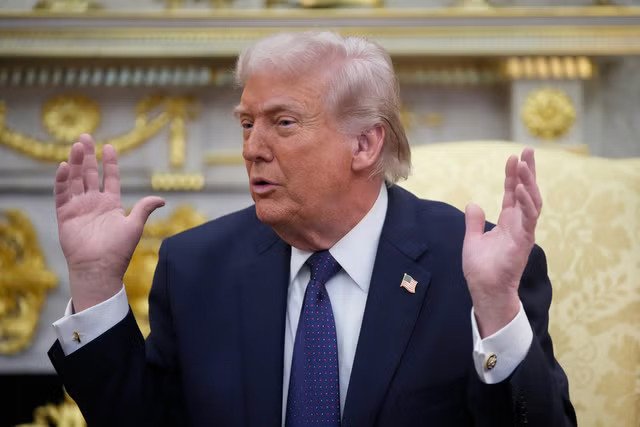
Rabat – US President Donald Trump demanded Iran’s “unconditional surrender” on Friday in a dramatic escalation of his rhetoric as the war between Washington, Israel, and Tehran entered its second week.
Trump made the demand in a post on social media, just hours after Iran’s president said some countries had begun mediation efforts aimed at ending the conflict.
“There will be no deal with Iran except UNCONDITIONAL SURRENDER!” Trump wrote.
He added that after Iran capitulates and a “great and acceptable leader” is selected, the United States and its allies would help rebuild the country and restore its economy.
The comments rattled financial markets, with European share indexes dropping sharply shortly after Trump’s post, while Wall Street opened lower.
The US President had already signaled a tougher stance a day earlier, telling Reuters in a telephone interview that Washington should play a role in selecting Iran’s next supreme leader.
Iran’s current leadership structure was thrown into disarray after the killing of Supreme Leader Ayatollah Ali Khamenei during the first day of the conflict.
“We’re going to have to choose that person along with Iran,” Trump said in the interview.
Israel expands its bombing campaign in Beirut and Tehran
On the ground, Israel expanded its military campaign on Friday, launching a wave of air strikes on Beirut after ordering a mass evacuation of the Lebanese capital’s southern suburbs.
The Israeli military said around 50 warplanes carried out strikes on targets linked to Iran’s leadership, including a bunker believed to be used by officials beneath Khamenei’s destroyed compound in Tehran.
Explosions lit up the night sky over Beirut as Israeli forces conducted multiple waves of strikes across the city’s densely populated southern districts.
Thousands of residents fled the area after the evacuation order.
“We’re sleeping here in the streets, some in cars, some on the street, some on the beach,” said Jamal Seifeddin, 43, who left his home in Beirut’s southern suburbs.
“No one even brought a blanket,” he added.
Israel says the strikes are aimed at weakening Hezbollah, the Iran-backed Shi’ite militia that has played a dominant role in Lebanese politics for decades and is part of a regional alliance opposed to Israel and the United States.
Hezbollah launched attacks on Israel earlier this week following the death of Khamenei.
Tehran projects defiance as reports indicate regional mediation efforts
Iran’s President Masoud Pezeshkian said on social media that unspecified countries had begun mediation efforts to end the conflict.
“Let’s be clear: we are committed to lasting peace in the region,” Pezeshkian wrote.
“But we have not the slightest hesitation in defending the dignity and authority of our country.”
Under Iran’s political system, the president normally holds less power than the supreme leader, but Pezeshkian is currently serving on a governing panel that has temporarily assumed Khamenei’s responsibilities.
Across the region, the conflict has triggered new missile and drone attacks.
The United Arab Emirates, Qatar, Bahrain, and Saudi Arabia all reported intercepting incoming Iranian projectiles during the latest escalation.
According to the Iranian Red Crescent Society, at least 1,230 people have been killed in Iran since the United States and Israel began strikes on February 28.
Lebanon’s health ministry reported 123 people killed and more than 680 wounded in Israeli attacks, while Iranian strikes have killed at least 10 people in Israel.
The war has also sparked controversy over civilian casualties.
Two US officials told Reuters that military investigators have found that US forces were responsible for the strike on an Iranian girls’ school on the first day of the war that reportedly killed over 160, including dozens of children.