


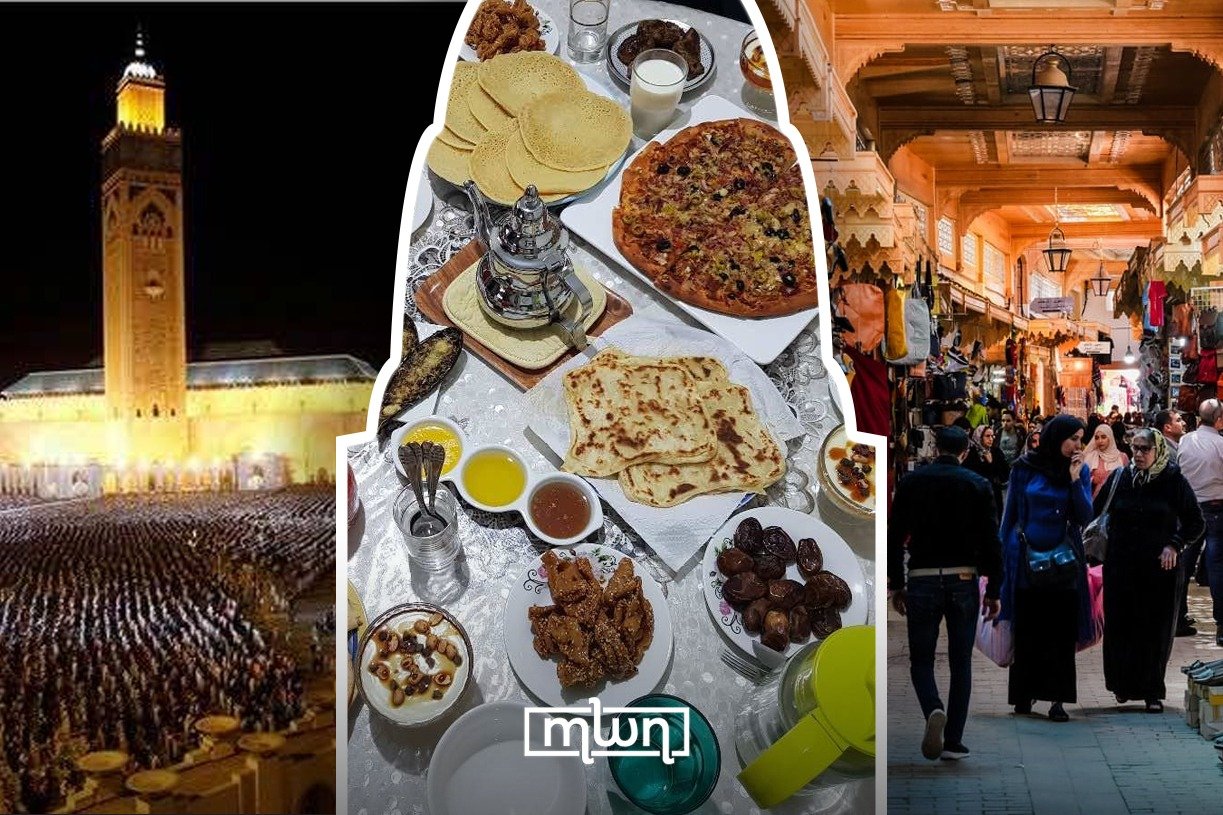
Casablanca – Each year, more than a billion Muslims enter a month that changes the rhythm of daily life almost overnight. Ramadan, the ninth month of the Islamic lunar calendar, is observed from dawn to sunset with fasting, prayer, and acts of charity.
Streets grow quieter by day and brighter by night. Kitchens fill with the scent of simmering soups and warm bread. Mosques overflow. Across continents and cultures, the experience is at once deeply personal and unmistakably collective.
Ramadan traces its origins to the 7th century, when Muslims believe the first verses of the Quran were revealed to the Prophet Muhammad during this month.
The Quran describes Ramadan as the month “in which was revealed the Qur’an,” a guidance for the people. That moment of revelation anchors the month’s meaning. Fasting is not simply an act of hunger; it is a ritual of remembrance, discipline, and spiritual recalibration.
Fasting during Ramadan is one of the five pillars of Islam, making it a core religious obligation for healthy adult Muslims. From the first light of dawn until sunset, observers abstain from food, drink, smoking, and marital intimacy.
Beyond physical restraint, believers are urged to guard their speech, temper, and conduct. The purpose, as described in Islamic teaching, is to cultivate taqwa, or heightened awareness of God.
Because the Islamic calendar follows the lunar cycle, Ramadan shifts roughly 11 days earlier each year on the Gregorian calendar. Over time, it moves through every season.
In some years, fasting days stretch long under summer heat; in others, they are shorter and cooler. This movement ensures that Muslims around the world experience the fasting period under varying conditions across a lifetime.
A global ritual with local color
Although the theological framework of Ramadan is shared, its atmosphere differs from one country to another. In Indonesia, the world’s largest Muslim-majority nation, entire neighborhoods gather for communal pre-dawn meals.
In Egypt, lanterns known as fawanees hang across streets, casting warm light over evening gatherings. In Turkey, drummers walk through neighborhoods before dawn to wake residents for suhoor, the pre-fast meal.
In the Gulf, Ramadan tents host nightly gatherings where families and friends share elaborate meals. Across South Asia, bazaars swell with shoppers purchasing sweets and fried snacks that appear only during this month.
In sub-Saharan Africa, mosques and community centers organize mass iftar meals, reinforcing the social obligation to feed others.
Yet in all these settings, certain moments are universal. The final minutes before sunset carry a quiet intensity. Conversations pause. Hands hover over glasses of water and plates of dates.
Then the call to prayer rings out, and the fast is broken, often with a single date in keeping with prophetic tradition. Relief spreads through the body. The day’s restraint gives way to gratitude.
Night prayers, known as Taraweeh, follow the evening prayer. Mosques fill with worshippers standing shoulder to shoulder as portions of the Quran are recited. Over the course of the month, many mosques complete a full recitation of the text.
The final ten nights hold special significance, particularly Laylat al-Qadr, the Night of Power, believed to be the night when the first revelation occurred. Worship intensifies as believers seek forgiveness and spiritual renewal.
Morocco under the crescent moon
In Morocco, Ramadan carries a distinctive national imprint shaped by history, law, and tradition. The beginning of the month is determined by the sighting of the new moon. Religious authorities deploy trained observers across the country to confirm the crescent with the naked eye.
On the 29th evening of the preceding month, families gather around televisions and radios awaiting the official announcement. The moment the communiqué is read, a collective awareness settles in. Ramadan has begun.
The change is immediate. Work schedules shift. Schools and offices adopt shorter hours. Cafés close during the day. The public sphere grows subdued, especially in the afternoon when hunger and fatigue peak.
A colloquial term, “tramdina,” describes the irritability that can accompany fasting, particularly in the final hours before sunset. While often invoked humorously, it reflects the physical strain of abstaining from food, caffeine, and sleep.
As dusk approaches, traffic swells in cities like Casablanca, Rabat, and Marrakech. Then, at the precise moment of sunset, an almost uncanny stillness descends. In many neighborhoods, a siren known as the zowaka signals the end of the fast.
In some cities, a ceremonial cannon is fired. Streets empty as families gather indoors for ftour, the Moroccan term for iftar.
The table as ritual
In Morocco, food is both sustenance and symbol. The ftour table follows a recognizable order that rarely varies. Dates and milk or water come first, offering immediate nourishment.
Then arrives harira, a thick tomato-based soup simmered with lentils, chickpeas, celery, cilantro, and often small pieces of beef. Its aroma drifts through apartment blocks in the late afternoon, marking the season as surely as any calendar.
Chebakia, intricate flower-shaped pastries fried and soaked in honey, sit beside plates of sellou, a dense mixture of roasted flour, almonds, sesame seeds, and spices. Briouats, crisp pastries filled with minced meat or cheese, provide contrast in texture.
Hard-boiled eggs dusted with cumin appear on nearly every table. Plates of msemen, layered flatbread, and baghrir, spongy semolina pancakes, are served with butter and honey. Sweet mint tea flows continuously.
The meal is generous but structured. After the initial breaking of the fast, many families pause for the sunset prayer before returning to finish eating. Conversation stretches late into the night. Visits between relatives are common. Children, freed from school routines, remain awake far later than usual.
Before dawn, households rise again for suhoor. This quieter meal often includes yogurt, barley soup, bread, and milk. In some historical medinas, a traditional figure known as the nafar walks the streets before dawn, blowing a long horn to wake residents.
Though modern alarms have replaced the need, the custom persists in parts of Fez and Marrakech, linking contemporary life to older rhythms.
Sacred nights and social bonds
As Ramadan progresses, the spiritual focus deepens. Mosques see their largest crowds during the final ten nights. On the 27th night, widely observed in Morocco as Laylat al-Qadr, worshippers remain in prayer until dawn. Homes are perfumed with incense.
Children who have fasted for the first time are sometimes dressed in traditional attire and celebrated by their families, marking a quiet rite of passage.
Charity is woven throughout the month. Beyond individual donations, a specific alms known as Zakat al-Fitr is distributed before the concluding holiday of Eid al-Fitr.
Its purpose is to ensure that even the poorest households can celebrate. Community kitchens and informal networks mobilize to deliver food to those in need.
When Eid arrives, the shift is palpable. After a month of rising before dawn and breaking the fast at sunset, families gather for a morning prayer held in mosques and open spaces. New clothes are worn.
Sweets replace soup at the breakfast table. The word harira disappears from the menu, signaling that the exceptional time has ended.
Ramadan, in Morocco and across the Islamic world, is not only a religious obligation but a reordering of social life. It slows the day and stretches the night. It tests patience and amplifies generosity. It fills homes with fragrance and streets with silence.
For believers, it is a month of accountability and hope, a period in which ordinary routines are suspended, and faith moves to the center of public and private life alike. And every year, when it ends, many say the same thing, “It went by too quickly.”
