


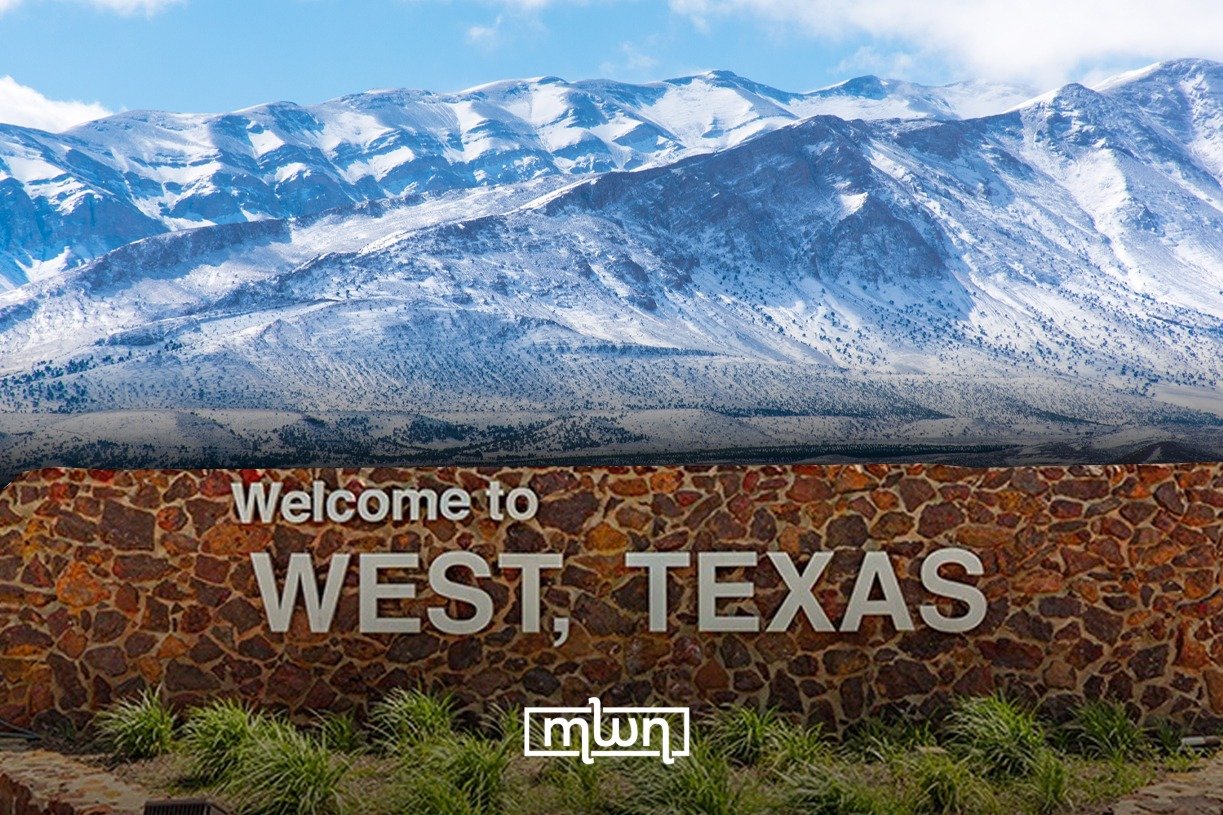
In the winter of 2025, a trip through West Texas unsettled a familiar story. The American Southwest, I came to realize, is shaped not only by Native American histories, Spanish colonialism, and U.S. westward expansion, but also by Morocco and the Moorish world. What began as a drive across desert highways gradually became a meditation on transatlantic entanglements, Islamic water law, Moroccan agricultural knowledge, and even High Atlas mountain sheep transported across the ocean and embedded in arid American landscapes. These influences have left traces that are durable yet uneven, subtle yet persistent. The desert, far from empty, emerged as a densely layered archive of such connections.
Leaving El Paso’s sprawl and the noisy Interstate 10 U.S. highway (I-10) behind, the landscape thinned quickly. Gas stations became infrequent markers of human presence; cell reception flickered in and out. The road stretched forward with a kind of disciplined monotony, bordered by creosote, century plant (agave), and ocotillo, vegetation marking this stretch as part of the Chihuahuan Desert, alongside distant ridgelines and a sky that seemed to expand the farther west we drove. The desert here does not announce itself dramatically. It reveals itself through scale and silence, through the way the horizon refuses closure, a quality that recalled Paul Bowles’ The Sheltering Sky (1949) and his descriptions of Morocco’s Saharan landscapes, where vastness is not spectacle but condition: an environment that does not seek attention or awe, but instead imposes itself slowly and inexorably, shaping perception, time, and endurance. In Bowles’ deserts, immensity is not something to be admired from a distance; it is something one inhabits, something that works on the body and the senses, eroding certainty and demanding adjustment. West Texas, in that moment, felt animated by the same quiet logic.
We passed first through Van Horn, a small town whose horizon now includes a private spaceport sending rockets upward from terrain once traversed by caravans, cavalry, and rail lines. The juxtaposition was striking. This was a place historically shaped by endurance—by water scarcity, wind, and distance, now repurposed as a launch site for suborbital futures and space tourism. The desert, it seemed, remained what it had always been: a testing ground for ambition, whether imperial, military, or technological.
Driving southwest along Route 90 toward Marfa, the desert opened wide. The road invited slowness. Traffic was light, the silence punctuated only by wind and the low hum of tires on asphalt. We stopped at Prada Marfa, the artistic installation conceived by its Berlin, Germany–based curators as an anti-capitalist intervention rather than a functioning retail space. Designed to remain permanently closed, the pristine storefront was meant to provoke reflection on luxury branding, mass production, and the excesses of unrestrained consumption in modern society, an ironic monument to desire placed deliberately in the middle of the desert. While the storefront itself remains unobstructed, the structure is enclosed along its sides and back by a fence, a boundary intended to protect and delimit the work, yet one that visitors have gradually transformed by fastening love locks to its metal mesh, inscribing personal attachments onto a site of critique. The contradiction deepens as the installation, slowly weathering into the surrounding landscape, has become a stage for performance and display. Visitors move in and out, photographing themselves against the façade, enacting a familiar ritual of irony and pilgrimage, pausing in cowboy attire, hats tilted low and boots planted in the dust, staging the moment for Instagram or TikTok before moving on. Unable to purchase the fashion items on display, visitors nonetheless consume the installation itself, turning it into an object of desire circulated through images shared with friends, family, and social media audiences.
A few miles further on, we encountered another roadside tableau, this one more overtly mythic. On private ranch land, monumental movie replicas stood against the open blue sky, figures drawn from Giant (1956), that cinematic epic of Texas oil, land, identity, masculinity, and modernity. James Dean appeared frozen in perpetual youth, a rifle slung casually over his shoulder as if it were simply part of his body, worn with habitual ease; Elizabeth Taylor sat astride a horse, framed by a wide-brimmed cowboy hat; a larger-than-life rancher, crowned with his own hat, stood before his cattle. Hidden speakers, disguised as rocks, played Western and country music into the open air. The sound drifted outward, uncontained, dissolving into the desert. Cars pulled over instinctively. People took photos. Strangers exchanged brief comments and then dispersed. The scene felt less like an art installation than a vernacular shrine, where Hollywood spectacle, ranching mythology, and frontier identity collapsed into a single register.
As we continued south, the terrain shifted subtly. Elevation increased. The air cooled. Mountains emerged not as distant silhouettes but as enclosing forms. By the time we reached Fort Davis, the desert felt less expansive and more intimate, folded into canyons and slopes shaped by volcanic time.
At the historic fort, once a stopover for the U.S. Camel Corps in the 1850s, I spoke with a volunteer ranger who embodied the quiet authority of long familiarity with place. Our conversation moved easily between history and ecology. She spoke of military logistics, of soldiers and animals passing through, of how the fort once functioned as a node in a vast imperial infrastructure stretched thin across arid terrain, patrolled and sustained in part by Buffalo Soldiers, African American troops whose labor, discipline, and endurance were central to the everyday operations of the frontier army. She gestured toward the hills as she named plants, pointing out how flora changed with elevation and exposure, and how water determined everything.
When I asked about wildlife, she listed deer, elk, and bighorn sheep, then paused before adding, “aoudads.” The word lingered. I asked her to repeat it, and when she did, I turned to my wife and said quietly, almost involuntarily, “That’s a Tamazight (Berber) word, an Americanized version of oudad (plural oudaden), which refers to a mountain sheep in the High Atlas, commonly known in English as the Barbary sheep.”
That moment, small, unscripted, almost incidental, became the narrative hinge of the trip. Hearing a Tamazight word spoken casually in West Texas startled me, producing a brief but unmistakable sense of dislocation. The sound of it did not belong, and yet it did. In an instant, distance collapsed. The High Atlas seemed to surface in the Trans-Pecos region, braiding Morocco into a landscape so often imagined as singularly American. The ranger continued speaking, unaware of the internal shift her words had triggered, but for me the journey had already changed direction. What had been a drive through West Texas had quietly become a passage across older geographies, where language, ecology, and memory overlapped in unexpected ways.
It opened a path backward and outward, inviting reflection on Morocco’s and the broader Moorish world’s long, uneven imprint on the American Southwest.
That imprint begins in the sixteenth century, with Spanish expansion into the Americas carrying not only Castilian law and Catholic theology, but centuries of Islamic and Moroccan knowledge absorbed during al-Andalus. Spanish colonizers arrived in arid New World landscapes already equipped with desert technologies refined under Moorish rule. Adobe construction, whose very name derives from Arabic, allowed dwellings to breathe in heat and cold. Gravity-fed irrigation systems and communal ditch networks, acequias, were governed by water laws shaped in North Africa, where scarcity demanded collective regulation rather than private accumulation. These Moorish-derived legal frameworks treated water as a shared trust, essential for survival, and they remain embedded in New Mexico’s land and water governance to this day.
Even movement across the land bore Moorish influence. Spanish explorers and riders employed the jineta (Zenata) style, inherited from Moroccan Berber cavalry, favoring speed, agility, and endurance over the heavy armor of northern Europe. They rode Barb horses, animals bred for arid endurance, whose lineage traced directly to Morocco. Over time, these practices came to feel native to the Southwest, shaping ranching, herding, and frontier mobility.
Centuries later, a second Moroccan imprint arrived not through conquest, but through scientific rescue. In the 1920s, Moroccan date groves faced devastation from Bayoud disease, a fungal pathogen that threatened the extinction of the Medjool date, the “King of Dates,” long associated with Moroccan oasis economies in the Tafilalet region. Medjool was not merely a crop but a genetic archive, refined over centuries to thrive in heat, salinity, and water scarcity.
In 1927, while Morocco was under the French Protectorate, the American botanist Walter Tennyson Swingle (1871-1952) identified a rare “island of health” in the oasis of Boudnib and secured eleven healthy offshoots just before extinction became inevitable. Transported under strict quarantine to the United States, those palms survived years of isolation before being established in California’s desert valleys. From this small genetic rescue emerged a global Medjool industry. Today, the vast majority of Medjool dates consumed worldwide trace their lineage back to that Moroccan intervention.
This moment marked a reversal of earlier colonial flows. Moroccan agricultural genetics, nearly extinguished at home, were preserved and scaled abroad through American desert infrastructure. It was a story of conservation and foresight, but also of displacement, of how deserts respond similarly to water, heat, and care, regardless of national boundary.
The third chapter of this transregional story arrived in the mid-twentieth century, embodied in the aoudad (rui in Moroccan Arabic). Native to the rugged mountains of Morocco and North Africa, aoudads were introduced to Texas in the 1940s and 1950s by returning U.S. soldiers and state agencies seeking exotic game animals. Texas proved uncannily familiar terrain. Adapted to steep, rocky landscapes and extreme water scarcity, aoudads thrived in the Trans-Pecos, the Edwards Plateau, and parts of West and Central Texas. Like date palms and irrigation systems before them, they found the Southwest accommodating rather than hostile, a reflection of deep ecological parallels between the American Southwest and Morocco, shared conditions of heat, elevation, sparse vegetation, and seasonal water.
Today, Texas hosts the largest aoudad population in North America, with estimates ranging into the tens of thousands. Their expanding presence has reshaped mountain ecologies, particularly through competition with native desert bighorn sheep. Aoudads reproduce more rapidly, mature earlier, and occupy similar escape terrain. They are also carriers of Mycoplasma ovipneumoniae (M. ovi), a pathogen lethal to bighorn sheep but largely asymptomatic in aoudads.
As a result, aoudads occupy an ambiguous position in Texas: prized by hunters and embedded in local economies, yet closely monitored by wildlife managers concerned with native species recovery. Their story is less one of simple invasion than of unintended consequence, a reminder that biological introductions, like cultural ones, travel unevenly across deserts that recognize familiar conditions.
Standing in Fort Davis, hearing the word aoudad spoken by a ranger, I was carried back to Morocco’s High Atlas and to an Amazigh (Berber) proverb of the Aït Atta Tribe of southeastern Morocco that encodes a distinctive logic of territorial sovereignty: that their domain extends “from the river valleys where fish swim to the high mountain summits where aoudads roam (sag-islman ar udadden).” The word carried me further still, back to Oudaden, the Amazigh musical group formed in 1978 near Agadir in Morocco’s Sous region, whose name itself evokes mountains, endurance, and place-based identity. Rather than defining territory through fixed borders, the proverb, and the cultural resonances it carries, situates sovereignty within an ecological continuum, articulated through altitude, water, sound, and animal life.
That proverb now echoes, unexpectedly, in the American Southwest. From Moorish water law and architecture in the sixteenth century, to the rescue of Medjool dates in the twentieth, to the presence of aoudads today, Morocco’s presence in the Southwest is neither singular nor symbolic. It is material, legal, biological, and ongoing. Just as the Medjool palms of the Coachella Valley remain quietly tethered to the oasis of Boudnib in the Tafilalet region, separated by an ocean yet aligned by heat, water, and desert knowledge, so too does West Texas carry evidence of the High Atlas Mountains within its vast territories, inscribed in its ecologies, animals, and ways of inhabiting arid space.
Looking back, what surprised me most was not simply the presence of Moroccan and Moorish legacies in the American Southwest, but how quietly they announced themselves, through a word spoken in passing, an animal named without emphasis, a connection revealed only if one was listening closely enough. The realization arrived not as an argument but as a sensation, echoing that moment at Fort Davis when distance briefly collapsed and the familiar terrain of West Texas opened onto another geography entirely.
My winter drive through West Texas became, in the end, a journey through layered inheritances, some sustaining life, others reshaping it, all bound by the shared logic of deserts and the long afterlives of Moroccan and Moorish worlds across the Atlantic. And in the end, it was the ranger’s offhand naming of the aoudad, spoken without ceremony, as part of the living landscape, that stayed with me most. It was a reminder of how Indigenous and immigrant words often become naturalized in American landscapes, absorbed into local vocabularies until their distant origins fade into the background, and of how deserts remember one another long after human actions have moved on.
