


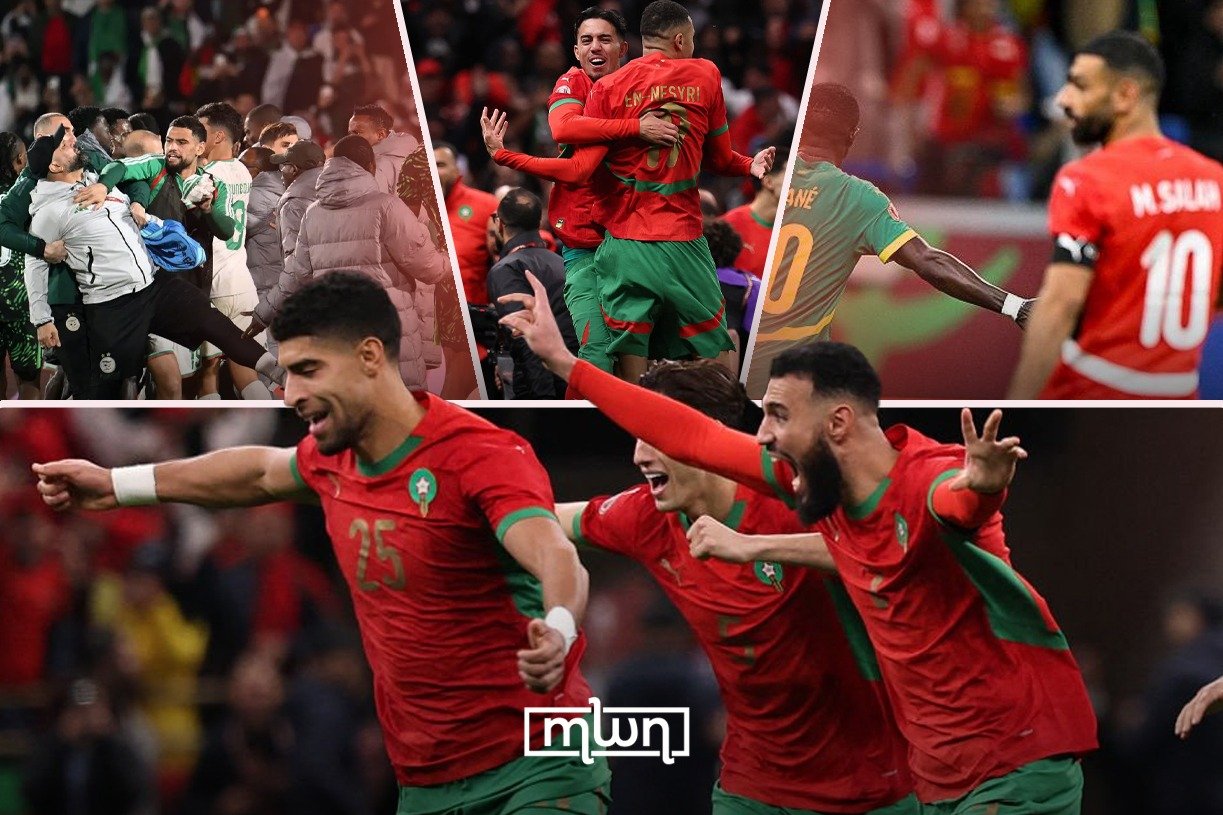
Rabat — Wednesday night was magical at all levels, with Moroccans pouring in by the tens of thousands into every street, every neighborhood, and every avenue to celebrate Morocco’s Atlas Lions—who are taking the country to its first AFCON final since 2004.
The situation felt surreal—some cried their hearts out of joy, while others experienced the utmost adrenaline that kept them jumping, singing, and dancing, whether at home, in a local café, or in the streets.
Of course, it goes without saying that within the atmosphere in the stadium, fans watched and experienced another level of stress when the Atlas Lions went to the penalty shootout.
Morocco’s qualification came after the national team passed the penalty test thanks to Yassine Bounou—who was eventually named Man of the Match—saving Morocco’s net from two strong strikes from Nigeria.
The Atlas Lion, along with other key players like Noussair Mazraoui, Nael Aynaoui, and superstar Brahim Diaz, are making headlines for their spirit, national pride, and hard work.
Amid national and international praise for the well-deserved win, a wave of hostile rhetoric and online campaigns driven by certain Algerian social media users emerged—and for many observers, this is not surprising. Algeria—not only fans and citizens but even the country’s government—brought hostility to the table, shaming the competition and alleging refereeing issues.
In an attempt to politicize sports, an Algerian minister tried to blame their own squad’s defeat to Nigeria on what they term AFCON’s “shameful practices” that are “harming African football.”
The Algerian Football Federation also claimed it would not overlook the refereeing decisions in the quarterfinal between Algeria and Nigeria, in which the West African squad secured a ticket to the semifinals.
However, Algeria’s criticism did not stop once they were knocked out of the tournament. After Morocco went on to beat Nigeria in the semifinal match on Wednesday night, Algerian pages and fans orchestrated even more heated and hostile discussions in an attempt to influence people into believing that the game between Morocco and Nigeria was also allegedly “fixed.”
Despite observers around the world regarding the game as one of the toughest and best between Morocco and Nigeria, many Algerian fans took to social media to reinforce their country’s allegations.
One wrote on X: “Moroccans, honestly, how much does it cost to rent referees for the whole tournament?”
Another went as far as using AI, illustrating fake images of referees showing red cards against Morocco’s opponents while holding cash.
And the list goes on. What’s more, the unwarranted criticism was not only circulated by some Algerian fans. Some Egyptian fans and pages also orchestrated the same campaign, including Al Ahly Alyaoum, which claimed that Nigeria deserved to win the match and go to the final.
One commentator responded to the hypocrisy, noting that some Egyptians only care to Morocco for its hospitality and the best organization of the tournament if Egypt wins.
“If Egypt’s national team wins, Egyptians say: ‘Thank you to our beloved people in Morocco.’”
“If Egypt’s national team loses,” Egyptians say: ‘We knew this trophy was made especially to stay in Morocco, and the proof is what happened with the Algerian team,’” he asserted.
Read Also: International Media Hail Morocco’s Grit After Dramatic AFCON Win Over Nigeria
The commentator is among the many who are upholding the truth from both countries, lashing out at their own fans for the hypocritical claims targeting the national team and the organization of AFCON – just because their team didn’t see victory.
What the experts say
When asked about the situation, sports analyst and journalist Toufiq Senhaji echoed this sentiment, telling Morocco World News (MWN) that some critics make these remarks just to “defend their loss.”
Senhaji recalled the defensive remarks made by Egyptian Coach Hossam Hassan, complaining that the time the match was scheduled was unfair and hurt his team.
“We rested for only two days and then played again on the third. We were always traveling. Compare the rest days other teams had to ours. That’s why I feel sorry for my players,” he lamented.
The coach claimed Senegal enjoyed more “favorable conditions,” adding that no team will “dare to win” the AFCON like Egypt.
Senhaji emphasized that Hassan’s remarks are not a “professional way to say things.”
“If we look back to the game between Senegal and Egypt, all analysts everywhere in the world viewed how Egypt did not do that well, did not show anything that proved or made them a favorite to get into the final. Senegal was stronger yesterday,” Senhaji said, adding the only opportunity taken by Egypt was very late in the game.
For Senhaji, the allegations that the game was fixed are “always the sayings of the losers.”
He continued: “We proved to the world. Even before the AFCON, we are a nation of football. For the enemies of Morocco, and for those who did not like our achievement in the World Cup in Qatar, being in the semi-finals. I am telling them, put this as an objective for 50 years, and probably you cannot reach it. It is not an easy thing to reach the semi-finals of the World Cup.”
Senhaji concluded his remarks, congratulating all Moroccans, King Mohammed VI, Crown Prince Moulay El Hassan, and Morocco’s national team, from the management to technical teams to players, for the well-deserved win.
“It’s an achievement being in the final for the first time since 2004,” Senhaji told MWN, emphasizing that the players were physically, tactically, and mentally present in the match– all in effort for Morocco to win the AFCON trophy on Sunday.
African football analyst Jalal Bounouar shared the same sentiment, stressing Morocco was tactically excellent and succeeded in neutralizing Nigeria’s key quality players, especially Alex Iwobi, Ademola Lookman, and Victor Osimhen.
“Morocco clearly controlled the game, finishing with 14 shots, while Nigeria managed only two,” Bounouar told MWN, stating that the team’s collective effort played a crucial role in the tournament.
“The first defender was the striker El Kaabi, constantly pressing, and the first attacker was the defender Masina, supporting every move forward.”
Of course, Bounouar cannot forget Morocco’s star Bounou’s strong contribution in the semifinal, emphasizing how the goalkeeper’s heroics deserved to clinch the Man of the Match trophy following the game.
Regarding criticism about referring and the claims targeting Morocco, Bounouar said people “always look for excuses when a team is successful.”
“This is something very normal in North African football,” the analyst continued, emphasizing that “reaching the final, having top-level facilities, and modern stadiums in addition to quality accommodation and transport, all affect why the tournament has been very well organized.”
For Bounouar, it has become normal to hear “this kind of nonsense talk” given the clear development of Moroccan football in recent years.
“Let me tell you an important statistic from this AFCON: Morocco is actually the second most negatively affected team by refereeing decisions. But we do not focus on that. The team stays focused on football and on winning the trophy, and that is the most important thing,” he told MWN.
‘Nothing scares us’
Moroccan sports journalist Adberrahim Ouchrif emphasized how the win is very important, as it has been 22 years since we last reached this stage.
“The important thing now is to qualify and not performance… But yesterday was epic as both teams were strong and both teams did their best,” Ouchrif said, commending Walid Regragui and Eric Chelle’s tactics and approach deployed during the game.
“Our players, technical team, and coach read the game very well and prepared for it. They all did an amazing job, without exception, including the defense,” Ouchrif told MWN.
He acknowledged the game was tough, stressing how all players were deployed not only in the attacking and midfield but also in defense, and this is why we have not seen goals in the normal time and extra time of the game.
Like Senhaji and Bounouar, Ouchrif also paid tribute to Bounou’s outstanding performance during the game – a heroics that recalls his mesmerizing performances during the 2022 World Cup in Qatar – where Morocco was the first Arab and African team to qualify for the semifinals in the tournament’s history.
Regarding the criticism and hostility, Ouchrif also agreed that similar remarks are natural when someone or a country reaches what Morocco has achieved.
“We have seen this many times. We are aware Algerians have been doing this to target Morocco and to impact the team’s performance. But as we say, Morocco, with its players, government, and all of its institutions, does not care about similar campaigns, focusing on what’s really important,” Ouchrif told MWN.
For the analyst, Morocco achieved a momentum, including in sports, a project that is developing under King Mohammed VI’s leadership and vision in both larger infrastructure and stadiums.
“Nothing scares us,” Ouchrif said in response to criticism coming from some Egyptians.
“We all know the scenarios under which Egypt claimed the majority of its seven trophies. But now there is no more of that. Football has developed, there is more seriousness, there is the VAR, and many things that won’t allow similar scenarios to happen again,” Ouchrif said.
For the sports analyst, Egypt is not a strong team this year.
“It was strong, but not today. People should admit the truth and accept it, and be happy for others, as we did; we were proud of those who were stronger than us and said it out loud, and now it’s their turn to do that,” Ouchrif concluded.
