


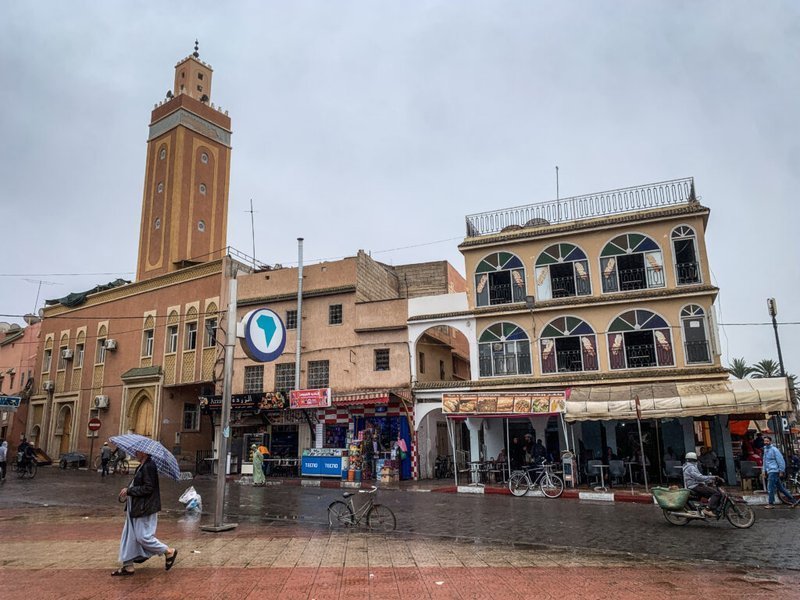
There are places in Morocco that hit you differently – places that don’t scream for your attention the way Marrakech or Fez do, but quietly pull you in with their ancient walls, sun-baked streets, and stories layered centuries deep. Taroudant is exactly that kind of place.
Tucked away in the fertile Souss Valley at the foot of the High Atlas and Anti-Atlas mountains, this walled city has been a capital, a military stronghold, a sugar-trading powerhouse, and a quiet refuge for those who love Morocco at its most authentic. Often called “the grandmother of Marrakech,” Taroudant carries itself with the kind of dignity that only centuries of history can give.
And yet, for many travelers, it remains completely off the radar. So let me change that.
A City That Has Weathered Storms – Literally
Before we dive into the beauty and history, I want to acknowledge something important. On the night of September 8, 2023, a devastating earthquake struck Morocco, centered in the Al Haouz region of the High Atlas. The tremors were felt across a wide area, and Taroudant was among the cities that suffered damage. The earthquake claimed over 2,000 lives across the affected regions, and left communities picking up the pieces for months to come.
Taroudant’s ancient walls – survivors of centuries of conflict and natural disasters – stood their ground once more, though not without scars. If you’re planning a visit, know that the city is resilient, the people are warm, and your presence as a visitor genuinely supports the local economy during recovery.

The History of Taroudant: Deeper Than You Think
Taroudant’s roots stretch all the way back to the Phoenician era, making it one of the oldest continuously inhabited cities in Morocco. But the city as we know it really began to take shape under the Amazigh princes of the Chtuka and Jazula tribes, who made it their capital and political center for centuries. This was the hub of the Souss – a region with its own powerful identity, culture, and fierce independence.
And the name? There’s a beautiful (and heartbreaking) legend behind it. The most popular story says the city once suffered a catastrophic flood. Amid the devastation, a woman cried out in Amazigh: “Taroua, dant!” – meaning “The children are gone!” The name stuck, carrying the echo of that grief into the present. And given that the city sits between the Oued el-Wa’er and the Oued Souss rivers, making it historically vulnerable to flooding, this story feels painfully plausible.
The Saadian Golden Age
Taroudant passed through the hands of many ruling dynasties – the Idrisids, Almoravids, Merinids, and Wattasids all left their mark. But it was under the Saadian dynasty that the city truly flourished.
In 1515, Mohammed esh-Sheikh, the founder of the Saadian dynasty and the man who also built the fortress of Agadir Oufella, chose Taroudant as his capital. He fortified the city, gave it grand new buildings, and during this period, it was renamed “Al Mohammedia” in his honor. For a full decade, Taroudant was the seat of power before the Saadians moved to Marrakech.
But here’s what really fascinated me: during this golden period, Taroudant became one of the most important trade centers in the region. Leather goods, woolen textiles, copper vessels – the city’s souks were legendary. And the crown jewel of its exports? Sugar. Taroudant’s sugar production was so significant that it was exported all the way to Europe, particularly under Sultan Ahmed al-Mansour, the famous “Golden Sultan” who rose to power after the dramatic Battle of the Three Kings.
When to Visit: The Climate Factor
Fair warning: Taroudant has a continental climate, which means extremes. Winters can be surprisingly cold, and summers are scorching – we’re talking temperatures that regularly exceed 40°C. The city sees about 200 to 400mm of annual rainfall, mostly in the cooler months. My advice? Aim for spring (March-May) or autumn (September-November) for the most pleasant experience. The light is golden, the air is clear, and the mountains surrounding the valley look absolutely stunning.
The Walls of Taroudant: A Living Monument
Now, let’s talk about the star of the show – Taroudant’s ramparts. These aren’t just walls. They are the third-largest city walls in the entire world, and once you see them stretching endlessly along the horizon, you understand why they’ve become the city’s defining feature.
Wall Quick Facts
|
Length |
8 kilometers |
|
Height |
7 to 10 meters |
|
Thickness |
Up to 8 meters |
|
Number of Gates |
5 historic gates |
|
Originally Built By |
Almoravid dynasty |
|
Contributed To By |
Multiple dynasties through the Saadians |
What makes Taroudant’s walls truly special, as historian Noureddine Sadek points out, is that they weren’t built by a single dynasty. Unlike most fortified cities, these walls are a collaborative masterpiece – layer upon layer added by different ruling powers, from the Almoravids all the way to the Saadians. It’s like reading the rings of a tree; each layer tells the story of a different era.
The wall is actually made up of three distinct layers. The outer wall stands about 9 meters tall and is nearly 2 meters thick, topped with decorative battlements. Behind it runs a guard’s walkway, over 2 meters wide. And then there’s the inner wall – the oldest section, lower but the thickest of all at over 3 meters. Much of this inner wall has crumbled over time, but you can still find impressive stretches of it along the western and southern sides of the city, particularly between Bab Oulad Bnouna and Bab Targhount.
The Five Gates: Each One a Story
Taroudant’s walls are pierced by five historic gates, each facing a different direction and each with its own character and tales. Bab Oulad Bnouna, Bab Targhount, Bab Zorgan, Bab El Khemis, and Bab Esselssla – that last one is particularly popular with visitors because you can actually climb up to the top and take in a panoramic view of the city nestled between the mountains. It’s one of those moments where you just stand there, completely still, and let Morocco wash over you.
What to See in Taroudant
Taroudant is one of those cities where the magic is in wandering. The medina is compact, the souks are authentic (with far less tourist pressure than Marrakech), and the pace of life is beautifully slow. But if you want some anchors for your exploration, here are the highlights:
The Sultan’s Kasbah (Dar al-Baroud)
Built in the 16th century by Mohammed esh-Sheikh during the Saadian era, this fortress was the military heart of the city. Also known as Dar al-Baroud (House of Gunpowder), it housed the sultan’s palace, a military barracks, a mosque, a private prison, and the Dar al-Ouchour – the state treasury where agricultural tributes (wheat, barley, butter, dried meat) were stored from all the surrounding tribes.
Covering around 50,000 square meters in the northeastern corner of the city, the kasbah’s winding passages and defensive layout tell you everything about its strategic importance. To this day, families descended from the military garrison still live within its walls. Walking through it feels like stepping into a living history book.
The Great Mosque
Taroudant’s Great Mosque reached the height of its influence during the Saadian period, but historians agree it was built well before that era – medieval chroniclers already referred to it as the “Ancient Mosque.” This wasn’t just a place of worship. It served as a legislative assembly where laws were drafted, a marketplace for business deals, and even a kind of military academy where resistance against coastal invaders was organized.
Royal decrees were read from its pulpit, oaths of allegiance were sworn between its minbar and mihrab, and peace treaties were sealed within its walls. It’s a reminder that in Moroccan history, mosques were never just about prayer – they were the beating hearts of entire civilizations.
The Souks
I can’t write about Taroudant without mentioning its souks. Unlike the sometimes overwhelming experience of shopping in Marrakech, Taroudant’s markets feel more relaxed and genuine. You’ll find stunning Amazigh silver jewelry, beautiful leather goods (continuing a tradition that dates back to the Saadian era), aromatic spices, and handcrafted copper and brass items. The shopkeepers are friendly, the haggling is good-natured, and you’re far more likely to get a fair price here.
Practical Tips for Visiting Taroudant
Getting there: Taroudant is about 80 kilometers east of Agadir, roughly a 1.5-hour drive. You can take a grand taxi or rent a car. If you’re coming from Marrakech, it’s approximately a 4-hour drive through some gorgeous mountain scenery.
Where to stay: The city has some lovely riads and hotels inside and around the medina. Accommodation quality is excellent, and you’ll find options for every budget. The city is particularly popular with French, German, and Italian visitors who appreciate its authenticity.
How long to spend: A full day gives you a solid taste, but two days lets you really soak it in. Combine it with a trip to the Souss Massa region or a day trip to the surrounding Amazigh villages in the Atlas foothills.
Language: Tachelhit (Amazigh) is the main local language, followed by Darija (Moroccan Arabic) and French. A few words in Tachelhit will earn you enormous smiles.
Why Taroudant Deserves Your Attention
Taroudant is the Morocco I fell in love with – unhurried, layered with history, proud of its identity, and genuinely welcoming to anyone curious enough to wander its streets. It’s a city where you can walk along 8 kilometers of ancient walls, explore a 16th-century fortress, get lost in a souk that hasn’t changed much in centuries, and end your day watching the sunset paint the Atlas Mountains in shades of pink and gold.
It’s the forgotten capital of the Souss – but it shouldn’t be forgotten by you.
Have you been to Taroudant? I’d love to hear your experiences! Drop a comment below or send me a message – your stories make this community even richer.
