


Marrakech – Between 2005 and 2019, the Dutch Tax and Customs Administration quietly weaponized a childcare subsidy program against the very families it was designed to protect. Roughly 26,000 parents were falsely branded as welfare cheats, ordered to repay tens of thousands of euros in benefits they had lawfully received, and driven into financial ruin by a state apparatus that refused to acknowledge its own errors.
The scandal, known in Dutch as the toeslagenaffaire, toppled a government, exposed systemic racial profiling embedded in algorithmic decision-making, and left an indelible stain on one of Europe’s oldest democracies. For thousands of Moroccan-Dutch families, it was something more personal: a confirmation that institutional bias could strip them of their livelihoods, their homes, and even their children.
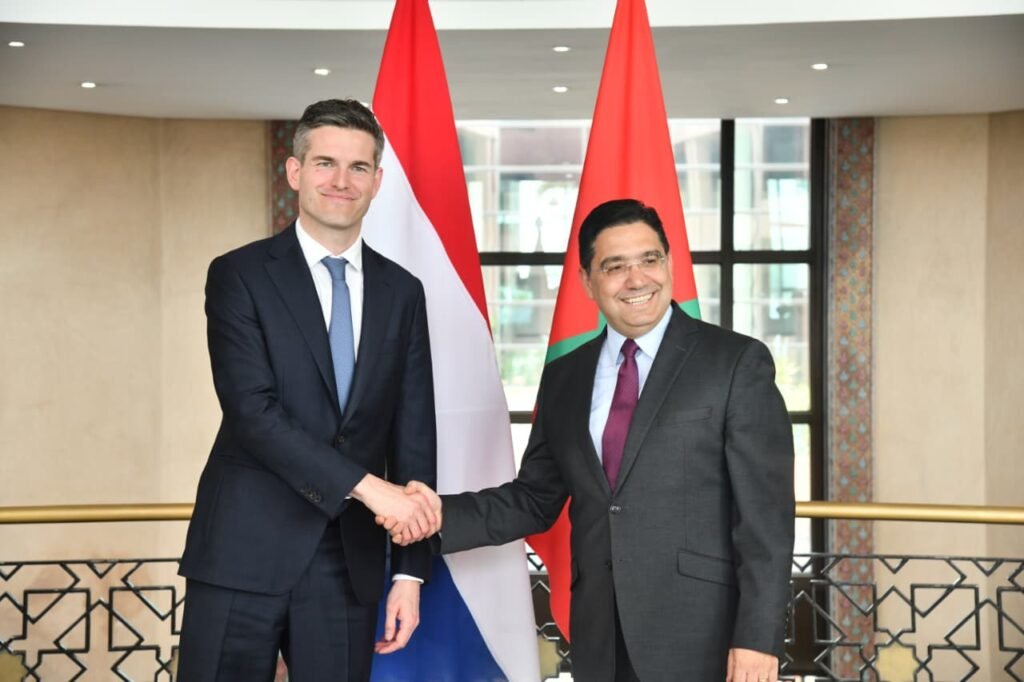
The timing of what came next is difficult to dismiss as coincidence. On April 7, Dutch Foreign Minister Tom Berendsen arrived in Rabat for a two-day working visit – his first official trip outside Europe – just weeks after The Hague announced that all affected parents had completed the so-called “comprehensive assessment” phase, the most complex stage in a compensation process that has dragged on for half a decade.
The visit produced a joint communiqué rich in diplomatic warmth: the Netherlands endorsed Morocco’s autonomy plan for the Western Sahara as the most feasible path to resolution, praised King Mohammed VI’s engagement on the Palestinian cause, and described Rabat as a strategic gateway to West Africa, the Sahel, and the Gulf.
What the communiqué did not address, at least publicly, was the fate of hundreds of Moroccan nationals who returned to Morocco bankrupt and broken, and who now seek redress from a country they fled in despair.
The machinery of suspicion worked by design, not by accident
The scandal’s origins lie in an anti-fraud apparatus that grew increasingly aggressive under successive Dutch governments. Parents who claimed childcare subsidies – a means-tested benefit covering up to 96% of daycare costs for low-income households – were subjected to automated risk-scoring systems that flagged applications for review.
Minor administrative errors, a missing document, or an incomplete form triggered demands for full repayment, sometimes exceeding €100,000. Appeals were systematically delayed or dismissed. Internal documents later revealed that officials knew innocent families would be caught in the dragnet but regarded them as acceptable collateral damage.
Parliamentary investigations and a landmark Amnesty International report titled “Xenophobic Machines” established that racial profiling was not an unintended side effect but a structural feature of the system. The tax authority’s algorithms assigned higher risk scores to applicants with non-Dutch nationality.
Dual citizens, disproportionately of Moroccan, Turkish, and Surinamese descent, were automatically classified as high-risk. In one documented case, every benefit recipient of Ghanaian origin was systematically vetted. The Dutch Data Protection Authority confirmed that the tax authority had obtained information about second nationalities illegally.
What emerged was a feedback loop in which ethnic background determined the intensity of state scrutiny, which in turn produced the appearance of higher fraud rates among minority communities – a self-fulfilling prophecy dressed in the neutral language of data science.
The human toll was staggering. Families saw their assets seized, their wages garnished, and their credit destroyed. Marriages collapsed under the weight of financial and psychological pressure. An estimated 1,819 children were placed into state care – removed from parents whose poverty was itself a direct consequence of the government’s wrongful demands.
The discriminatory underpinnings of the scandal are no longer a matter of political debate alone; they carry the weight of formal legal adjudication. In September 2024, the Netherlands Institute for Human Rights (College voor de Rechten van de Mens) ruled that Dienst Toeslagen had committed prohibited discrimination on the basis of race against a Dutch-Moroccan woman whose childcare benefits were revoked and reclaimed.
The woman, born in the Netherlands and holding both Dutch and Moroccan nationality, had never disclosed her second passport to the tax authority – she saw no reason to. Yet during a fraud investigation into her child’s care provider, the agency requested the nationality and dual-nationality status of all affected parents, alongside contracts and payment records.
Her benefits were set to zero, a repayment demand followed, and a subsequent review concluded she had committed no fraud whatsoever. The board found that applicants with “foreign characteristics” were overrepresented among victims, that the fraud investigation’s data collection specifically targeted indicators of migration background, and that persons with non-Dutch surnames were disproportionately pulled into sample checks.
Dienst Toeslagen failed to rebut the presumption of indirect discrimination and offered no objective justification. The ruling formalized what tens of thousands of families had lived through in silence: that the Dutch state’s own fraud-detection machinery treated ethnic origin as a marker of guilt.
A government fell, but the same political class endured
In January 2021, the entire Dutch cabinet resigned after a parliamentary committee’s report, titled “Unprecedented Injustice,” concluded that fundamental principles of the rule of law had been violated. The resignation was historic in its symbolism but limited in its consequences.
Prime Minister Mark Rutte, whose political career had been intertwined with tough-on-fraud rhetoric since at least 2003 – when, as Secretary of State, he encouraged municipalities to target Somali welfare recipients – was returned to office in subsequent elections. The institutional structures that enabled the scandal remained largely intact.
The compensation framework that followed offered each recognized victim a minimum of €30,000, with additional payments calibrated to individual harm. Government debts were written off. Free legal aid and psychological support were extended to affected families.
By February 2026, the dossiers of roughly 69,000 applicants had been assessed, with more than 43,000 recognized as victims. The average compensation per affected household is projected at approximately €190,000.
Yet advocates warn that the process remains painfully slow. The deadline for submitting claims for supplementary damages passed on April 1, 2026, and the full resolution of outstanding cases is not expected before the end of 2027. Some families have waited more than a decade for a measure of justice that remains, by any honest reckoning, incomplete.
For Moroccans who fled home, the distance compounds the injustice
Among the most vulnerable victims are those who left the Netherlands entirely, returning to Morocco with nothing. They had no means to navigate the Dutch bureaucracy from abroad, no access to legal counsel, and often no awareness that compensation mechanisms existed.
The Dutch government has since established a dedicated channel for overseas claimants, the Regeling Buitenland, which allows victims to file remotely via digital platforms or an international phone line, with free legal representation and translation services in Arabic and Tarifit. The question is whether these provisions reach the people who need them most – individuals scattered across Moroccan cities and towns, many of whom lost trust in the very institutions now offering restitution.
This is where Moroccan diplomacy enters the equation. Rabat has long positioned the protection of its diaspora as a pillar of its foreign policy, and the deepening strategic relationship with The Hague offers genuine leverage. Berendsen’s visit, which also included his counterpart in the justice portfolio, David van Weel, produced agreements on judicial cooperation, extradition, and asset recovery related to organized crime.
Morocco’s cooperation on returning failed asylum seekers – a priority for the current Dutch government – has been publicly praised. If Rabat can extract Dutch concessions on security and territorial questions, it can also press for expedited processing of compensation claims filed by Moroccan nationals, consular assistance for victims navigating the system, and formal accountability mechanisms that ensure no file is lost in bureaucratic limbo.
Algorithmic injustice does not end where a border begins
The toeslagenaffaire is frequently cited in European policy circles as a cautionary tale about the dangers of automated governance. The European Parliament raised the scandal in formal questions to the European Commission, invoking it as a case study in structural racism and algorithmic discrimination.
Amnesty International described the Dutch system as a model of how ostensibly neutral technology can institutionalize xenophobia. Yet the deeper lesson – one that resonates far beyond the Netherlands – concerns the willingness of democratic states to sacrifice the rights of marginalized communities in the name of fiscal discipline and fraud prevention.
For Morocco, the scandal carries an additional dimension. It is a reminder that the welfare of its citizens abroad cannot be entrusted solely to host-country institutions, however democratic their credentials. The families destroyed by the toeslagenaffaire were not undocumented migrants operating outside the law.
They were taxpayers, workers, and parents who played by the rules and were punished for it. Their ordeal demands not only financial repair but a confrontation with the structural racism that made it possible – and a diplomatic posture from Rabat that treats their dignity as a matter of sovereign interest, not peripheral concern.
The Dutch state has acknowledged the injustice. It has disbursed billions in compensation. It has reformed parts of the tax authority. What it has not yet done is ensure that every Moroccan family shattered by its policies has been made whole. Until that happens, the warm communiqués issued in Rabat remain, for thousands of people, promissory notes awaiting redemption.
Read also: More Moroccan Dutch Are Returning Home as the Netherlands Loses Its Appeal