


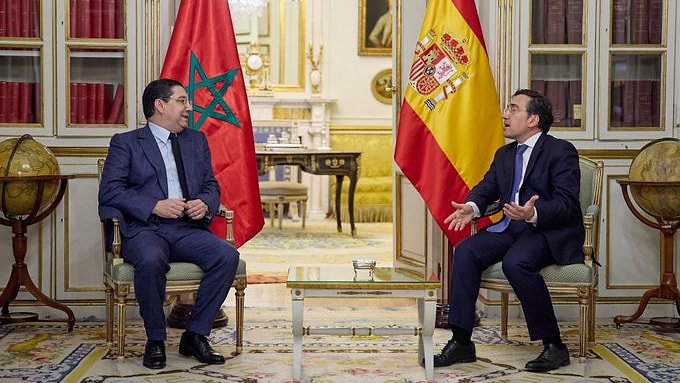
The quadripartite meeting held last Sunday 8 February 2026 in Madrid, the first since 2019, took place under U.S. mediation. It brought together representatives from Morocco, Algeria, Mauritania, and the Polisario Front for nearly four hours. This meeting was part of renewed consultations led by the United Nations aimed at resolving the regional conflict over the Moroccan Sahara. The goal was to outline the details of an agreement regarding the implementation of the Autonomy Plan.
One of the key features of the meeting was the detailed presentation by Morocco’s Minister of Foreign Affairs, Nasser Bourita. He focused on the powers and responsibilities proposed for the populations of the Southern Provinces, especially regarding their representative institutions, judicial structure, and public finances. His presentation included visual materials and a forty-page official document that explained the autonomy proposal in detail. It received a positive response from U.S. mediators Massad Boulos and Mike Waltz, as well as from the Mauritanian delegation. In contrast, Algerian and Polisario representatives seemed unsettled by a discussion that remained strictly technical instead of ideological.
These consultations took place at the United States Embassy in Madrid, with American and UN officials present. They were part of broader efforts to support a political solution that aligns with the guidelines laid out by the United Nations Security Council. During this meeting, the Moroccan delegation reiterated that the updated autonomy initiative represents, as stated in Security Council Resolution 2797 adopted on October 31, 2025, the only realistic and viable framework for a political settlement under Moroccan sovereignty.
It’s noteworthy that U.S. involvement marks a significant change in Washington’s approach, transitioning from offering political support to directly facilitating negotiations. This renewed engagement brings fresh energy to a process that had been stagnant for years. It also reflects the current U.S. administration’s commitment to achieving real political progress within a set timeframe.
A new round of negotiations, also under U.S. mediation, is planned for Washington. According to sources close to the U.S. administration, this stage could be crucial, as the White House aims to reach a formal final agreement.
In this context, Morocco’s clarified position, along with the efforts of American special envoys, has helped address some long-standing obstacles. This includes recognizing Algeria’s role as a party to the negotiations and a shift in the Polisario Front’s stance, which could pave the way for potentially concluding the process.
Additionally, these initial discussions, following a long period of stagnation, occurred in a generally calm environment, without hostilities or confrontational exchanges, according to observers.
Some analyses view this diplomatic re-engagement as a chance to move past a conflict that has long affected regional relations. Others suggest that Algeria’s participation may reflect external pressures, including political and diplomatic influences from the United States. These viewpoints highlight the need for Moroccan diplomacy to stay vigilant to protect the autonomy framework as recognized by the United Nations.
Other interpretations link Algeria’s involvement in the quadripartite talks to fears of possible U.S. sanctions, the risk of international isolation similar to Venezuela’s situation, and the potential for the Polisario Front to be labeled a terrorist organization. From this perspective, Algeria and the Polisario’s presence in Madrid does not necessarily imply true commitment to a political compromise.
The central question remains whether the increased U.S. involvement will effectively unlock this issue, especially given past unsuccessful mediation attempts. However, many observers believe that the current international situation shows a stronger determination among major powers to end this long-standing dispute. They argue that Morocco should leverage this momentum to protect its rights and territorial integrity within the framework of its full sovereignty.