


If you are spending more than one day in Tangier and looking for more things to do in Tangier, the city centre — the medina, the Kasbah, is worth checking the waterfront. About 14 kilometres west, the coastline shifts into one of the most geographically and historically significant stretches in Morocco.
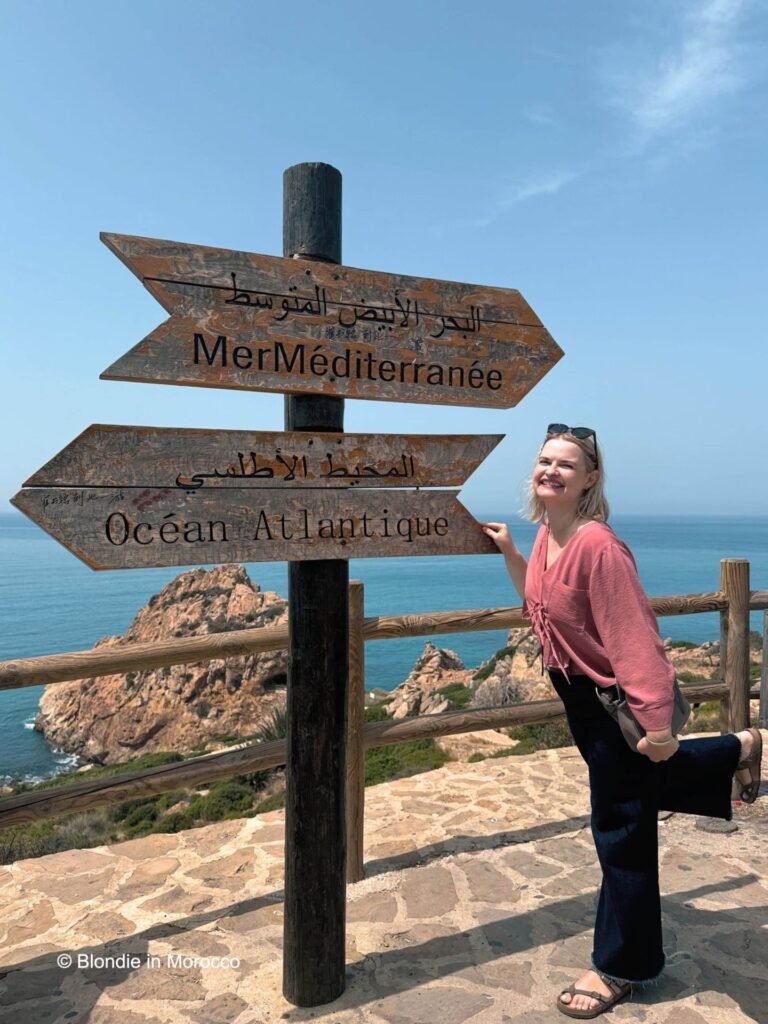
Cap Spartel, the Caves of Hercules, and Perdicaris Park can all be covered in half a day. From Cap Spartel, you can see where the Atlantic Ocean meets the Mediterranean, and on a clear day, the coast of Spain is visible across the Strait of Gibraltar.


Practical Information
How to Get to Cap Spartel / Herculis cave and Perdicaris Park from Tangier city?
- Rental car: most flexible, allows the Achakkar Beach walk
- Grand taxi: negotiate from the central Tangier as half day trip (around 25min drive) – I had nice grand taxi driver in Tangier, didn’;’t save his name, but try to text him via WhatsApp +212 670986361 (French or Arabic only, also can drive you to other cities around)
- Hop-on, hop-off bus in Tangier: there are blue and red lines. The red line bus also stops at the Donabo gardens. Maybe because it was summer, the bus was very crowded (mainly Moroccan tourists, also, let’s leave the visit to Perdicaris Park for another time, since it’s so big.
- Shared collective taxi: cheapest option one way, ~20 MAD per person from Rue Sidi Bouabid near the Grand Socco
Entrance fees:
- Cap Spartel lighthouse and park: ~50 MAD
- Caves of Hercules Tangier: ~60 MAD
- Perdicaris Park: free
- Villa Perdicaris museum: ~70 MAD
How long: A half-day covers all three stops plus lunch. Add the Achakkar Beach walk and you have a full day. If you take taxi or car, I suggest first stopping at the Perdicaris Park, then Cap Spartel and leave Herculis cave for the last stop. Or, even better, if you ask the taxi to leave at Cap Spartel, walk by Achakkar Beach toward Hercules cave, and then have lunch/drink at the Mirage hotel terrace. On a clear day, this stretch — with the Atlantic on one side and the cliffs of the Strait of Gibraltar ahead — can be great way to relax.


Your Morocco trip begins here
10 years in Morocco. Boutique planning for curious travellers
Cap Spartel: Tangier’s Most Famous Viewpoint


Cap Spartel is the northwesternmost point of Africa — the exact geographic location where the Atlantic Ocean meets the Mediterranean Sea at the entrance to the Strait of Gibraltar. There is a wooden directional sign marking the point, and yes, every visitor photographs it. But the sign is worth understanding properly, because standing at Cap Spartel means standing at one of the most strategically significant maritime passages in history. Every ship that crossed between the Atlantic and the Mediterranean — from Phoenician traders to 19th-century European merchant fleets — passed this cape, and the waters here claimed a significant number of them.
The Cap Spartel lighthouse, Morocco’s oldest, was built in 1864 under Sultan Muhammad IV. What makes it historically unusual is how it came to exist: ten European powers and the United States jointly negotiated and financed its construction, because safely navigating this stretch of the Strait of Gibraltar was a matter of shared international interest. It was not generosity — it was commerce.


You pay a small entrance fee (around 50 MAD) to access the park around the Cap Spartel lighthouse. The grounds are well-maintained — a botanical garden, terraced paths, and panoramic views over the point where the two seas converge. The lighthouse itself is open to visitors and includes a small maritime museum, with historical dates and documents painted along the interior spiral staircase. The park also has a café and a restaurant if you want to stop for something before continuing south toward the Caves of Hercules.
Caves of Hercules Tangier


About five kilometers south of Cap Spartel along the coast, you can visit the famous Caves of Hercules. The cave’s ocean-facing opening is shaped like the outline of the African continent — an accident of erosion, wind, and angle that has become one of Morocco’s most reproduced images.
The caves themselves have been inhabited since Neolithic times. Before they became a tourist attraction, local workers quarried the rock here to cut millstones — the circular indentations are still visible in the cave walls. The connection to Greek mythology comes from the legend that Hercules rested here before his eleventh labor. The site sits just above Achakkar Beach, which is worth a stop before or after the cave if the weather allows.
The honest assessment: the visit is brief and the space is small. On busy days, and particularly on weekends, the Caves of Hercules Tangier fills up with local tour groups and the experience becomes — enter, see the famous ocean opening shaped like Africa, take the photo, leave. If you are already doing the Cap Spartel route, it makes complete sense to include it.
In my opinion, Herculis cave it’s not must must thing to do in Tangier – was very crowded and small cave.
Perdicaris Park Tangier


Between Cap Spartel and the city, the road passes through Perdicaris Park — officially the Forêt Urbaine Perdicaris, also known as Parc Rmilat — a 70-hectare woodland of eucalyptus, pine, and oak that Tangier locals use for walking, picnics, and escaping the summer heat. Entrance is free. On weekdays it is genuinely quiet, and the contrast with the crowded tourist sites a few kilometers away is noticeable.
The park is named after Ion Perdicaris, a Greek-American who arrived in Tangier in the 1870s and became the unofficial social center of the city’s expatriate community. He purchased this forested hilltop and built a grand villa he called Aidonia — Greek for “Place of Nightingales” — partly to give his wife, who suffered from tuberculosis, cleaner air and open surroundings.


In 1904, Perdicaris and his stepson were kidnapped from the property by the Moroccan chieftain Mulai Ahmed er Raisuni, who used the abduction to extract political concessions from the Sultan. The crisis escalated fast. President Theodore Roosevelt dispatched seven US warships to the Moroccan coast, and his Secretary of State issued what became one of the most quoted telegrams in American diplomatic history: “Perdicaris alive or Raisuli dead.” The ransom was eventually paid, Perdicaris was released, and Roosevelt — partly on the strength of this show of force — won re-election later that year.
The villa still stands inside Perdicaris Park and was recently restored as a small museum (around 70 MAD entry; reviews are mixed on whether the interior is worth the fee). The forest itself is free, open daily, and one of the more pleasant places to spend a quiet hour in this part of Tangier. The hop on hop off bus Tangier route stops here, which is how many visitors end up finding it. Takes time to walk it all.
Lunch places around
Near Cap Spartel, Le Mirage is a luxury hotel set on the Atlantic cliffs. Non-guests can come for lunch or a drink on the terrace, and the setting does exactly what a clifftop terrace above the Atlantic should — it slows you down. The views are the real reason to be there. Make a reservation if you are visiting on a weekend. I also like the L’Océan Restaurant Tanger (a bit further) – nice to have lunch/wine there even without visiting the monuments.

