


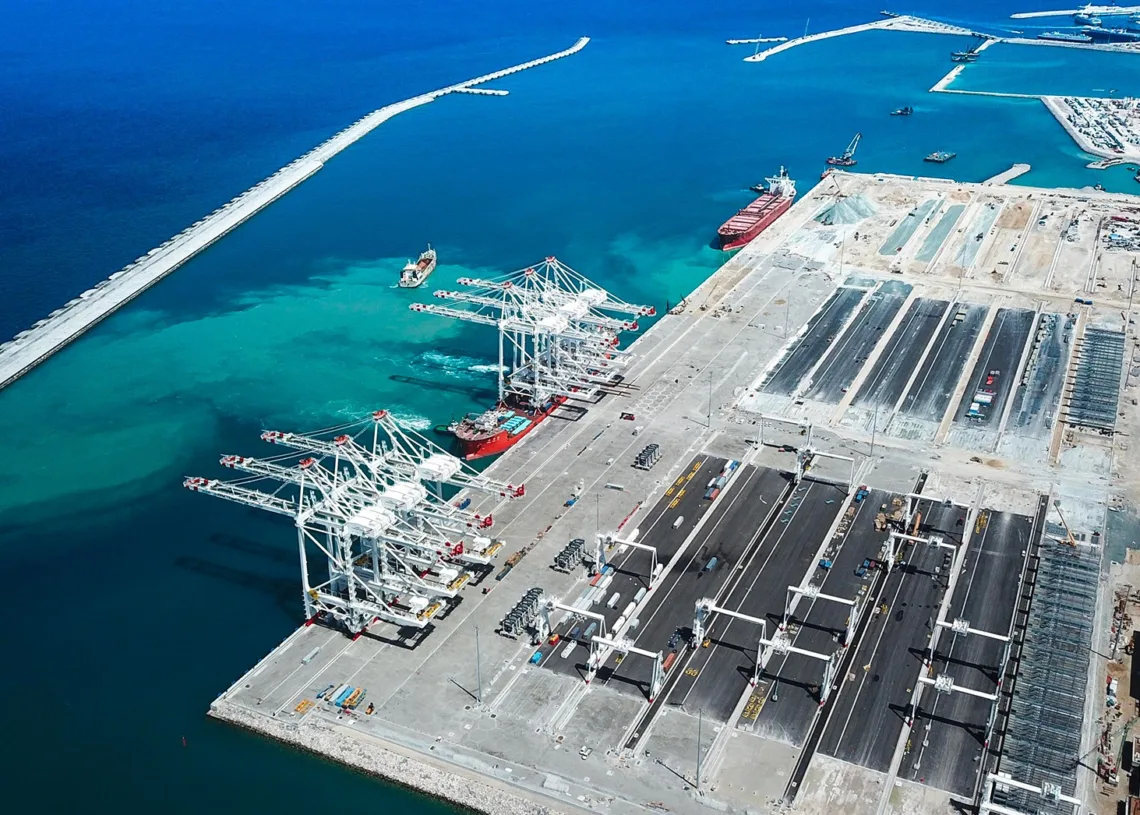
Rabat – Morocco’s two largest ports have secured leading positions in a regional ranking that measures integration into global maritime routes, according to a new report from the Arab Investment and Export Credit Guarantee Corporation (Dhaman).
The study lists Port of Tanger Med and Port of Casablanca among the most connected ports in the Arab region within the Global Liner Shipping Connectivity Index.
The ranking covers 71 Arab ports and compares their position within a global network of more than 930 ports.
Major regional hubs such as Port of Jebel Ali, Khalifa Port, Port of Alexandria, Port Said Port, King Abdulaziz Port Dammam, Port of Damietta, and Port of Salalah also appear among the leading facilities in the index.
The findings appear in the institution’s fourth sector report of 2025 on maritime transport in Arab countries. The report states that the sector attracted 146 foreign investment projects across the region during the past 23 years, with total investment close to $4 billion.
Data in the study shows steady expansion in the Arab commercial fleet. The number of vessels rose by about 4% in 2025 to reach roughly 2,900 ships based on actual ownership.
Total carrying capacity also increased by 4.6% and reached nearly 109 million metric tons of deadweight, which represents about 5% of global maritime shipping capacity.
Investment between Arab countries also took shape through several joint projects.
Six countries, Morocco, United Arab Emirates, Saudi Arabia, Bahrain, Oman, and Egypt, participated in 11 regional initiatives in the maritime transport sector with investments that exceeded $218 million.
The report also provides insight into cargo activity across Arab ports. Facilities in the region handled more than 423 million metric tons of goods in 2023. Ports in Morocco, the UAE, Saudi Arabia, and Egypt accounted for 58% of that volume.
During the same year, Arab ports loaded around 1.6 billion metric tons of cargo destined for global markets, which represents nearly 14% of total international maritime trade. Oil shipments alone represented about 58% of that cargo.
Container traffic also recorded strong growth. Ten major Arab ports registered a 19% rise in handling volumes in 2023 compared with 2019, with total container throughput close to 59 million twenty-foot equivalent units.
According to the report, the average ranking of Arab ports in the global liner shipping connectivity index improved during the final quarter of 2024. Morocco, the UAE, Egypt, and Saudi Arabia held the strongest positions in the region.
Trade in maritime transport services across 11 Arab economies also expanded. The value of external trade in these services reached more than $53 billion in 2024, after a 12% increase.
Maritime transport service exports from Arab countries rose by 14% to about $9 billion, while imports reached nearly $45 billion after a 13% increase.
