


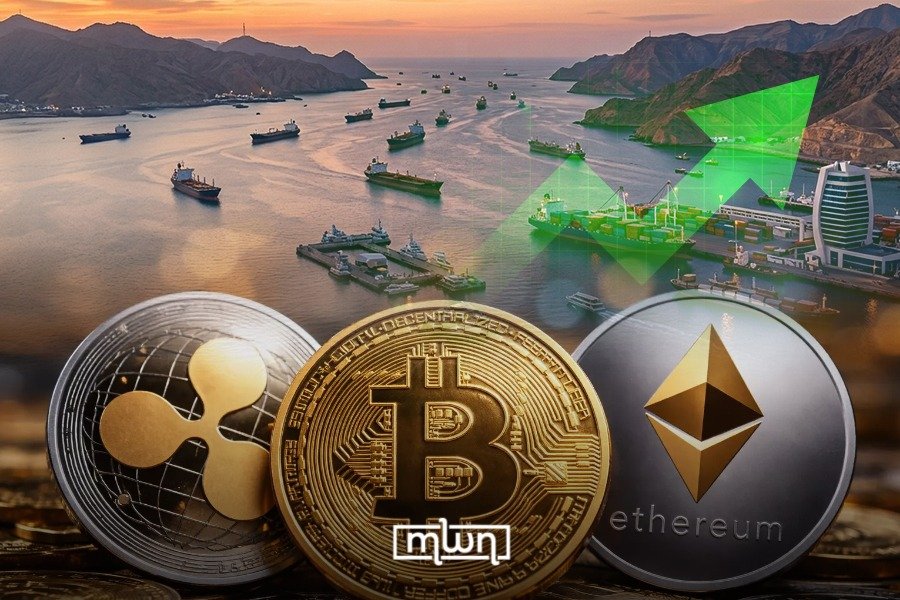
Casablanca – Iran’s reported plan to charge oil tankers in cryptocurrency for passage through the Strait of Hormuz is doing more than rattling shipping markets. It is once again putting a spotlight on when crypto actually gets used and why.
For years, bitcoin has been pitched as a form of everyday money. In reality, most of its activity still revolves around trading. Yet moments like this show a different pattern, as crypto tends to surface not in stable economies, but in crisis.
Iranian authorities are considering a system where ships would be asked to pay in bitcoin within seconds of receiving instructions, a way to avoid seizure under sanctions. The market reaction was immediate and crypto edged up as the news spread.
Data from TRM Labs suggests that Iran’s Islamic Revolutionary Guard Corps has already been accepting payments since March, charging as much as $2 million per vessel. Alongside bitcoin, payments can also be made in yuan or tether.
When access to the global financial system is restricted, cryptocurrencies offer a workaround. Iran, heavily sanctioned, has long used bitcoin mining to generate revenue and pay for imports. Estimates suggest it accounts for about 4.5% of global mining activity.
Read also: Iran-US-Israel Conflict Shapes Crypto’s Biggest 2026 Stress Test
But crypto’s usefulness here says less about innovation and more about constraint. Shipping firms trying to comply would face serious hurdles, due to the difficulty of buying large amounts of cryptocurrency without alerting regulators.
Exchanges that facilitate such transactions risk sanctions themselves. Two UK-registered exchanges, Zedcex and Zedxion, were sanctioned earlier this year for processing crypto transactions linked to Iran’s Revolutionary Guards.
There is also a misconception at play. Bitcoin is not invisible, and transactions are recorded on a public blockchain and can be traced in real time. Authorities could cross-check a vessel’s cargo and timing through the strait to infer whether a toll was paid.
Crisis drives crypto demand
The reported fee, roughly $1 per barrel of oil, adds a calculable cost that can be monitored, but also absorbed. And in an environment where traditional payment rails are blocked or politically risky, crypto becomes one of the few remaining options.
The geopolitical implications stretch further. Accepting yuan alongside crypto could weaken the dominance of the dollar in oil trade. Mallika Sachdeva, a strategist at Deutsche Bank, said the situation could mark early signs of a shift toward a “petroyuan,” where oil is priced and traded in Chinese yuan instead of US dollars.
She pointed to growing use of non-dollar payments in sanctioned trade, particularly involving Iran and China, as pressure on the petrodollar system begins to build.
At the same time, parts of the US energy sector are positioned to benefit. Companies like Exxon and ConocoPhillips have invested in bitcoin mining powered by excess gas, a practice recognized by the World Bank. Rising oil prices and renewed crypto demand tend to move in their favor.
The pattern is becoming familiar with crypto not replacing traditional finance in calm periods. But, filling gaps when systems break down or are deliberately cut off. In that sense, its growth is often tied less to everyday utility and more to instability.
Morocco World News is also on X — check out our latest posts now! Get MWN on iOS and Android for instant access to breaking news.
