


Many have over the past month hailed Spain, through the bold anti-war rhetoric of its Prime Minister Pedro Sanchez, for being the only European country to have mustered the moral courage to oppose Western arrogance and American hubris in the alarmingly escalating war on Iran. While Sanchez has indeed taken a commendable stance on the crisis ongoing in the Middle East, anyone familiar with Spanish history and Spain’s prevailing political discourse knows that anti-Islamn sentiments and Western paternalism are part and parcel of Spain’s attitude toward Muslims.
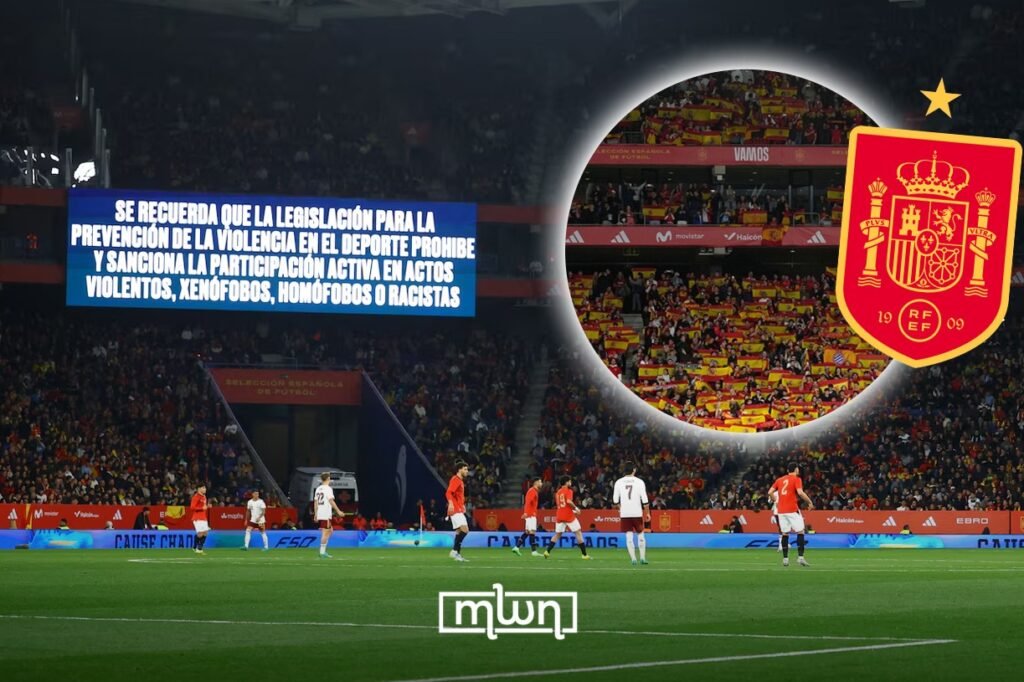
And the Islamophobic chants by Spanish fans during yesterday’s friendly match between Spain and Egypt were the latest, eloquent confirmation of the alarming normalization and popular embrace of a deep-seated antipathy towards Islam and Muslims. Some might contend that the mainstreaming of this sentiment is relatively new as it coincides with the rise of Great Replacement-obsessed far-right parties across Europe.
Spain is still uneasy about its Muslim past
But the problem with this reading is that it captures the political and sociology propelling this alarming social trend without addressing its deep historical roots. Because, at their core, yesterday’s chants are the symptom of a deeper issue that tainted, sometimes burdened, centuries of Spain’s dealings with Africans (more broadly) and Muslims in particular. Or, as I discuss in detail in my 2021 book about the “tumultuous centuries” or “great misunderstandings” between Spain and its Moroccan neighbor, a certain sense of cultural purity and civilizational superiority has long pervaded Spaniards’ perception of Muslims.
In this sense, Spanish fans’ chants against Islam reflect a cultural pattern that has prevailed in Spain since the expulsion of Muslims from the Iberian Peninsula in 1492. Indeed, one of the defining characteristics of Spanish literary and academic production since that historical milestone has been the effort to distance Spanish identity from its Muslim past. For generations of Spanish politicians and intellectuals, to acknowledge their country’s Muslim past is to put an indelible stain on its belonging to the Western world.
As such, rather than embracing and reclaiming the impressive and rich cultural legacy of the Muslim Iberian Peninsula, Spanish elites have viewed it as a stigma, an unwanted and dirty mark that would only tarnish the “purified” image Spain has sought to project of itself as a Western nation.
Hence the sustained effort in elite Spanish circles, over the past five centuries, to demonize Muslims. And given its geographical proximity and the central role it played in the establishment of Islam and in the continuation of Muslim presence in the Iberian Peninsula until 1492, Morocco has been a primary target of this intellectual demonization and cultural shaming spree. Both in Spanish literature and in the expansionist policies espoused by successive Spanish governments, there is sustained insistence of the supreme urgency of weakening or subduing Morocco.
Under the guise of preventing Morocco from posing any threat to Spain’s territorial integrity, stability, or prosperity, the real goal was to create and perpetuate a Moroccan reality in line with the perception — Muslim societies as weak, backward, and in need of assistance — that generations of Spanish scholars and politicians had cultivated among their countrymen.
As part of that project of cultural infantilization, Spanish history books made sure to present Islam, Prophet Mohamad, and Muslims in the most negative and offensive light possible.
According to the book Islam in the Classroom, the authors of Spanish school textbooks have long been driven by a strong determination to distance themselves from their Arab-Muslim past and to reject it as an integral component of their history and cultural heritage. And so, far from adhering to any standard of objectivity, the authors of these textbooks have primarily sought to revive the same falsehoods that have circulated since the end of Muslim presence in Spain. Writers such as Diego de Haedo, Luis del Mármol Carvajal, Jaime Bleda, among others, are some of the foremost promoters of this strand of hardcore Islamophobia.
These authors’ accumulation of prejudices and historical distortions permeated all aspects of Spanish socialization, from schools to newspapers and folk songs. They presented Islam as a false and inferior religion, its Prophet as a heretical figure, and its followers as a backward and culturally inferior people. In so doing, the designers of these textbooks aimed to perpetuate a negative image of Muslims and to portray them as the irreconcilable enemies of Spanish modernity and prosperity.
Morocco as the ideal scapegoat of Spain’s cultural paternalism
Again, Morocco bore the brunt of these racist delusions and historical inaccuracies because of its geographical proximity to Spain. Indeed, as the authors of Islam in the Classroom have shown, the crushing majority of Spanish textbook writers offer a truncated and partial reading of Spanish-Moroccan relations over the past century.
Evidently biased and eager to dismiss well-documented stories of Spanish cruelty toward its Muslim neighbor, the few of these textbooks that address centuries of Spain-Morocco relations fail by design to even mention the use of toxic gases by the Spanish military against the population of the Rif region in Morocco. Instead, these school textbooks offer long, copious passages where Moroccans — and, by extension, Muslims — are systematically portrayed in negative, dismissive, and derogatory terms.
Not surprisingly, these authors largely overlook or outright dismiss the period between 1927 — marking the end of the so-called “pacification” campaign conducted by Spanish forces in northern Morocco — and Morocco’s independence. This omission serves to obscure the fact that Spanish troops subjected to degrading, immoral treatment the defenseless population living in the Spanish zone of influence, or that Madrid indiscriminately imposed in those areas a policy of terror and intimidation to suppress resistance to Spanish military presence. When they read about their country’s history or past, young Spaniards are never told that the Moroccans who took part in the fratricidal conflict of 1936 were, in the majority of cases, compelled against their will to sacrifice their lives in defense of a cause that was not their own.
Even more troubling — and indicative of the determination among segments of the Spanish intelligentsia to instill distorted narratives in younger generations while portraying Spain’s presence in Morocco as altruistic and selfless — is the fact that certain textbook authors advance claims entirely disconnected from historical reality. Chief among these ahistorical claims is the assertion that Spain, of its own accord, chose to end its presence in Morocco, thereby forcing France to do the same in its own protectorate zone.
According to one of the textbooks analyzed by the authors of “Islam in the Classroom,” Spain’s occupation of Morocco was nothing like France’s; Spain was supposedly a friendly, generous, and cultural difference-accommodating colonizer. “During the most critical moments of Morocco’s struggle for independence, the attitude of the Spanish government was one of respect toward the people it protected; for this reason, it did not approve of the deposition of King Mohammed V carried out by France (1953), which exercised the protectorate over the rest of Moroccan territory,” the textbook claimed. “On the contrary, three years later, Spain granted independence to its own zone. This decision compelled France to also abandon its protectorate in Morocco.”
To this day, such a biased, ideological, and dehumanizing treatment of anything related to Morocco or to any Muslim country still pervades the Spanish media. Morocco, or any issue related to Islam, is rarely covered for positive developments. Instead, Islam and Muslims are primarily covered to spotlight socio-economic crises, political unrest, cultural backwardness, or mass immigration.
Statements of support are nice, but Spain needs radical reforms
It is therefore not surprising that, while welcoming the Egyptian national team in what should have been a “friendly match” to strengthen social and human ties between the two peoples, a sizable part of the Spanish fan base behaved in a manner that is unworthy of a “civilized” country that hopes to host the final of the 20230 World Cup.
Indeed, followers of La Liga (spain’s top-tier football league) would recall that these anti-Muslim chants are a continuation of the shameful racism that persists in Spanish stadiums. In recent years, Brazilian forward Vinicius Junior has been the visible victim of this pervasive racism.
Addressing this issue cannot be limited to the occasional publication of statements condemning such behavior. It requires, above all, recognizing that these racist outbursts are the result of a broader cultural pattern marked by intolerance and a lack of respect for the culture, religion, history, and identity of billions of non-Western people around the world.
Spain, like the rest of the Western world, should accept and come to terms with the fact that the economic and political dominance it has enjoyed over the past two centuries does not grant it any legitimacy to consider itself the center of the world or the guiding light of humanity. As such, a profound reform of school textbooks and history books should be one of the first steps Spain must take to combat the racism that persists across different sectors of its society.
The Spanish government and many significant voices in Spain’s cultural, intellectual and media establishments have in recent years admirably spoken out in support of the Palestinian people and against the policies of the Israeli government. This is indeed a welcome and commendable development. Yet that alone cannot erase Spain’s colonial past, whether in Latin America or in Morocco, where millions of people suffered — and many lost their lives — as a result of the mercantilist and strategic calculations of elites whose primary objective was to enrich themselves and build an empire at the expense of other peoples.
To address this troubling historical legacy honestly and, at the same time, combat the persistence of racism and Islamophobia, Spain should undertake a profound reform of its school textbooks. Such a reform should aim first and foremost to eliminate any discourse that portrays Muslims as an inferior culture, incompatible with Western values, or as violent or inherently threatening peoples.
Racism is one of the deepest afflictions affecting Spanish society, and its eradication requires bold and structural decisions. Failing to commit to these radical reforms, while expecting racism to decline or respect toward Muslims to become a new norm, would be akin to trying to cure a disease with the wrong treatment.
Samir Bennis is the co-founder and publisher of Morocco World News. You can follow him on Twitter @SamirBennis.