


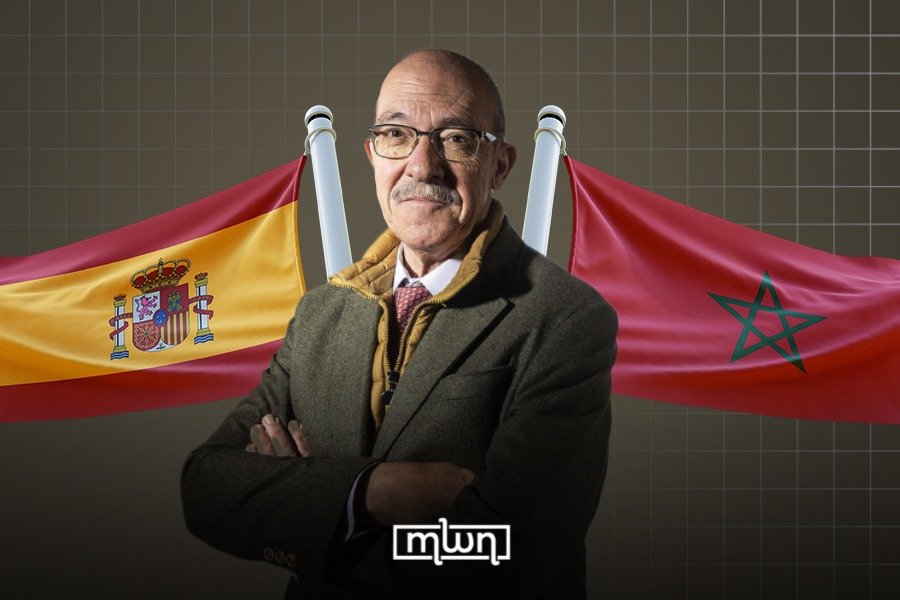
Rabat — Former Spanish Chief of Defense Fernando Alejandre is under scrutiny for his latest remarks in which he declared Morocco a “real and clear threat” to Spain.
Alejandre made his remarks during a recent interview with Spanish news outlet ABC, claiming that what worries him the most is what he called a “rapprochement” between Morocco and the US – two allies that have shared relationships for over 250 years.
“Two things worry me. One is the clear rapprochement between the United States and Morocco, which did not begin because of the Prime Minister’s recent statements,” Spain’s ex-general said, which could be a reference to the recent Spain-US tensions amid the Middle East war.
Pedro Sanchez, Spain’s Prime Minister, is now depicted as the “most vocal critic” of the US, especially over Trump’s policy on war with Iran.
However, the notion that Morocco and the US needed a “rapprochement” in the first place appears to be a mix of simplification or absence of fact-checking, as the US and Morocco are frequently described as long-standing allies.
The two countries share more than diplomatic ties but also cooperation across different trade sectors, including economic ties.
Morocco was the first country to recognize America’s independence.
The two countries are linked through a Free Trade Agreement, which has been active since 2006, making Rabat the first and still the only African nation to hold such an economic accord with Washington.
The US is also one of the largest arms suppliers to Morocco. It supplied 60% of Morocco’s arms imports during 2021-2025.
The former general’s incorrect portrayal of Morocco-US ties as merely a “rapprochement” is a position likely shaped by the strengthening ties between the two countries since Washington adopted an unambiguous stance over Western Sahara in December 2020.
In that year, the US formally recognized Morocco’s sovereignty over its southern provinces in Western Sahara, endorsing Rabat’s position as legitimate.
Since then, the US administration has aligned with Morocco’s position, including within the UN Security Council (UNSC), where Washington is backing the Autonomy Plan as the only realistic and durable political solution to the long-standing territorial dispute.
The position is far away from ambiguous stances or direct hostility displayed by some Spanish lawmakers, who continue to use European floors to advocate for pro-Polisario outdated narratives pushed by the Algerian regime in an attempt to undermine Morocco’s territorial integrity over its southern provinces in Western Sahara.
Such pro-separatist advocacy often brings a short-lived relief to separatists, who await any remarks to read between the lines and come up with interpretations to feed their separatist claims.
Ex-General Alejandre also delivered his insights on news and speculation alleging Morocco could be an alternative location for a US base in Rota.
The rumors intensified recently, especially amid Spain’s policy on the US position in the Middle East war with Iran.
Spain’s strong opposition to the Middle East War
Today, Spain escalated its opposition to the US-Israel alliance in their war with Iran.
The Spanish government decided to close the country’s airspace to US aircraft involved in attacks.
Margarita Robles said her country doesn’t authorize either the use of military bases or the use of airspace for actions related to the war in Iran.
“I think everyone knows Spain’s position. It’s very clear,” she said.
For his part, defense chief Alejandre suggested that the US will not abandon the Moron and Rota bases as retaliation for Spain’s position.
“I don’t think it’s an option right now. Could it become one§ It could,” he said.
But, what worries him the most is the relationship between Rabat and Washington.
He said that NATO’s missile shield in Rota “cannot be based on a non-member country. So I don’t think the shield will move to Morocco, but it could be relocated to another southern-flank country- and that would give us considerable headaches.”
He also sparked scrutiny over his remarks on the Spanish enclaves of Ceuta and Melilla, claiming Spain “missed several opportunities to include Ceuta and Melilla in the Washington Treaty.”
Alejandre does not see allies supporting his country if “Spain had to invoke Article 5 over an aggression against Ceuta or Melilla.”
“ At the beginning of this century, when we lost an islet, we couldn’t invoke it. It’s a very complicated situation. We could invoke it, but whether they would affirmatively respond – I personally have my doubts,” he said.
Article 5 of NATO is one of the cornerstones of the alliance that establishes that an armed attack against one member in Europe or North America is considered ana track against all members.
The remarks reflect the ex-general’s clinging approaches to maneuvers and colonial possessions of the enclaves.
Seeing Morocco as a ‘threat’ is not new
Alejandre’s remarks, however, are far from isolated among major Spanish voices.
Many surveys in Spain throughout the years have shown a significant shared perception among Spanish respondents, who view Morocco as a strategic risk.
The surveys echo a long-entrenched public perception instead of being a surprising narrative.
In 2025, a Spanish poll said 66% of Spaniards considered the possibility of their country becoming involved in an armed conflict in the coming years.
The survey shows how far-right rhetoric continues to fuel fears about Morocco among Spaniards.
The same survey shows that 42.2% of respondents view Morocco as a potential adversary, ranking the North African country second only to Russia — which was confirmed in a 2022 survey.
A different survey by Spain’s Elcano Royal Institute shows that 55% of Spanish people view Morocco as a main external threat.
The number marks a six-point increase from a similar survey that the institute carried out a year earlier.
That year, the findings showed Morocco ranking higher than Russia in terms of how much the North African country is perceived as a threat among Spaniards.
The same trend has been transferred throughout the years and documented from one survey to another.