


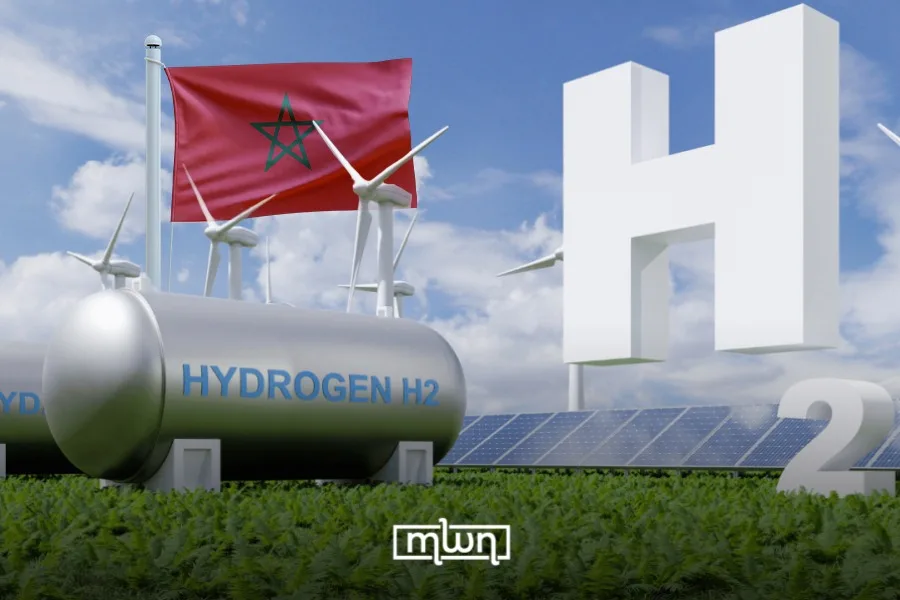
Marrakech – Two Spanish energy heavyweights, Acciona and Moeve (formerly Cepsa), have advanced into the development phase of large-scale green hydrogen projects in Morocco, after securing preliminary land reservation agreements from the Moroccan government last Thursday – an essential milestone in the kingdom’s green energy rollout.
Spanish media reports indicate that the agreements follow the preselection of the companies’ respective consortiums in March 2025 under Morocco’s flagship green hydrogen program. With the competitive phase concluded, developers are now required to demonstrate the technical, financial, and industrial viability of their individual projects.
The agreements were formally received on February 5 during a high-level meeting in Rabat chaired by Head of Government Aziz Akhannouch, alongside senior national and international investors.
The ceremony marked the operational launch of five structural hydrogen projects in Morocco’s southern regions, reinforcing Rabat’s long-term strategy to anchor energy sovereignty, industrial transformation, and export capacity.
Moeve has partnered with Taqa Morocco, a subsidiary of Saudi Arabia’s TAQA Group, to develop a large-scale green ammonia and industrial fuel complex at the Jorf Lasfar Port. Under the arrangement, Taqa Morocco will supply renewable electricity from assets located in southern Morocco, while Moeve will lead the production and commercialization of e-fuels.
“This agreement represents an important step toward bringing large-scale green molecule production to Morocco,” said Moeve CEO Maarten Wetselaar. “By combining our experience in green fuels with Taqa Morocco’s renewable capabilities, we are laying the foundations for a project that accelerates the decarbonization of industry and heavy transport.”
Taqa Morocco CEO Abdelmajid Iraqi Houssaini echoed this assessment, stating that the partnership “will contribute to the decarbonization of Taqa Morocco’s portfolio and support green mobility through the development of hydrogen-derived products critical for industrial and transport applications.”
Read also: Morocco’s $35.15 Billion Green Hydrogen Gamble: Ambitious Plans Amid Market Doubts
Separately, the ORNX consortium – bringing together Acciona via its joint venture Acciona Nordex Green Hydrogen, German turbine manufacturer Nordex, and US-based firm Ortus – secured land in Laayoune for a renewable ammonia production project. The plan includes more than two gigawatts of renewable capacity to power a 900-megawatt electrolysis unit.
According to Asharq Business on February 6, citing agreement documentation, the project carries an estimated investment of $4.5 billion.
The consortium envisions three integrated hydrogen projects across Laayoune, Boujdour, and Dakhla, targeting annual production of 100,000 tons of low-cost hydrogen, converted into roughly 560,000 tons of green ammonia.
Both initiatives fall under Morocco’s “Offre Maroc” framework, a national program designed to position the kingdom as a leading hydrogen hub serving African and European markets.
The government has earmarked MAD 319 billion (around $31.9 billion) for hydrogen development, selecting five consortia to deliver six flagship projects from nearly 40 proposals submitted by investors representing 17 countries.
The preselected groups include Saudi Arabia’s ACWA Power, Morocco’sNareva, the ORNX consortium (Ortus-Acciona-Nordex), the TAQA-Moeve consortium, and a Chinese-led group comprising United Energy Group (UEG) and China Three Gorges.
TotalEnergies and Engie are involved in separate, parallel cooperation tracks with Morocco on hydrogen and renewable energy development, but do not form part of the five-consortium selection announced in this initial project phase.
Morocco has allocated one million hectares to support hydrogen-sector investment, a scale that underscores its ambition to capture more than 4% of global hydrogen demand – transforming geography, sun, and wind into long-term strategic leverage.