


I’ve lived in Morocco long enough to know that some places carry a weight you can’t quite explain. You feel it in the air, in the hush of the people around you, in the way locals lower their voices when they speak the name. Sidi Chamharouch is one of those places.
Tucked into the rugged folds of the High Atlas Mountains, roughly sixty kilometers from Marrakech, this tiny village sits along the trekking route to Jebel Toubkal — North Africa’s highest peak at 4,167 meters. Most hikers know it as a rest stop. But for thousands of Moroccans, Sidi Chamharouch is something far more profound: it’s believed to be the earthly court of the Sultan of the Jinn, a place where the invisible world and our own brush up against each other every single Thursday.
And yes — only Muslims are allowed to enter.
Getting There: The Trek from Imlil
The journey begins in Imlil, the last village accessible by car and the famous gateway to Toubkal. From there, it’s about a two-hour hike along a rocky mountain path — a walk that is beautiful, challenging, and strangely atmospheric all at once.
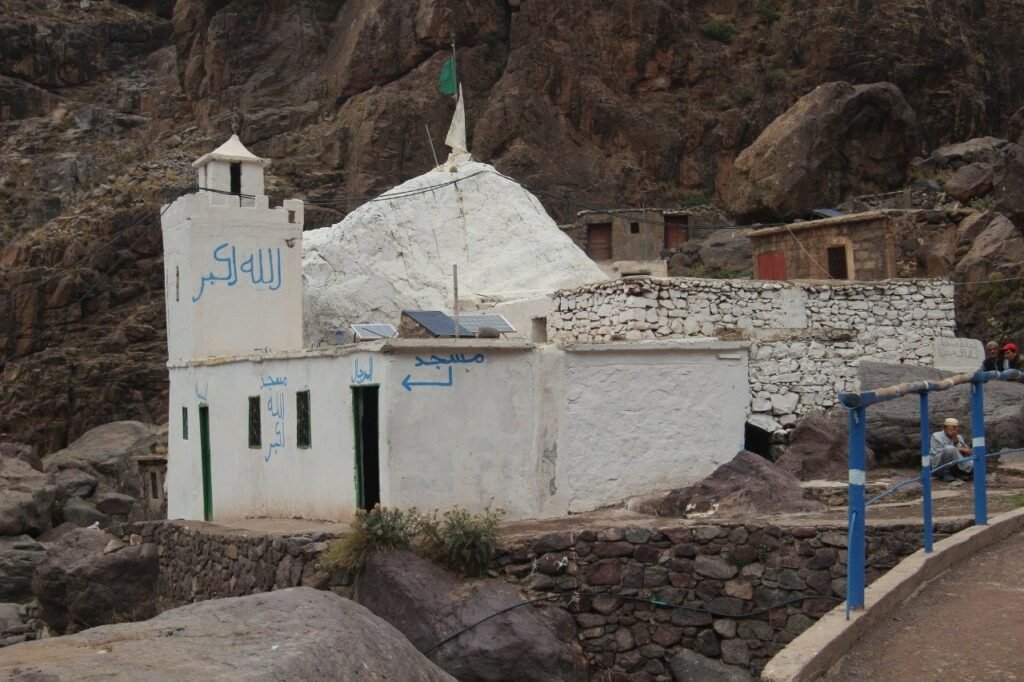
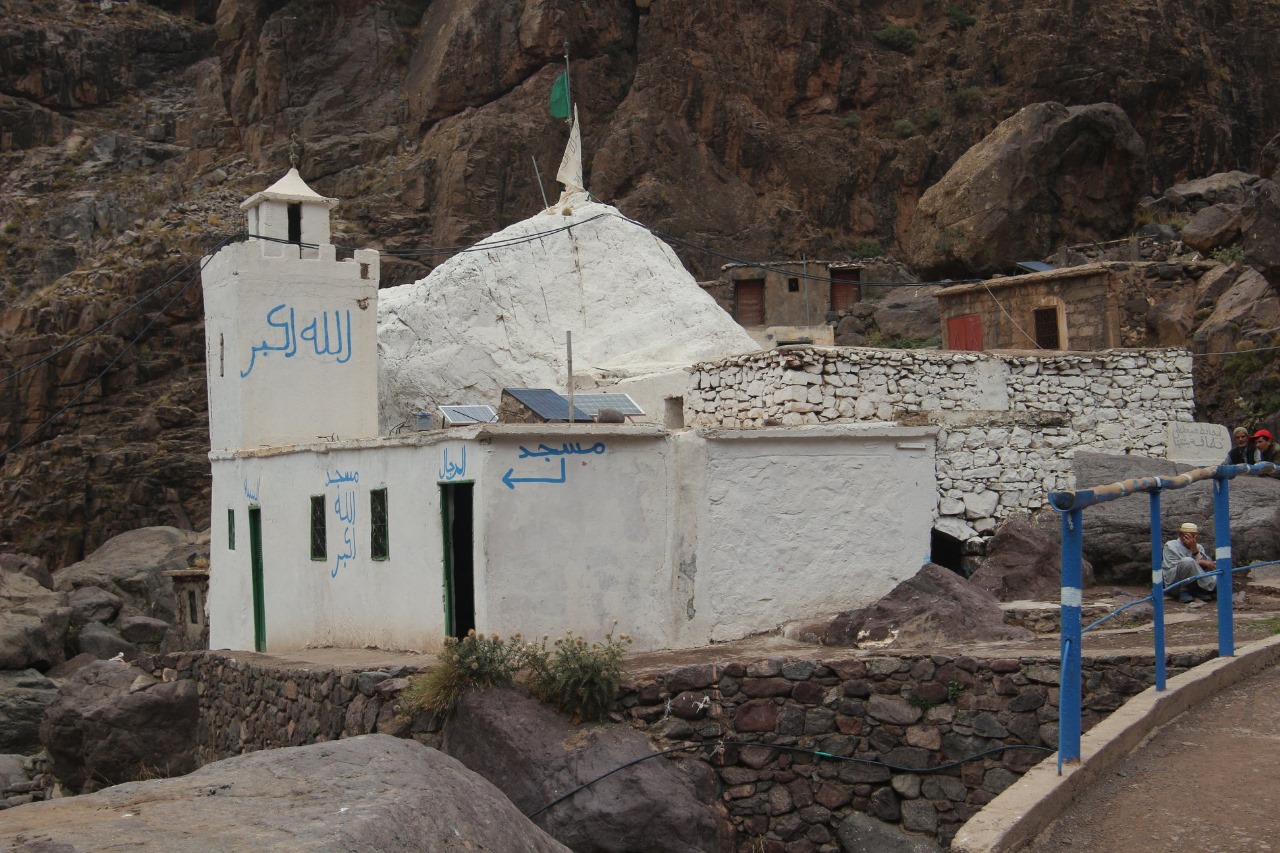
As you approach the village, the first thing you’ll notice is the crows. Locals say they’re inhabited by spirits — meskoun, or “possessed.” Then come the humble stone houses, a small white dome, and white candles scattered around like quiet offerings. There’s a particular energy here that’s hard to put into words. You don’t have to believe in the supernatural to feel that something about this place is different.
Near the small mosque, you’ll find a large rock with a hollowed-out cavity, draped with white and green flags. This is the heart of the shrine. A sign in Arabic and French makes it clear: entry is permitted for Muslims only, and photography is forbidden. This isn’t a tourist attraction — it’s a living, breathing spiritual site.
So Who Is Chamharouch, Exactly?
According to Moroccan folk tradition and historical “Books of the Jinn,” there are seven jinn kings who rule the earth, each governing a specific day of the week and carrying distinct powers and characteristics:
- Sunday — King Abdallah Al-Mudhahab
- Monday — Lalla Mira, interpreter of the human soul
- Tuesday — Abu Mahrez Al-Ahmar, master of military cunning
- Wednesday through Saturday — Kings Barqan, Al-Abyad (the White King), and Sidi Mimoun each take their appointed day
- Thursday — Chamharouch, the greatest and wisest of them all
Chamharouch is regarded as the father figure and supreme judge of the earthly jinn. His throne is said to lie within that massive rock — a small tomb covered in green cloth, surrounded by walls inscribed with Quranic verses and prayers. The colors white and green, associated with justice and peace, are considered sacred to him.
According to Mohamed, a descendant of Hajj Id Belaid (the family that established the shrine beside the rock in 1929), Chamharouch’s full title is Sheikh Abu Al-Walid Chamharouch — described as a Muslim jinn and companion who has lived for over fourteen centuries, having been alive during the time of the Prophet Muhammad. It’s said he eventually handed his throne to his son, Abderrahman, though he still presides over the most important trials between jinn kings.
Thursday: Court Is in Session
Every Thursday, the village transforms. Pilgrims arrive from across Morocco, bringing gifts and offerings — seeking justice, healing, or simply answers.
The belief is that when court begins, certain signs appear: a person possessed by jinn may suddenly begin to speak in the jinn’s voice, or the weather may shift dramatically. It’s a moment that blends deep faith with centuries-old folk tradition in a way that is uniquely, unmistakably Moroccan.
For those seeking healing from spiritual ailments — believed to be caused by possession (al-mass) or sorcery (sihr) — a three-day ritual may unfold. It begins with animal sacrifice, carried out and distributed by the Id Belaid family, the hereditary guardians of the shrine. This is followed by Al-Hadra (also called Al-Zar) — expressive spiritual sessions involving rhythmic drumming, chanting, and trance-like dance intended to transport the afflicted person into the jinn’s realm.
If these rituals don’t bring relief, the final resort is a spiritual trial — a direct appeal to Chamharouch himself. It’s a fascinating, sometimes unsettling practice that reveals just how deeply interwoven the seen and unseen worlds remain in Moroccan culture.

The Origin Story: A Black Dog and a Destiny
Anthropologist Hassan Rachik, professor at Hassan II University, traces the Chamharouch legend back to the mid-eighteenth century and the Id Belaid lineage.
The story goes that a man named Moussa bin Idriss encountered a black dog that appeared to him for seven consecutive days. As Moussa observed the animal, it revealed itself to be Sidi Chamharouch. The jinn king then appointed Moussa and his tribe as the guardians of the sacred site, tasked with overseeing the rituals and sacrifices.
To this day, the Id Belaid family continues to fulfill that role — a responsibility passed down through generations for nearly three centuries.
What the Experts Say
The shrine and its traditions invite a range of perspectives, and I think it’s important to share them honestly.
Ali Shaabani, a sociology professor, views the enduring belief in Chamharouch’s powers as an integral part of Moroccan folk culture. He points out that the Quran itself mentions jinn, which reinforces belief in figures like Chamharouch. He also notes, however, that simple practices can harden into fixed rituals over generations — and that some people profit from promoting these traditions commercially.
Faisal Tahari, a psychologist, offers another lens. He explains that belief in spiritual healing through shrine visits can produce a temporary psychological improvement — essentially a placebo effect rooted in deep faith. But he stresses the importance of proper medical and behavioral treatment for mental health conditions, noting the ongoing challenge of communities attributing psychological disorders to evil spirits and jinn possession.
It’s a tension that runs through many aspects of Moroccan life: the pull between centuries of tradition and the push toward modern understanding. Neither side has the full picture, and I think the most respectful approach is to acknowledge both.
Why This Place Matters
You don’t have to believe in jinn to appreciate what Sidi Chamharouch represents. It’s a window into a layer of Moroccan culture that most tourists never see — one where faith, folklore, community, and the mountain landscape are all woven together into something powerful and enduring.
For the local Ait Mizan tribes, this isn’t superstition. It’s heritage. It’s identity. And whether you’re a skeptic or a seeker, standing in that narrow valley surrounded by towering peaks, with the sound of wind and distant prayer, you can’t help but feel that this corner of the Atlas holds secrets that go far deeper than any guidebook could capture.
Practical Information for Visitors
- Location: Approximately 60 km from Marrakech, along the Toubkal trekking route
- How to get there: Drive to Imlil (about 1.5 hours from Marrakech), then hike approximately 2 hours
- Access: The shrine interior is restricted to Muslims only; non-Muslim hikers can visit the village and surrounding area
- Best time to visit: Thursday, when the weekly “court” takes place and the village is most active
- What to bring: Good hiking shoes, water, sun protection, and layers — mountain weather changes quickly
- Respect: This is a sacred site. Dress modestly, ask before photographing people, and be mindful of the spiritual significance of the place
Have you ever visited Sidi Chamharouch on your way to Toubkal? Or have you heard stories about the jinn kings of Morocco? I’d love to hear your experiences — drop a comment below or find me on social media!