


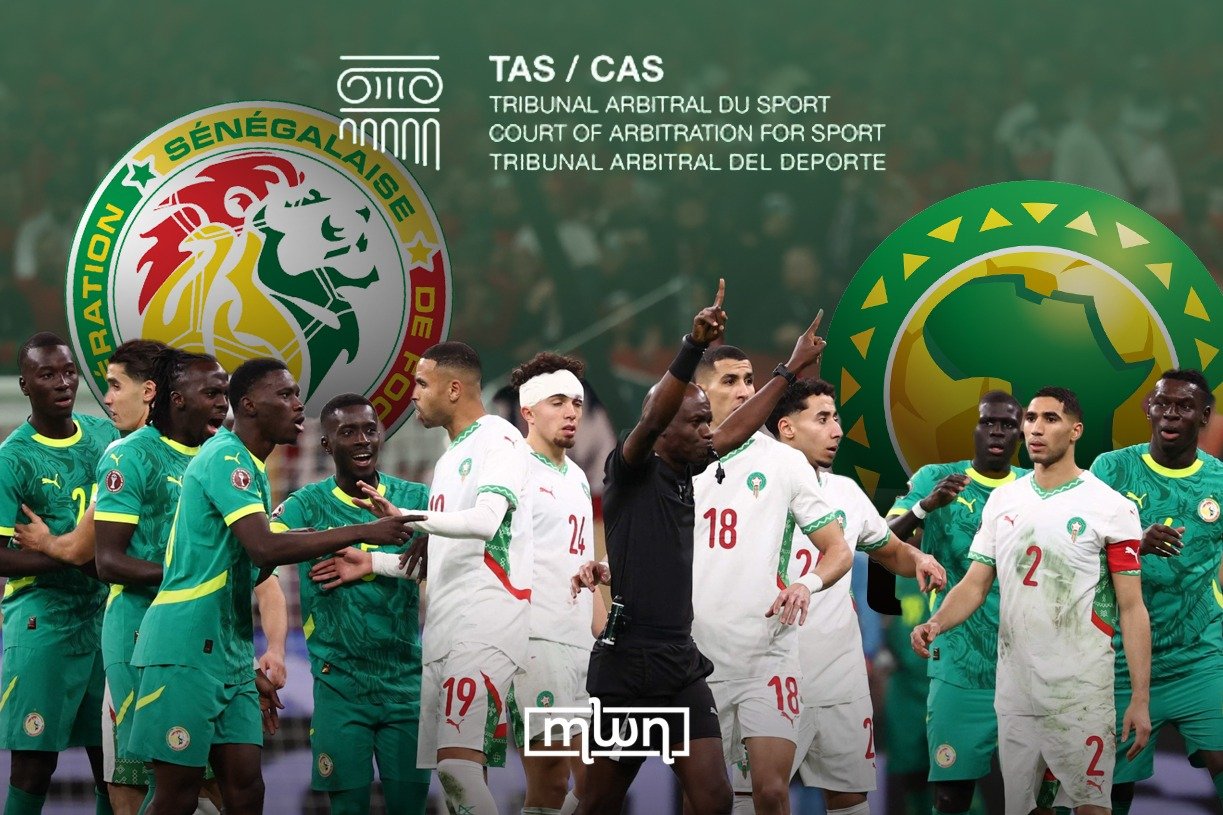
As it projected throughout this past week the bases of its grievances against CAF – and interestingly against Morocco – ahead of a potentially long judicial process at the Court of Arbitration for Sports (CAS), the Senegalese Football Federation (FSF) has appeared unsettled.
Judging from the press conference the federation organized this week and the attendant statements its president and other members connected to the Senegalese team have issued throughout the week, it indeed looks as though, having likely recognized the weakness of its legal position against CAF and Morocco, the FSF has decided to shift the debate into the realm of politics and perception management.
No room for interpretations when the rules are crystal clear
And the reasons for this change of strategy are easy enough to discern. By virtue of paragraph 2 of Article 48 of the CAF Statutes, which governs appeals before CAS, “The Code of Sports-related Arbitration shall govern the arbitration proceedings. With regard to substance, CAS shall apply the various regulations of CAF and FIFA or, if applicable, of national associations, members, leagues and clubs, and, as a last resort, Swiss law.” Paragraph 4 of the same provision further clarifies that CAS “does not adjudicate on appeals related to: violations of the Laws of the Game; suspensions of up to four (4) matches or three (3) months; [and] decisions taken by an independent arbitration tribunal duly established by an independent association.”
The wording of this article is particularly unfavorable to Senegal, as it underscores the structural weakness of its case before CAS. The arbitrators will examine the facts and determine whether the CAF Appeal Board strictly applied the relevant provisions of the AFCON regulatory framework.
Bound by the application of CAF and FIFA regulations, CAS is not free to reinterpret clear rules beyond what Articles 82 and 84 provide. Moreover, the well-established principle ubi lex non distinguit, nec nos distinguere debemus (“where the law does not distinguish, we must not distinguish”) further limits any attempt to introduce discretion or interpretation where the regulatory text is clear.
It follows that CAS is likely to conclude that the CAF Appeal Board correctly applied Articles 82 and 84 by imposing the appropriate sanctions for Senegal’s conduct during the AFCON final.
A misplaced and irrelevant invocation of the Laws of the Game
The case gets even more problematic for Senegal when one considers its reliance on arguments related to the Laws of the Game. Senegal contends that the CAF Appeal Board’s decision violates the sanctity of the referee’s authority under Article 5 of the Laws of the Game. This argument is fundamentally misplaced, however. It runs directly counter to paragraph 4 of Article 48 of the CAF Statutes, as well as article paragraph 2 of article 63 of CAF Disciplinary Code, all of which explicitly exclude from CAS jurisdiction any appeals relating to violations of the Laws of the Game.
By framing the dispute as a refereeing issue, Senegal effectively places its argument outside the scope of CAS review. CAS is not empowered to reassess whether the referee’s decisions were correct, final, or binding. Accordingly, it is very unlikely to engage in a debate as to whether the referee’s decision to resume and complete the match cures or nullifies the legal consequences of Senegal’s conduct. Such matters fall within the domain of match officiating and are expressly excluded from CAS jurisdiction.
Instead, CAS will most likely focus on whether the CAF Appeal Board correctly applied the relevant regulatory framework. The central issue is therefore not the referee’s authority, but whether Senegal’s conduct – namely, its withdrawal from the field of play – constitutes a regulatory breach triggering automatic sanctions under CAF regulations.
Even in the unlikely event that CAS were to consider Senegal’s arguments relating to the Laws of the Game, it would still conclude that the withdrawal from the pitch falls outside the referee’s match-management authority and squarely within the category of disciplinary violations governed by Articles 82 and 84.
The core of Morocco and CAF’s position is that the resumption and completion of the match do not negate the occurrence or the legal consequences of the regulatory breach. The violation was consummated the moment Senegal deliberately withdrew from the pitch under the instruction of its coach. This act alone is sufficient to trigger the automatic application of Article 82. The referee’s authority is limited to managing the match; it does not extend to overriding or nullifying regulatory sanctions.
Morocco’s legal strategy has been particularly effective in this regard. By grounding its case in the legal consequences of Senegal’s withdrawal, rather than in a challenge to the referee’s decision, Morocco has aligned its arguments with the applicable regulatory framework. Had Morocco instead based its case on an alleged refereeing error, its claims would likely have been dismissed by both CAF’s Disciplinary Committee and Appeal Board. The decision to rely on Articles 82 and 84 has therefore significantly strengthened its position.
Defiance as a strategy of last resort
Senegal could be in clear violation of CAF Statutes and the Disciplinary Code if it proceeds with its announced plan to parade the AFCON trophy ahead of its friendly match against Peru at the Stade de France. Such a move would constitute a further and manifest breach of CAF’s regulatory framework.
Article 8 of the CAF Disciplinary Code provides that “decisions taken by the Appeal Board shall be final and binding on all the parties concerned.” This provision is only subject to appeals lodged before the Court of Arbitration for Sport (CAS).
Senegal may seek to argue that, having filed an appeal before CAS, the decision of the CAF Appeal Board no longer has binding effect. The implicit premise of this argument is that the appeal produces a suspensive effect on the enforcement of the CAF ruling.
However, this interpretation runs contrary to both the letter and the spirit of CAF regulations. Paragraph 2 of Article 59 of the CAF Disciplinary Code clearly states that “an appeal does not have a suspensive effect except with regard to orders to pay a sum of money.”
Paragraph 7 of Article 48 of the CAF Statutes further reinforces this principle. The paragraph explicitly provides that “an appeal to CAS shall not have suspensive effect. Decisions appealed against shall remain in force pending the final decision of CAS.”
Therefore, should Senegal proceed with parading the trophy, it would be in clear violation of a binding decision issued by CAF’s Appeal Board. Such a move could once again expose the country to further sanctions under the CAF disciplinary framework. More importantly, Senegal would also risk breaching a key FIFA disciplinary provision if it follows through on its plan to parade the AFCON trophy ahead of its friendly against Peru tonight. Under Article 21 of the FIFA Disciplinary Code (FDC), which addresses “failure to respect decisions,” any club, official, or member association that fails to comply with a ruling issued by a FIFA body is subject to a range of disciplinary measures provided for by the article. These sanctions range from fines to more severe penalties in cases of repeated non-compliance.
CAS is not a political forum
In sum, Senegal’s case appears untenable for three main reasons.
First, it cannot credibly claim the existence of procedural flaws in the CAF Appeal Board’s ruling. Both parties – Morocco and Senegal – were heard and given the opportunity to present their arguments. Allegations relating to the format of the hearing (such as the use of videoconference) or the duration of submissions are legally irrelevant unless they amount to a denial of the right to be heard, which is not the case here.
CAS will focus on whether due process was respected in substance, not on the technicalities of how the hearing was conducted. By contrast, Morocco was justified in challenging the Disciplinary Committee’s earlier decision, which was rendered without properly hearing its position. Senegal cannot make a similar claim regarding the verdict of the Appeal Board.
Second, Senegal faces significant difficulty in challenging the merits of the decision. The Appeal Board did not engage in discretionary interpretation; it simply applied the relevant regulatory provisions. CAS will assess whether the applicable rules were correctly applied, and on this point, Senegal appears particularly vulnerable.
Morocco’s case is supported by a coherent legal framework and corroborated by consistent evidence, including Senegal’s documented withdrawal from the field of play, its refusal to continue the match, and the converging reports of the referee, the match commissioner, and the CAF security officer. Given all this, CAS is likely to uphold the Appeal Board’s ruling.
Third, Senegal’s position raises broader concerns regarding the integrity of the competition. Were CAS to overturn CAF’s decision, it could create a dangerous precedent whereby teams dissatisfied with refereeing decisions might attempt to disrupt matches or exert pressure on officials, only to resume play without consequence. Such a scenario would undermine the integrity and stability of football competitions.
This broader context helps explain Senegal’s recent announcement of a potential international criminal investigation into alleged corruption within CAF. Far from a legal strategy aimed at influencing CAS proceedings, this move appears to be an attempt to shift the debate into the political and public sphere. But CAS is not a political forum; it is a judicial body that adjudicates on the basis of law and evidence. As such, it will not be influenced by rhetorical escalation or attempts to politicize this judicial dispute.
Ultimately, this strategy suggests an awareness within the Senegalese camp of the limitations of its legal case. Faced with the strength of the regulatory framework and the weight of the evidence, the shift toward allegations of corruption appears aimed at shaping public perception rather than altering the legal outcome. Yet CAS, being used to such tactics, will remain focused on the law. And on that terrain, Senegal’s case appears particularly weak.
