


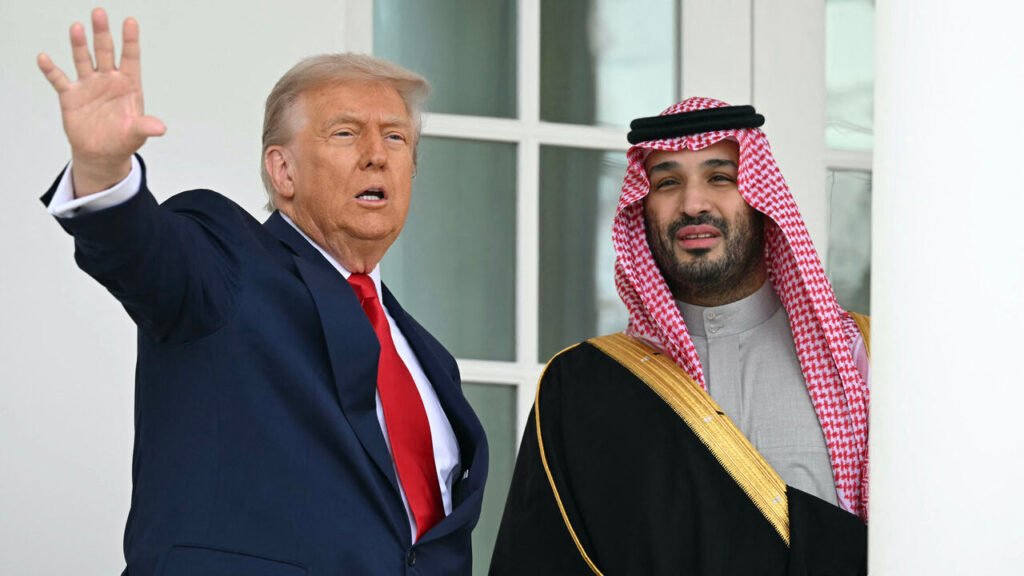
Marrakech – Saudi Crown Prince Mohammed bin Salman told US President Donald Trump on Tuesday that the kingdom wants to join the Abraham Accords but requires “a clear path” to Palestinian statehood before normalizing relations with Israel.
Speaking alongside Trump in the Oval Office, MBS stated: “We want to be part of the Abraham Accords. But we also want to be sure that we secure a clear path to a two-state solution.” The crown prince added that Saudi Arabia seeks peace for both Israelis and Palestinians, who should “coexist peacefully in the region.”
The meeting marked MBS’s first US visit since the 2018 killing of journalist Jamal Khashoggi by Saudi agents. Trump welcomed the Saudi leader with promises of advanced F-35 fighter jets and a potential $1 trillion investment package.
He acknowledged their discussion covered both one-state and two-state solutions but avoided making commitments. “I don’t want to use the word commitment, but we’ve had a very good talk on the Abraham Accords,” Trump said.
The Saudi position represents a towering obstacle to Trump’s normalization goals. MBS has consistently maintained that any deal with Israel must include concrete progress toward Palestinian statehood, a demand that has grown stronger since Israel’s ongoing genocidal campaign in Gaza.
Saudi Arabia’s stance reflects broader Arab and Muslim world sentiment regarding Palestinian rights. The kingdom holds particular influence as custodian of Islam’s holiest sites in Mecca, making any perceived betrayal of the Palestinian cause politically costly.
Trump offered Saudi Arabia F-35 jets “pretty similar” to those Israel possesses, calling both countries “great allies.” He also mentioned reaching a defense deal with Saudi Arabia and expressed openness to a civilian nuclear agreement.
The crown prince’s primary objectives during the visit include securing advanced weapons systems and a comprehensive US defense pact. Saudi Arabia seeks security guarantees similar to those Trump extended to Qatar, which treats attacks on that nation as attacks on the US itself.
Saudi Arabia sees no urgency in normalization
Analysts note that MBS has little incentive to rush normalization. Saudi Arabia already maintains quiet security cooperation with Israel while avoiding the regional backlash that formal normalization might bring without Palestinian concessions.
The timing proves challenging for any breakthrough. Despite Trump’s brokered October 10 ceasefire, Israel continues its relentless assaults in Gaza and the West Bank, making Palestinian statehood discussions politically impossible for Israeli Prime Minister Benjamin Netanyahu’s far-right government.
Trump’s Abraham Accords previously brought Israel normalization deals with Bahrain, the United Arab Emirates, Morocco, and Sudan, and more recently, Kazakhstan.
As for Syria, Ahmed Al-Sharaa has already dismissed any possibility of normalization so long as the Golan Heights remain under Israeli occupation.
However, Saudi participation remains, in the eyes of the Trump team, the ultimate prize, given the kingdom’s unmatched regional influence and economic power.
The crown prince’s Washington visit aims to rehabilitate his international standing following the Khashoggi murder while securing strategic US partnerships. The formal dinner and full diplomatic treatment signal improved US-Saudi relations despite human rights concerns.
For Palestinians, Saudi Arabia’s conditional approach offers hope that Arab nations will not abandon their cause for regional deals. The kingdom’s insistence on statehood progress maintains pressure on both Israel and the US to address Palestinian aspirations.
The normalization discussion will likely continue as both sides pursue their strategic interests, but immediate progress appears unlikely without fundamental changes to Israel’s Palestinian policies.