


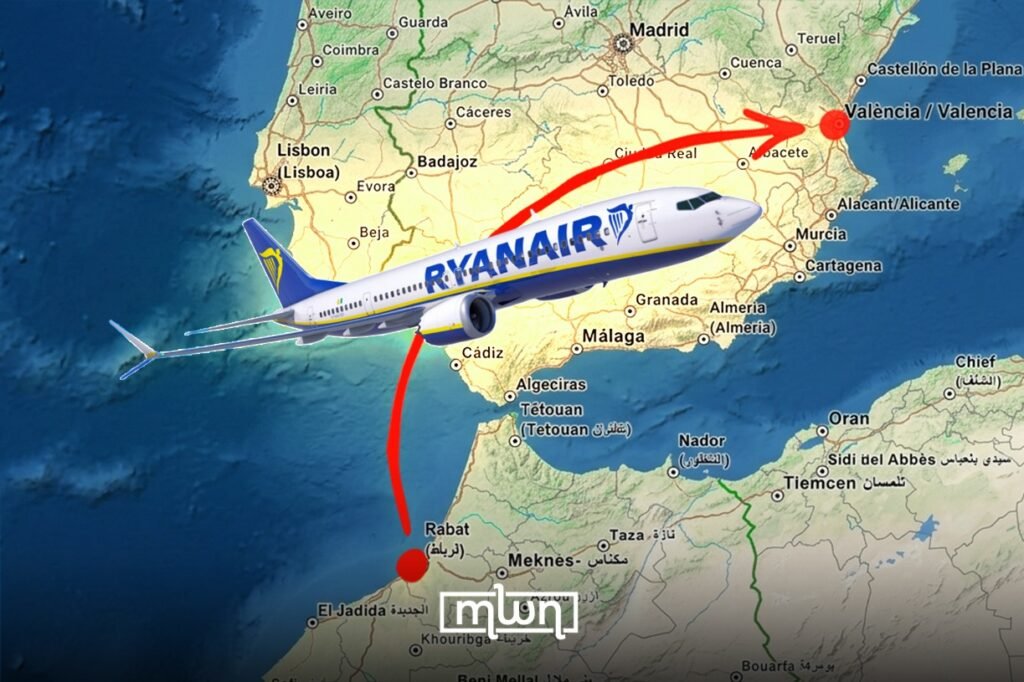
Rabat– Ryanair is deepening its footprint in Morocco with a coordinated expansion that combines new routes, infrastructure alignment, and a long-term investment in the capital’s air connectivity.
The Irish low-cost carrier has confirmed the launch of a new direct route linking Valencia and Rabat, scheduled to operate four times a week as part of its summer 2026 program.
For Ryanair, the addition is more than a seasonal adjustment as it reflects a broader commercial push to strengthen travel flows between Morocco and Spain while widening affordable travel options across Europe.
The Valencia–Rabat connection arrives alongside the official opening of a new Ryanair base at Rabat–Salé Airport.
Backed by an investment estimated at $200 million, the base signals a shift from incremental growth to a more anchored, long-term presence in Morocco’s aviation landscape.
Ryanair plans to operate up to 20 routes from Rabat, effectively repositioning the airport as a more active regional hub. To support this network, the airline will station two Boeing 737 aircraft permanently at the airport.
The decision seek to reduce operational dependency on external bases and allows for tighter scheduling, increased frequency, and faster turnaround times; key elements in the low-cost model.
Spain, already one of Morocco’s closest economic and tourism partners, stands to benefit directly from the new Valencia link, which complements existing connections between the two countries.
The timing of Ryanair’s move aligns closely with a major upgrade in airport infrastructure. The recent completion of a new terminal at Rabat–Salé Airport marks a turning point in the facility’s operational capacity.
The Terminal 2 expansion, spanning approximately 69,000 square meters, raises the airport’s annual passenger capacity to 4 million.
Designed across multiple levels, the terminal introduces expanded check-in areas, streamlined passenger flows, and new retail and dining spaces.
This synchronization between airline expansion and infrastructure readiness is unlikely to be coincidental. Airlines typically scale operations where airport capacity can sustain growth without operational bottlenecks.
In Rabat’s case, the upgraded terminal provides the physical framework needed to accommodate increased traffic while maintaining service standards.
While cities like Marrakech and Fez have traditionally dominated tourist inflows, Rabat has often remained secondary despite its administrative and cultural significance.
By concentrating resources in the capital, Ryanair appears to be testing whether improved connectivity can shift travel patterns toward less saturated destinations.
The establishment of a base typically generates direct and indirect employment, from ground operations to ancillary services.
It also creates downstream effects for local tourism, hospitality, and transport sectors. For a city like Rabat, which balances its political role with a quieter tourism profile, increased air access could help diversify its economic activity.
At the same time, competition in Morocco’s aviation market is intensifying. Low-cost carriers continue to expand across North Africa, drawn by rising travel demand and the region’s proximity to Europe.
Ryanair has been pledging an aggressive pricing strategy as a central lever, and its expanded summer program is expected to maintain pressure on fares across key routes.
The airline, through its regional representatives, has framed the expansion as part of a broader effort to provide more travel options at competitive prices.
Its full summer 2026 schedule, including the new Valencia route, has already been opened for booking through its digital platforms, signaling confidence in demand for the upcoming season.
Yet the success of this expansion will ultimately depend on sustained passenger demand beyond peak travel periods. Seasonal spikes are common, but maintaining consistent traffic throughout the year remains a challenge for many secondary routes.
For Morocco, the development fits into a wider ambition to strengthen its position as a regional travel hub. Improved connectivity, particularly with European cities, remains a cornerstone of that strategy.
Rabat’s emergence as a more active entry point could help redistribute tourist flows and reduce pressure on traditionally crowded destinations.