


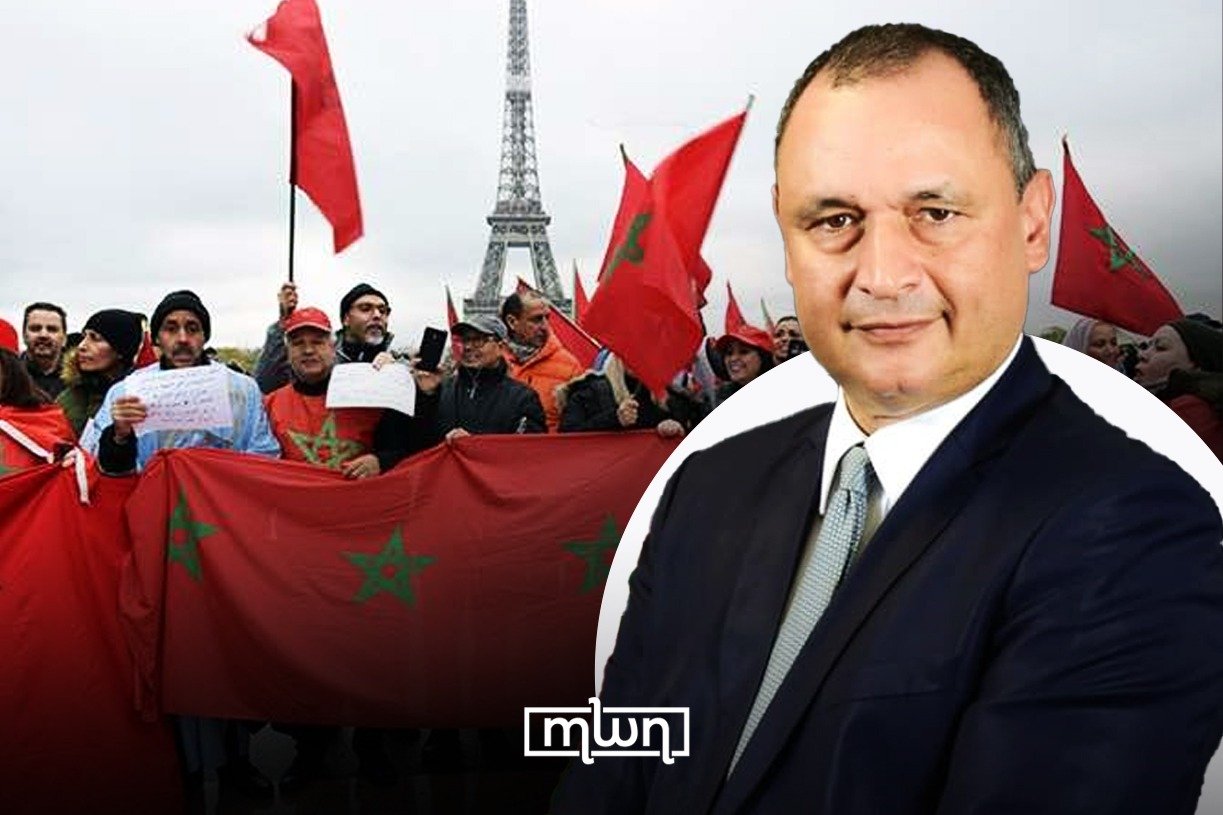
Marrakech – There is a peculiar brand of arrogance that flourishes in the corridors of power when officeholders forget who butters their bread. Ryad Mezzour, Morocco’s Minister of Industry and Trade, demonstrated this spectacularly during a Ramadan iftar hosted by the association of graduates of Morocco’s grandes écoles.
Looking into the cameras with the self-assuredness of a man unburdened by self-awareness, the minister mustered the audacity to tell five million Moroccans living abroad that their return to the homeland deserves neither gratitude nor ceremony.
“When someone comes back to work in their country, it doesn’t mean they’re giving me a gift… this is natural,” Mezzour declared. Then, lest anyone mistake his condescension for mere philosophical musing, he sharpened the blade further with a colloquial Moroccan jab: “Bza’at,” which roughly translates to“Who cares?” Yet he continued: “This is your country, you’re home, should I thank you for showing up?”
The phrase, dripping with the dismissiveness of a landlord scolding a tenant, sent shockwaves through diaspora communities from Paris to Montreal, from Brussels to Amsterdam. It was not the sentiment of a statesman courting investment. It was the barking of a man who has confused bluntness with bravery, and who apparently believes that demeaning your most prolific economic constituency is a viable governing philosophy.
View this post on Instagram
Let us be surgically precise about what Mezzour disparaged. Moroccans abroad pumped a record-shattering MAD 122 billion – roughly $13 billion – into the national economy in 2025 alone. That figure climbed every single year of the decade: from MAD 115.15 billion in 2023, to MAD 118.9 billion in 2024, to 2025’s historic zenith.
These remittances constitute over 8% of the country’s GDP, dwarfing foreign direct investment. They cushion the trade deficit. They stabilize the dirham. They feed hundreds of thousands of families for whom a monthly wire transfer from a son in Lyon or a daughter in Rotterdam is not a luxury. Simply put, they are oxygen to the national economy.
Bank Al-Maghrib itself forecasts these flows to swell to MAD 130 billion by 2027. Morocco is the second-largest remittance recipient in the entire Middle East and North Africa, trailing only Egypt. And yet here stands the Minister of Industry, treating these billions as though they were coins tossed into a wishing well.
Stewardship demands more than occupying someone else’s chair
The irony curdles further when one examines what Mezzour has actually accomplished in his portfolio since King Mohammed VI appointed him in October 2021. He inherited a ministry that was already humming under the stewardship of Moulay Hafid Elalamy, who orchestrated Morocco’s transformation into Africa’s premier automobile manufacturer and shepherded the kingdom’s aeronautics sector into the global top tier. Mezzour arrived, in essence, at a table already set. And he naturally proceeded to take credit for the meal. As the former speaker of the UK’s House of Lords, Baroness Hayman, pertinently put it while welcoming former US president Barack Obama, politicians are often well-versed in that distinctively infuriating “art of arriving late but claiming all the credit.”
Yet Mezzour, having owned the success story that his predecessor scripted, has struggled to deliver on his own. Beneath the glossy barometer presentations and the recycled talking points about MAD 816 billion in industrial turnover, the numbers that actually matter tell a damning story. Youth unemployment, the truest thermometer of industrial policy’s efficacy, has not budged. It has metastasized. It soared to 39.5% by January 2025, according to none other than Nizar Baraka, Mezzour’s own party leader at Istiqlal.
Among university graduates, the figure approaches an unconscionable 40% in certain regions. One in three young Moroccans under 24 is neither employed, nor in school, nor in training — the ignominious NEET category.
Business insolvencies surged by 18% in 2022, 13% in 2023, and 11% in 2024 under Mezzour’s watch, with over 40,000 enterprises collapsing in 2024 alone, according to the Confederation of SMEs. Nearly 99% of those failures were micro-enterprises – the very backbone of local employment. Allianz Trade forecasted yet another 7% spike in 2025 – a projection that proved accurate when Morocco recorded the bankruptcy of nearly 52,000 companies in 2025 – placing Morocco among the world’s worst-performing economies in business survival. This is the track record of the minister who lectures the diaspora about gratitude.
The sheer diplomatic illiteracy of Mezzour’s outburst is staggering when placed against the global playbook. Israel built an entire nation-financing architecture around its diaspora, raising over $46 billion through bonds that transformed scattered émigrés into stakeholders in state-building. India leveraged its overseas community through three blockbuster bond issuances, pulling in billions during its most precarious balance-of-payments crises. A century ago, Ireland financed its very independence through bonds marketed to Irish-Americans in Boston and New York.
These nations understood something Mezzour apparently cannot fathom: diaspora engagement is not charity. It is statecraft. And it demands the alchemy of trust, recognition, and symbolic hospitality. You do not slap the face of someone holding out a check.
Investors read tone before they read spreadsheets
What makes Mezzour’s remarks particularly venomous is their timing and context. The government is ostensibly in the middle of a charm offensive to attract diaspora investment – an area where Morocco performs abysmally, with only 10% of remittances directed toward productive investment, a statistic that Minister Delegate Karim Zidane himself lamented publicly.
King Mohammed VI has repeatedly emphasized the strategic importance of the diaspora, announcing institutional reforms and calling for simplified administrative procedures. The King’s own words – that mechanisms for managing diaspora affairs “should be revisited” – stand in direct, mortifying contradiction to the cavalier tone of a minister who seems to believe that mockery is a substitute for policy.
Is this how you attract investments? Is this how you market a country desperate to woo back its best and brightest to build factories, launch startups, and transfer expertise? Is this how you build confidence among international partners and investors, who watch how a government treats its own people as a barometer of how it will treat theirs?
An industry minister is, by definition, a nation’s chief salesman to the world – and Morocco’s chief salesman just told his most loyal customers that their patronage is unremarkable. One would not tolerate such behavior from a shopkeeper, let alone a cabinet minister.
The damage of Mezzour’s ill-advised comments transcends economics. Morocco’s national football team – the pride of an entire continent at the 2022 World Cup – is composed predominantly of diaspora children. Nearly two-thirds of the squad were born or raised abroad, and each one chose the red jersey over the tricolore, the orange, or the Belgian black-yellow-red. They chose Morocco not because they were begged, but because they were welcomed, because the Royal Moroccan Football Federation (FRMF) understood what Mezzour does not: that belonging is a flame you tend, not a debt you dismiss.
Royal vision deserves better than ministerial sabotage
This is not the first time such tone-deafness has emanated from this government. The infamous talk of “re-educating Moroccans” still festers in collective memory – a phrase that reeked of colonial paternalism and drew widespread revulsion. Mezzour’s iftar tirade is cut from the same patronizing cloth, a cloth woven by officials who view citizens as subjects to be lectured rather than partners to be respected. And so, perhaps now is the time to tell Mezzour what he should have known in the first place, what he should never ever lose sight of if he takes his current position seriously: the diaspora does not seek flattery or gratitude. Instead, it seeks institutions that function, policies that deliver, and a government that speaks to them as equals, not as freeloaders crashing a party they bankroll.
“You catch more flies with honey than with vinegar,” goes the proverb. But Mezzour chose vinegar – and poured it into a wound that was already festering. The Mohammedia Foundation, promised to the diaspora as an institutional anchor, remains a phantom. The Council for Moroccans Abroad, meant to give five million people a voice, languishes in desperate need of restructuring. Administrative nightmares – from property acquisition to business registration to pension portability – continue to strangle every diaspora member who dares attempt the “natural” return Mezzour so glibly invokes.
If the minister truly believes that returning to Morocco is as natural as walking through one’s front door, perhaps he should ask himself why, according to the Afrobarometer, 28% of Moroccan youth have “thought a lot” about emigrating – up eight points in seven years.
Perhaps he should ponder why Morocco’s brain drain accelerates even as he takes victory laps over industrial barometers. Perhaps he should reflect on the fact that his own biography – a Swiss-educated engineer who chose to return – is the exception that proves the rule, not the rule itself. The overwhelming majority of skilled Moroccans abroad stay put, not out of disloyalty, but because the ecosystem Mezzour is supposed to be building has failed to give them a compelling reason to come home.
A minister of industry who alienates his country’s largest external economic constituency is not bold. He is reckless. A public servant who confuses condescension for candor is not refreshing. He is dangerous. And a government that allows such rhetoric to stand uncorrected is not merely negligent – it is complicit in the slow erosion of a bond that took decades to build and that no barometer, no turnover figure, no iftar soundbite can replace.
Mezzour owes the diaspora an apology – not because they demand one, but because the dignity of five million Moroccans and the credibility of an entire government depend on it.
Read also: Is Morocco Becoming Europe’s Backyard? Engineers Earn €1,500 vs €6,500
