


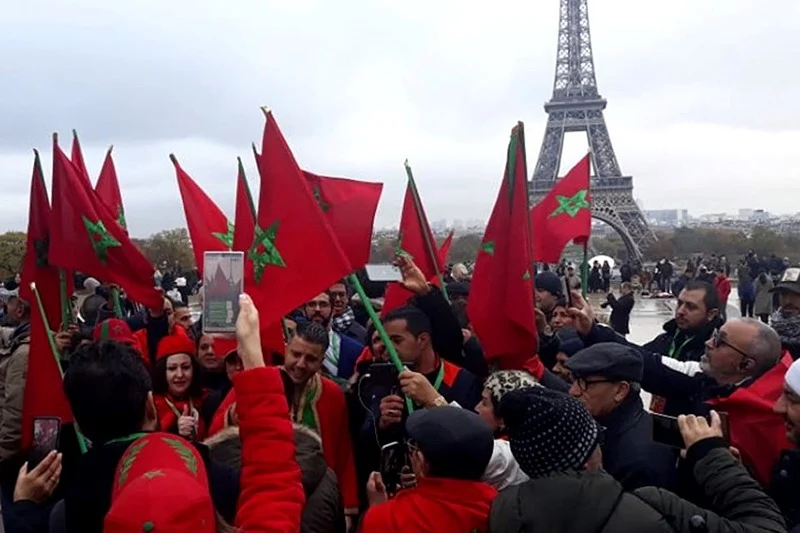
Marrakech – With Morocco’s legislative elections set for September 23, the question of diaspora voting rights is once again at the center of political debate. The Civil Democratic Council of Moroccan Migration has issued a sharp statement denouncing what it calls the continued exclusion of Moroccans residing abroad from the electoral process.
The Paris-based organization said the legal framework governing the upcoming vote, based on Organic Law No. 53.25 on the House of Representatives, “consecrates once again the exclusion of Moroccans residing abroad from their legitimate right to full political participation.”
It described the situation as “a manifest contradiction with the provisions of the Constitution,” which guarantees equal rights and duties to all Moroccan citizens.
The dispute is not new. Morocco’s 2011 Constitution recognizes the rights of citizenship of Moroccans abroad, including the right to vote and be elected under Article 17. Article 18 commits public authorities to ensuring broad diaspora participation in advisory bodies and governance institutions.
Yet in reality, Moroccans abroad can only vote by proxy or by traveling back to Morocco, as no constituencies or polling stations exist in foreign countries.
The ink promises inclusion; the practice has yet to follow
Morocco briefly experimented with diaspora parliamentary representation between 1984 and 1993, but the issue disappeared from the political agenda until 2005, when King Mohammed VI outlined a new migration strategy positioning Moroccans abroad as a strategic national asset.
The Council’s statement accused the government of “institutionalizing the political marginalization of millions of citizens abroad.” It called the exclusion “a denial of constitutional rights and a manifest contempt for repeated royal directives that clearly called for guaranteeing Moroccans of the world the full exercise of their citizenship.”
The group warned that sidelining over 15% of the Moroccan population from legislative representation carries serious consequences. Among them: “the feeling of incomplete citizenship,” “the erosion of trust in institutions,” and “the deprivation of competencies and expertise acquired abroad in administration, governance, and democracy.”
It also pointed to a weakening sense of national belonging among younger generations and negative effects on territorial development.
The debate around diaspora voting has intensified in recent months. Several political parties, including the PPS and the PJD, have called for direct voting from countries of residence and dedicated parliamentary seats for expatriates. The PJD’s position represents a notable reversal from 2021, when it opposed direct participation.
Interior Minister Abdelouafi Laftit, responding to a written question from UNMT-affiliated councilor Khalid Setti in June 2025, maintained that the national electoral system already guarantees Moroccans abroad the right to register on general electoral lists, vote, and run in all elections held on national territory – just like any citizen residing in Morocco.
He noted that the legislature had broadened registration options to account for the diaspora’s specific circumstances. In practice, however, Moroccans abroad can only vote directly at polling stations inside Morocco or through a proxy established from their country of residence. They may also run in local and legislative races, but only in constituencies within Morocco.
Laftit pointed to financial incentives introduced during the 2021 elections, when each party was required to place a female candidate residing abroad at the top of at least one regional list or forfeit public funding. He added that similar mechanisms exist to encourage parties to include diaspora candidates on their local lists.
Still, the minister stressed that these goals can only be met through the active engagement of political parties, which he described as bearing the primary responsibility for placing diaspora candidates in electable positions.
Valued for their wallets, ignored at the ballot box
The Council also took aim at Industry and Trade Minister Ryad Mezzour over remarks he made during a Ramadan iftar hosted by the association of graduates of Morocco’s grandes écoles. Speaking on camera, Mezzour told Moroccans living abroad that their return home deserved no special recognition.
“When someone comes back to work in their country, it doesn’t mean they’re giving me a gift… this is natural,” he said, before adding in colloquial Moroccan Arabic: “Bza’at” – roughly meaning “who cares?” The comments drew swift backlash from diaspora communities across Europe and North America.
The Council described them as “irresponsible” and “contrary to the moral values and traditions of mutual respect” in Moroccan society, particularly given that Moroccans abroad sent a record MAD 122 billion ($13 billion) in remittances in 2025 alone – over 8% of GDP and the second-largest such inflow in the Middle East and North Africa after Egypt.
Mezzour later walked back the controversy. He denied that his remarks were directed at Moroccans living abroad, clarifying that they were a response to a specific individual at the event who, in Mezzour’s own description, was “acting superior toward his own country.”
The minister framed the exchange as a reaction to one person’s attitude, not a broadside against the diaspora at large.
In its closing demands, the organization called for full respect of constitutional provisions on equality, effective parliamentary representation for Moroccans abroad, and a national debate on restructuring the Council of the Moroccan Community Abroad (CCME).
It noted that King Mohammed VI had called for accelerating the CCME’s restructuring, yet “the current team continues to manage its budget without real oversight or accountability.”
Morocco is home to an estimated five million expatriates, mainly concentrated in Europe. Remittances remain the country’s second-largest source of hard currency after tourism. The disconnect between the diaspora’s economic weight and its political exclusion remains one of Morocco’s most persistent democratic contradictions.
