


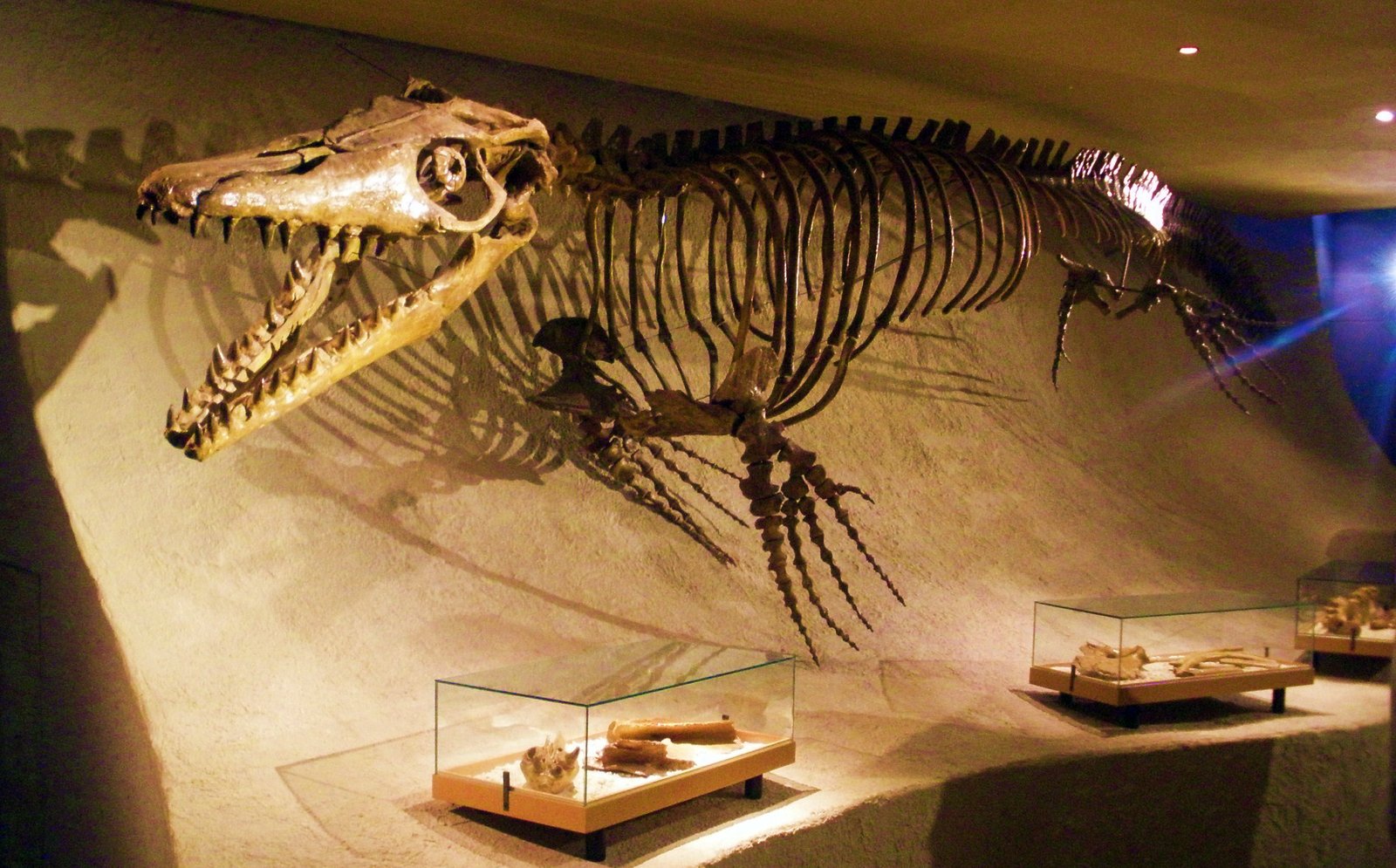
Marrakech – A team of paleontologists has identified a new giant species of mosasaur from Morocco’s phosphate deposits. The species, named Pluridens imelaki, lived roughly 66 to 67 million years ago during the Maastrichtian, the final stage of the Cretaceous period before the mass extinction that wiped out the dinosaurs.
The discovery was published last week in the journal Diversity by Nicholas Longrich of the University of Bath in the UK and Nour-Eddine Jalil from the National Museum of Natural History in Paris and the Natural History Museum of Marrakech at Cadi Ayyad University.
The fossil consists of a 1.25-meter-long skull and associated lower jaws found at the Sidi Chennane site in Morocco’s Khouribga Province.
Based on the skull size, the researchers estimate the animal reached more than 9 meters in total body length. That makes it comparable in size to some of the largest predatory mosasaurs known from the region, such as Thalassotitan.
Pluridens imelaki belonged to the Halisaurinae, a subfamily of mosasaurs generally considered smaller than other groups. Earlier members of this subfamily ranged from about 4 to 5 meters in species like Halisaurus to roughly 7.5 meters in the related Pluridens serpentis, also found in Morocco. The new species significantly exceeds both.
Despite its large size, the animal had remarkably long and slender jaws. This implies a relatively weak bite force and suggests it fed on small, soft-bodied prey. Its teeth were also relatively small for an animal of its size. The anterior teeth were recurved and claw-shaped, while the posterior teeth had short, wide crowns that hooked strongly backward near their base.
The researchers identified several features that distinguish Pluridens imelaki from the closely related Pluridens serpentis.
These include a more pointed snout, a unique T-shaped connection between the premaxilla and maxilla bones, straighter and more slender jaws, and differences in tooth shape and eye size. The new species also had fewer neurovascular openings on the snout, which are linked to sensory function.
“Differences between P. imelaki and P. serpentis in the jaw and tooth structure, eye size, and innervation of the rostrum, as well as overall size, suggest they had different foraging strategies and occupied distinct ecological niches,” the study stated.
The phosphate beds where the fossil was found were laid down in a shallow marine embayment along the eastern margin of the Atlantic between the Late Maastrichtian and the Early Eocene.
The area functioned as a marine upwelling zone, supporting a rich food chain. It was during this period that mosasaurs, a specialized group of large marine lizards, became the dominant marine predators.
“The Late Cretaceous witnessed a major radiation of the Mosasauridae, which became the dominant marine predators during the final 25 million years of the period,” Longrich and Jalil said.
Morocco’s Late Maastrichtian phosphate beds have produced what is considered the most diverse mosasaurid assemblage known to science, and possibly the most diverse marine reptile fauna in the world.
More than 16 mosasaur species have now been reported from these beds. All four major mosasaurid subfamilies are represented there: Mosasaurinae, Plioplatecarpini, Tylosaurinae, and Halisaurinae.
What makes the find particularly notable is the species’ apparent rarity. Only a single specimen has been recovered despite decades of intensive fossil collection from the phosphates.
“Pluridens imelaki appears to have been exceptionally rare in the phosphates, being documented by only a single specimen among the many hundreds of mosasaur remains recovered over many years,” the researchers wrote.
“This underscores how the species richness of the phosphates and other diverse assemblages is driven by rare taxa that are only revealed through extensive sampling.”
The study also challenges previous assumptions about the Halisaurinae subfamily. Rather than being overshadowed by the dominant Mosasaurinae, the halisaurines appear to have undergone their own adaptive radiation in the Late Cretaceous.
“Pluridens imelaki reveals that Halisaurinae were not only more species-rich than previously recognized, but also exhibited greater diversity in tooth morphology, jaw shape, and body size than previously thought,” the authors concluded.
“Rather than simply being outcompeted by Mosasaurinae, the Halisaurinae staged a minor adaptive radiation in the Late Cretaceous and were important members of the ecosystem in low latitudes.”
The holotype specimen is housed at the Natural History Museum of Marrakech at Cadi Ayyad University.
Read also: 160-Million-Year-Old Dinosaur Teeth Reveal Morocco’s Oldest Turiasaurian Sauropods
