


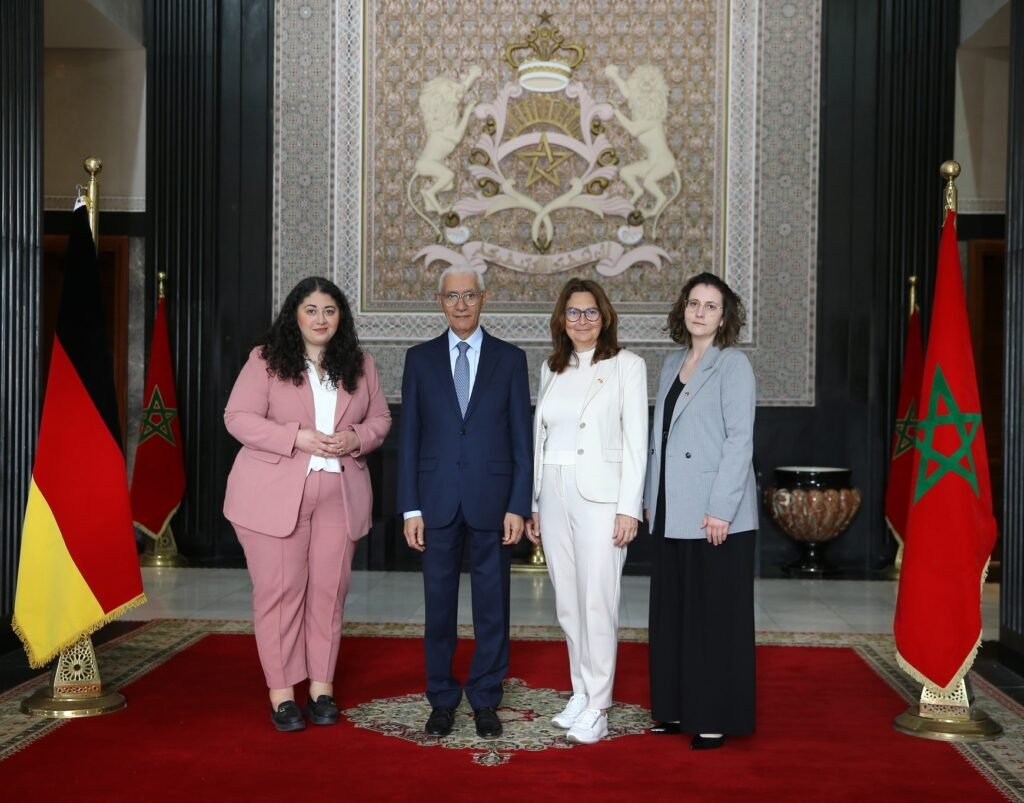
Marrakech – Speaker of Morocco’s House of Representatives Rachid Talbi Alami received a delegation from Germany’s Bundestag on Thursday in Rabat. The visit marks the 70th anniversary of diplomatic relations between the two countries.
During the meeting, Talbi Alami reviewed major reforms and development projects carried out by Morocco under King Mohammed VI. He also welcomed Germany’s support for Morocco’s territorial integrity and its autonomy plan for the Western Sahara, according to a statement from the lower house.
The speaker pointed to strong cooperation between the two legislative bodies. He cited exchanges of expertise, parliamentary working visits, and aligned positions across international parliamentary forums.
Both sides discussed a range of shared priorities. These included family affairs, women’s rights, youth empowerment, environmental policy, and renewable energy. Talbi Alami outlined Morocco’s progress in each of these areas.
German lawmaker Sanae Abdi, a member of the parliamentary friendship group for Maghreb relations and spokesperson for economic cooperation and development at the Bundestag, told reporters the visit aimed to deepen parliamentary cooperation. She specifically noted the economic and human development dimensions.
Abdi hailed the progress Morocco has achieved on multiple fronts and expressed Germany’s readiness to share experiences and expertise with the kingdom.
The German delegation included Mechthild Heil of the CDU/CSU, who chairs the Bundestag’s Committee on Human Rights and Humanitarian Aid. It also included Deborah Saskia Düring of Alliance 90/The Greens, the party’s foreign policy spokesperson, along with senior Bundestag administrative officials.
The same delegation also held a separate meeting at the House of Councillors, Morocco’s upper chamber. The Morocco-Germany parliamentary friendship group at the upper house hosted the session, also on Thursday in Rabat.
Abdellatif El Ansari, who heads the friendship group at the House of Councillors, described the visit as a reflection of a shared desire to elevate bilateral cooperation. He stressed the importance of accelerating joint projects, particularly in renewable energy and green hydrogen.
El Ansari also drew attention to the role of Morocco’s community in Germany in strengthening human and cultural exchanges between the two countries. He welcomed Germany’s support for the autonomy initiative under Moroccan sovereignty.
For her part, delegation head Mechthild Heil commended the level of development Morocco has achieved in recent years. She expressed Germany’s interest in expanding cooperation, particularly in energy, migration, and skilled labor recruitment. Heil noted that Morocco-Germany relations rest on solid foundations of mutual respect and trust.
The meeting at the upper house was attended on the German side by lawmakers Sanae Abdi and Deborah Düring. On the Moroccan side, several members of the House of Councillors were present, including Noureddine Soulik, Fatiha Khartal, and Mouhsine Zahra.
Berlin makes economic and diplomatic commitments on Western Sahara
The parliamentary exchanges came on the same day as a broader diplomatic push between the two countries. Foreign Minister Nasser Bourita and his German counterpart Johann Wadephul held the second session of the Morocco-Germany Multidimensional Strategic Dialogue in Rabat.
A joint declaration issued after the session carried language with real-world follow-through on the Western Sahara question. Germany reaffirmed the centrality of autonomy under Moroccan sovereignty and committed to acting in line with that position on both the diplomatic and economic fronts.
Berlin welcomed UN Security Council Resolution 2797, adopted on October 31, 2025, which stated that genuine autonomy under Moroccan sovereignty represents the most feasible outcome to the regional dispute.
The Western European country described Morocco’s autonomy plan as a serious and credible basis for negotiations toward a just, lasting, and mutually acceptable solution.
In the same declaration, Wadephul recognized Morocco’s reforms under King Mohammed VI and the country’s role in promoting regional and international stability.
He described Morocco as a key strategic partner for the European Union, NATO, and Germany in Africa. He also acknowledged the North African country’s efforts in counterterrorism and combating irregular migration.
Separately, Wadephul visited the Royal Mausoleum of Mohammed V in Rabat. He wrote in the guestbook a tribute to Morocco’s protection of Jews and European refugees during the Nazi era. At the time, Sultan Mohammed Ben Youssef refused to enforce anti-Jewish laws imposed by France’s pro-German Vichy government during World War II.