


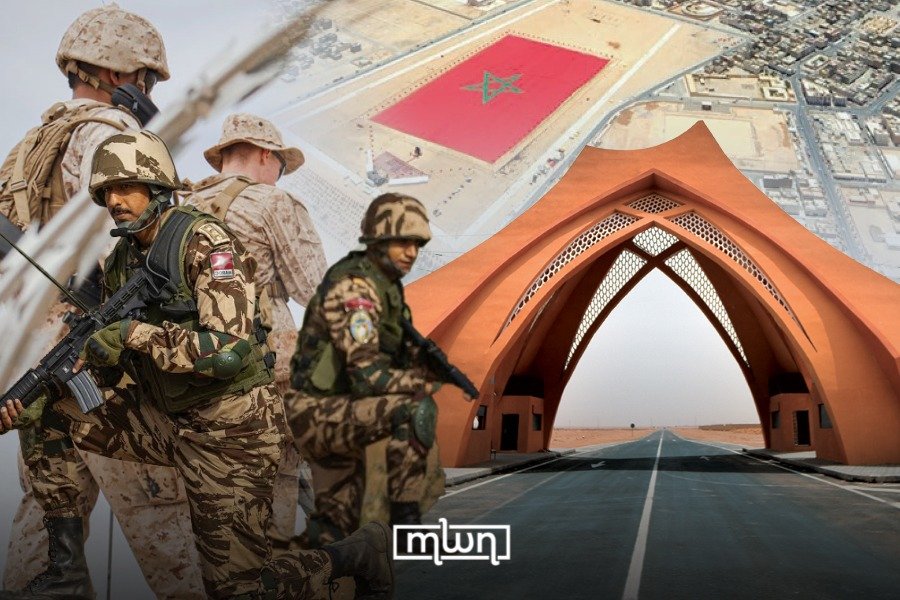
Rabat – A new report from defense-focused platform Defensa shed light on Morocco’s military posture, which combines territorial safeguarding with a broader regional security approach.
Defensa particularly emphasized the importance of the Bir Anzarane airbase in Morocco’s southern provinces as one of the country’s pillars to ensure a comprehensive security approach in the region.
It also cited a possible US interest in the site as Washington is reportedly seeking to strengthen its military presence in West Africa following the “decline of its influence in Sahel countries.”
Commenting on the military base, Defensa stated that the construction of the base began in 2021 and was completed by the end of 2023, making it officially ready for military operations.
“It serves as an advanced support point allowing Moroccan armed forces to expand the reach of their air operations. This will be achieved in particular through the operation of unmanned aerial vehicles (drones) and Apache attack helicopters,” the report added.
The country’s goal is to reinforce its security along the Mauritanian border and protect the sand berm, referencing Polisario’s hostility.
The report also indirectly cited Iran-Polisario collusion and its significant impact on the region’s stability.
Read Also: US Publicly Raises Concerns About Iran-Polisario Collusion
It notably reported an escalation after Polisario’s recent terrorist attacks targeting Morocco’s southern provinces, especially es-Smara.
Last year in June, “at least four Iranian-made rockets landed on the outskirts of Smara.”
The case dates back to when Polisario launched a practice attack near the region in a grave violation of Morocco’s sovereignty and international law.
The explosions occurred in an uninhabited area a few kilometers outside the city, close to a MINURSO camp. Images and videos shared online showed debris from the projectiles scattered in the area.
Defensa said that although the attack caused no casualties or material damage, it “marked a clear sign of the escalation” in the ongoing Western Sahara dispute.
Defensa also highlighted the importance of the Bir Anzarane base, which is part of Morocco’s approach to contributing to regional security.
The report notably revealed news of Morocco’s possible military system that would enable the country to carry out airstrikes against groups active in the Sahel region, in coordination with the US and France.
“Although these reports have not been officially confirmed by any authority and remain within the realm of possibility and study, the overall trend of strengthening military infrastructure in Morocco’s provinces largely aligns with the requirements of any future strategy to address regional threats,” the report concluded.
Morocco has long warned against the apparent lack of robust regional and global efforts to effectively tackle the increasingly worsening situation in the Sahel.
It has been consistently urging international efforts, warning that the Sahel has been a safe haven for terrorists.
In 2022, Habboub Cherkaoui, the head of the Central Bureau of Judicial Investigations (BCIJ) reiterated Morocco’s call to adopt a shared and sharp approach to tackle the deepening insecurity in the Sahel.
In an interview with EFE, Cherkaoui said that one of the terror organizations creating security concerns in the Sahel is ISIS, which he sees as “intensely active” in the region.
For Cherkaoui, ISIS’ presence in the region poses a threat not only to Africa but also to Arab and European countries.
“The focus that bothers and worries Morocco the most, currently, is the Sahel area, which has become a safe and fertile refuge for terrorist networks.”
Morocco has also been warning the international community about the lack of cooperation, including from Algeria.
Cherkaoui said Algerian authorities refuse to cooperate, although their country shares direct borders with Mali and Niger, two of the main hotspots in the Sahel’s decade-long confrontation with armed militias and terrorist groups.
Morocco is concerned about its proximity to the Polisario-run camps in Tindouf, a province in western Algeria.
He said data is confirming that local imams in the Polisario-controlled territory on Algerian soil have recruited young people and sent them to Al Qaeda in the Islamic Maghreb (AQIM).