


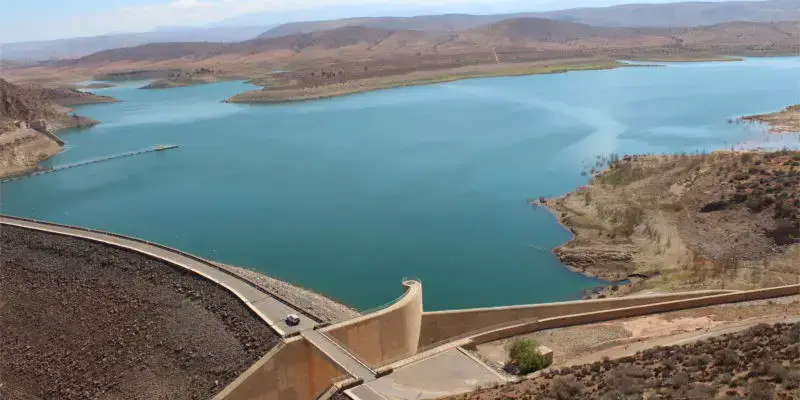
Rabat – Morocco enters mid-February 2026 with a far stronger water position than it held a year ago.
Official figures released show that, as of today, dams across Morocco contain 11.857 billion cubic meters of water.
At the same date last year, reserves stood at just 4.644 billion cubic meters. In twelve months, stored volumes have expanded by roughly 155%, a dramatic reversal after successive seasons marked by scarcity and uncertainty.
The national fill rate now reaches 70.7%, compared with only 27.5% one year earlier. Such a gap illustrates the scale of the turnaround.
Recent rainfall has reshaped the outlook, restored confidence in supply systems, and eased fears that had weighed heavily on households and farmers alike.
Loukkos approaches full capacity, while Bouregreg and Sebou both exceed 90%. Within the Sebou basin, the strategic Al Wahda Dam now holds more than 3.2 billion cubic meters, a volume that secures water for vast agricultural areas and major urban centers.
In the Rabat-Casablanca corridor, the Sidi Mohamed Ben Abdellah Dam stands close to 95%, a reassuring figure for one of the country’s most densely populated zones.
Other regions also report improvement. Tensift records a solid rise, and the Guir-Ziz-Rheris basin surpasses 60%. In the southeast, the Hassan Addakhil Dam reaches 78%, a welcome development in an area that has faced acute stress in recent years.
Yet the national picture remains uneven. The Oum Er-Rabia basin stays below the halfway mark at 46.3%, while Sous-Massa stands at 54.5%, with wide disparities between individual dams.
The Youssef Ben Tachfine Dam, for instance, does not reach 50% capacity. Draa-Oued Noun continues to face the greatest vulnerability, even if its situation shows improvement compared with last year.
Between February 17 and 18, the Al Massira Dam gained more than 21 million cubic meters. The Mohammed V Dam added over 5.5 million cubic meters, while the Sidi Mohamed Ben Abdellah Dam rose by more than 2.2 million cubic meters.
Such increases confirm that the hydrological year has unfolded under far more favorable conditions than the previous one.
This rebound strengthens drinking water security, supports irrigation, and reduces pressure on emergency measures adopted during the drought years. However, climate variability and regional gaps remind policymakers that abundance can prove temporary.
Morocco continues to invest in desalination plants and alternative water sources to shield the country from future shocks.
The middle of this month marked a turning point – as the reservoirs refill, confidence returns, and the specter of crisis recedes.