


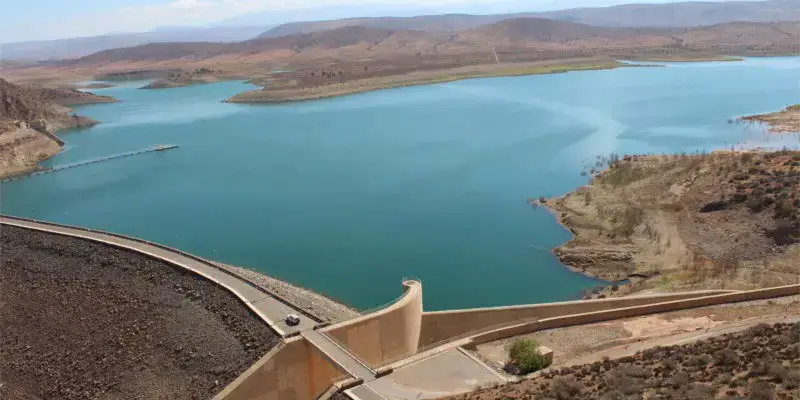
Rabat – Recent weeks of heavy rainfall across Morocco have lifted the country’s water reserves, offering relief to regions that rely heavily on dams for agriculture, drinking water, and energy production.
Official data from the Ministry of Equipment and Water’s “Ma Dialna” platform shows that the nation’s dams reached 70.6% of their total capacity by Wednesday.
The country now holds an estimated 12.2 billion cubic meters of water in its main reservoirs.
Some dams have seen particularly remarkable levels. In Taounate province, the Al Wahda Dam filled to 85%, and the Idriss I Dam reached 86%.
In Larache, the Dar Khrofa Dam reached full capacity, while Bin El Ouidane Dam in Azilal holds 77% of its total volume.
Smaller but significant improvements also appeared in other regions. The Al Massira Dam in Settat stands at 32% capacity, whereas the Charif Al Idrissi Dam in Tetouan reached 100%.
Authorities note that these increases reflect the tangible impact of recent water inflows, strengthening Morocco’s overall water security and providing crucial support to areas that depend on stable reservoir levels.
The rise in dam levels offers hope for farmers and communities, particularly in regions where water scarcity has historically challenged daily life and agricultural productivity.
Although the recent rainfall has bolstered Morocco’s water reserves, the heavy rains have also brought serious challenges. Several regions faced flooding that damaged homes and infrastructure, destroyed crops, and caused tragic deaths.
Farmers saw fields washed away, and local communities struggled to recover from the sudden impact.
The boost in dam levels is somewhat of a silver lining, but it comes alongside a reminder of the risks that extreme weather can pose to lives and livelihoods across the country.