


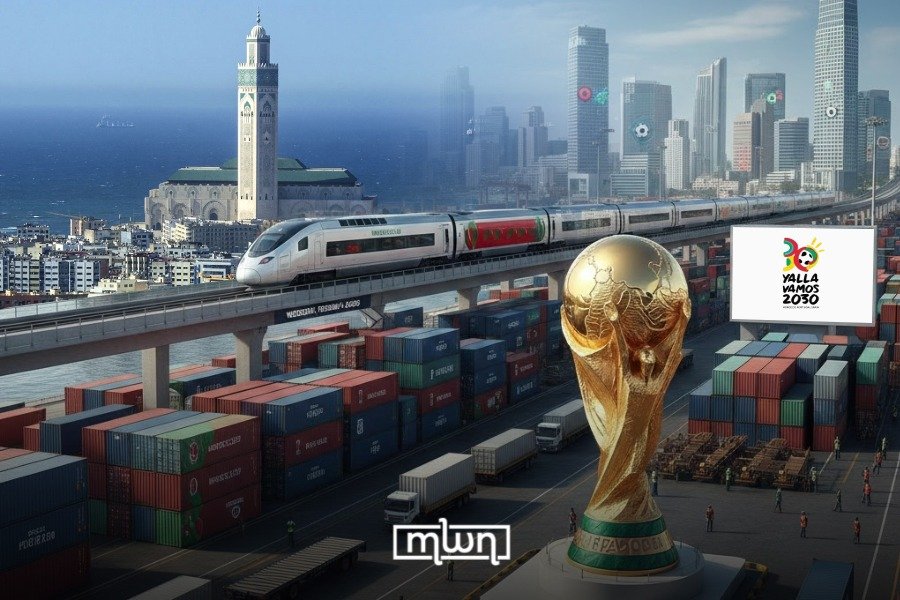
Mega sporting events reshape nations. When aligned with vision, infrastructure, and governance, they become powerful economic accelerators. Morocco’s role as a host of the FIFA 2030 World Cup represents precisely such a moment — not only for the country itself, but for Europe, the United States, the MENA region, and Africa at large.
Morocco is not hosting the World Cup as a symbolic celebration. It is leveraging the event as a strategic economic multiplier, accelerating long-term investments in infrastructure, logistics, energy, tourism, and human capital — sectors that deliver sustained global returns well beyond the final whistle.
The World Cup as an economic multiplier
Historically, World Cup host nations experience a surge in infrastructure development, international visibility, and foreign direct investment. Morocco’s case is particularly compelling because the foundations are already in place: political stability, strong institutions, and a clear national development strategy.
The World Cup is expected to fast-track transport, digital, and urban infrastructure, expand tourism, hospitality, and aviation capacity, as well as increase real estate and commercial asset values.
All of this will strengthen Morocco’s global brand as a safe, modern investment destination, and with that create jobs, skills, and long-term gains in productivity.
For global investors, this represents a pre-event investment window with outsized upside.
A new Atlantic port redefining trade with Africa
Among Morocco’s most transformative initiatives is the development of a new major Atlantic port, designed not only to serve Morocco, but to act as a free-trade gateway for African nations. By offering this port as a shared logistics and trade platform, Morocco is positioning itself as Africa’s most reliable maritime bridge to Europe, the Americas, and global markets.
This port will reduce trade costs for African exporters, enable regional value chains and industrial integration, all while strengthening South-South and North-South trade and anchoring Africa’s participation in global supply chains.
For Europe and the United States, investing in this infrastructure means secure access to emerging African markets through a stable, trusted partner.
Why Morocco is the smart bet
Morocco offers what global capital increasingly seeks: predictability, proximity, and purpose. The country combines competitive costs with access to European markets, strong public-private partnerships, and a growing, skilled workforce.
Key sectors benefiting from World Cup-driven momentum include:
- Transport and logistics
- Renewable energy and green hydrogen
- Smart cities and construction
- Tourism, sports economy, and services
- Manufacturing, automotive, and aerospace
This is not speculative growth — it is planned, phased, and policy-backed.
Leadership that inspires confidence
At the center of Morocco’s trajectory stands King Mohammed VI, the nation’s visionary leader whose reign has consistently balanced economic modernisation with social compassion. His long-term commitment to infrastructure, African partnership, climate resilience, and human development has earned Morocco international credibility and investor trust.
Under his leadership, Morocco has demonstrated that development is not measured only in GDP, but in dignity, inclusion, and opportunity — values increasingly important to global investors and institutions.
A global opportunity, not a local event
The World Cup in Morocco is not just a sporting event — it is a signal. A signal that Morocco is ready to host the world, connect continents, and lead Africa’s next growth chapter.
Governments, development banks, and private investors who align with Morocco now will benefit not only from World Cup-driven returns, but from participation in one of the most strategically positioned growth stories of the 21st century.
Morocco is building for the future — and inviting the world to invest in it.
An international call
Supporting Morocco is not simply about bilateral relations — it is about building a stable MENA region, empowering Africa, and shaping a sustainable global future. Governments, development banks, and private investors who align with Morocco today are investing in long-term peace, prosperity, and shared growth.
As the 2030 World Cup nears, opportunities for regional collaboration are on the rise, and with Morocco at the helm, the path is clear.