


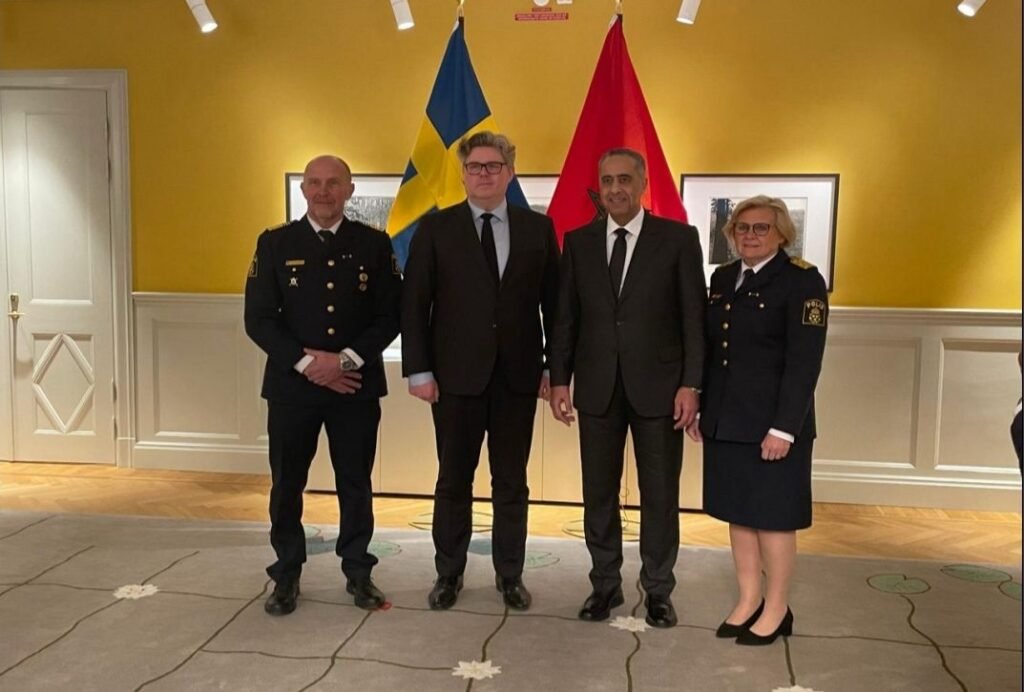
Rabat – After Sweden recently expressed a desire to boost security cooperation and coordination with Morocco, Abdellatif Hammouchi, the General Director of National Security and Territorial Surveillance (DGSN-DGST), traveled to the European country this week with a security delegation to Sweden.
Hammouchi held talks with Swedish officials, including Sweden’s Minister of Justice Gunnar Strommer and Lena Petra Lund, the National Police Commissioner, as well as Stefan Hector, the Deputy National Police Commissioner.
Discussions focused on efforts seeking to tackle shared challenges, covering emerging security threats and risks both at the regional and international levels.
As part of their commitment, Morocco and Sweden signed a Memorandum of Understanding on security cooperation between DGSN-DGST and the Swedish National police.
The agreement aims to establish a contractual framework to boost the exchange of expertise, experience, and best practices in policing.
It also seeks to reinforce bilateral cooperation in security training methods and the mechanisms for responding to information requests related to cooperation issues.
The MoU further facilitates the procedure for exchanging and sharing information between security services in both countries, including terrorism, extremism, organized crime, illicit drug and psychotropic substance trafficking, in addition to financial cybercrimes, irregular migration, and human trafficking.
During the meeting, Sweden appealed for integrating Morocco’s security services into the European Network for Fugitive Search, citing the country’s role in arresting internationally wanted individuals in transnational organized crime cases.
Sweden also stressed the importance of Morocco’s security model and expanding police cooperation with Morocco.
Read also: Morocco, Sweden Vow to Boost Judicial Cooperation with New Declaration of Intent
In addition, the visit also included a discussion between Hammouchi and officials from Sweden’s intelligence services, with talks exploring security challenges stemming from the activities of terror groups, especially in the Sahel-Sahara region, the Middle East, and Europe.
The visit is part of Morocco’s commitment to cooperation with international partners that frequently stress Rabat’s role and strategic participation in combating transnational crimes.
In November last year, Hammouchi renewed Morocco’s commitment at the 93rd General Assembly of the International Criminal Police Organization (INTERPOL).
Morocco hosted the general assembly of the Interpol in Marrakech, convening more than 800 delegates from 179 countries, including 82 police chiefs.
“Morocco’s commitment to hosting the 93rd session of Inteprol stems from its firm dedication to strengthening multilateral security cooperation and its active engagement in consolidating the international coalition against the threats posed by transnational organized crime,” Hammouchi said.
Cooperation between Sweden and Morocco has intensified in recent months, especially in the fight against criminals based abroad.
In 2023, a Swedish police liaison officer was stationed in Rabat in addition to the exchange of visits among Swedish and Moroccan officials.
Last year, Morocco arrested three individuals as part of cooperation between the two countries, while three more individuals were detained after a Swedish delegation visited Rabat.
Hector commented on cooperation between the two countries, stressing that cross-border collaboration “gives us a strategic advantage.”
The fact that we are seeking key figures being arrested abroad is direct proof that this joint effort is paying off,” he added.
The security official also described Morocco as a crucial partner in the fight against organized crime.