


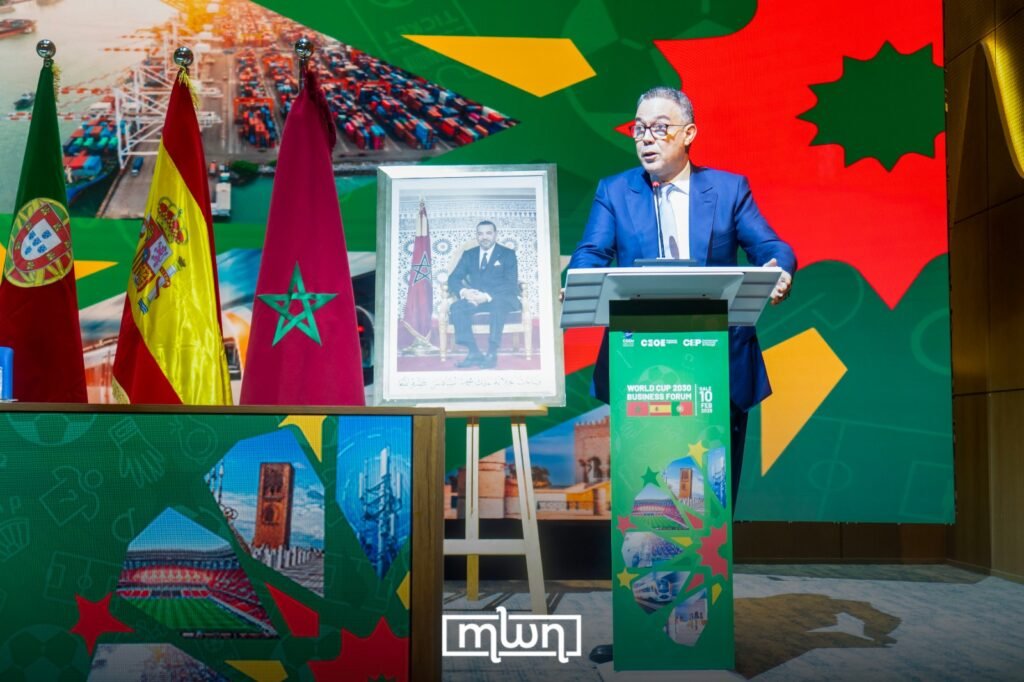
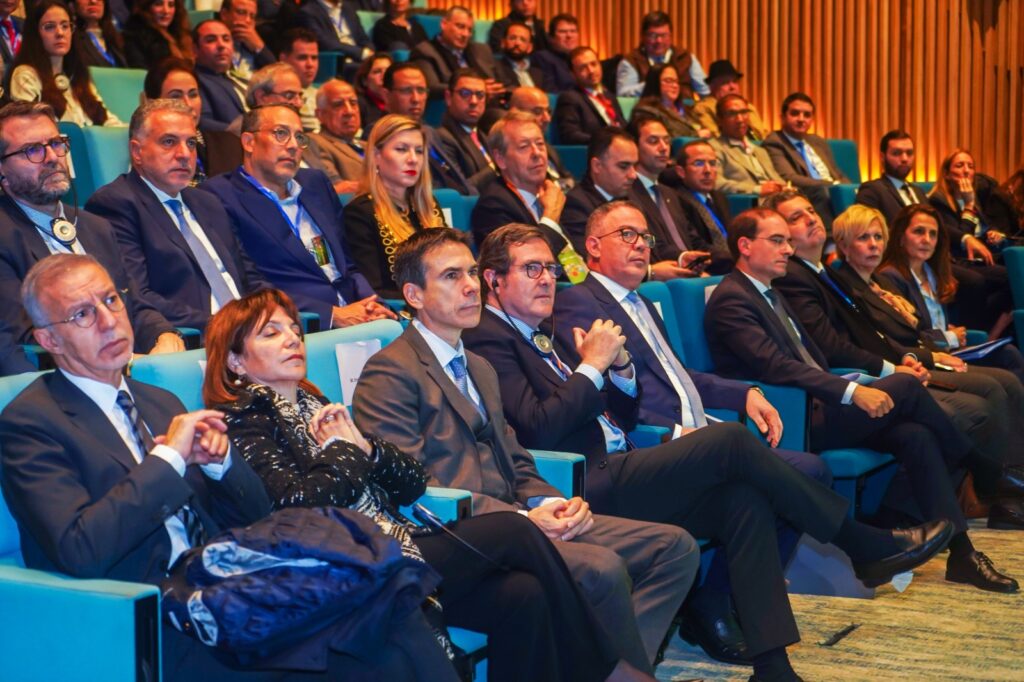
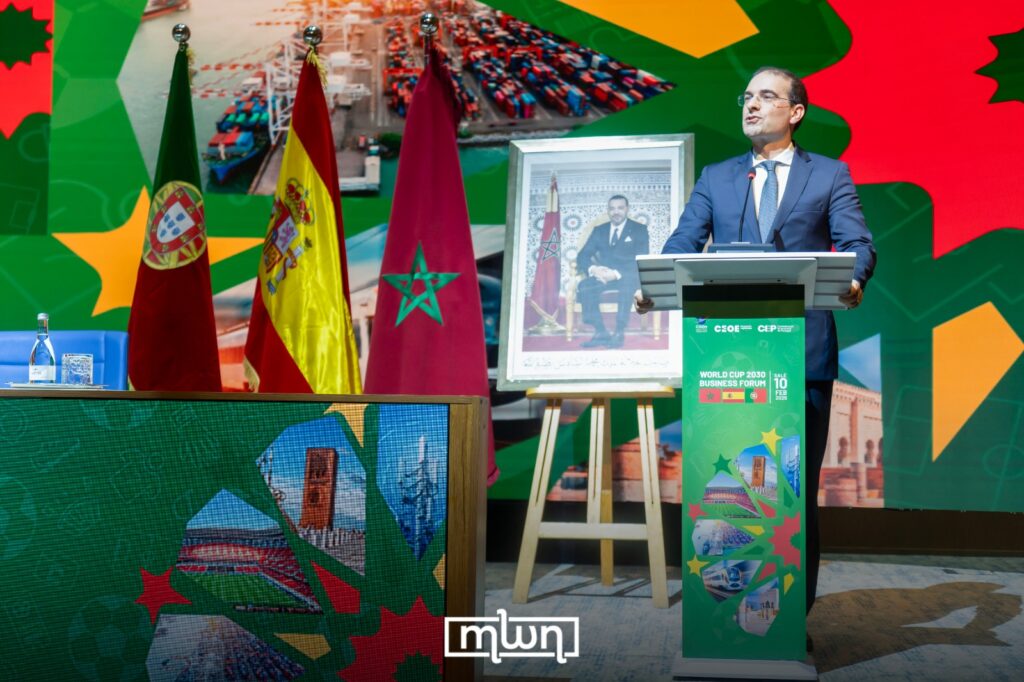
Rabat – Business leaders, policymakers, and institutional figures from Morocco, Spain, and Portugal met today at the Mohammed VI Complex in Salé for the Morocco-Spain-Portugal Business Forum dedicated to the 2030 World Cup.
The meeting took place under the joint coordination of the General Confederation of Moroccan Enterprises (CGEM), the Spanish Confederation of Business Organizations (CEOE), and the Portuguese Business Confederation (CIP).
The forum served as a space where economic ambition, political alignment, and cultural proximity converged around a shared global project. Participants examined how the co-hosted World Cup could act as a long-term economic driver rather than a short-lived sporting event.

World Cup as a diplomatic and cultural catalyst
For Nuno Gabriel Cabral, counsellor at the Portuguese Embassy, the 2030 World Cup represents far more than a competition calendar.
“Every time we spoke about the World Cup, there was a spontaneous and very positive reaction, full of enthusiasm,” Cabral told Morocco World News (MWN) on the sidelines of the event.
“I felt this among our Moroccan friends and also among the Portuguese, but perhaps even more strongly among Moroccans.”
Cabral described the tournament as a rare moment that naturally created proximity between institutions, businesses, and societies.
“There was an enormous potential that we identified as companies and as public, political, and cultural institutions,” he said. “It was an extraordinary pretext to bring people together.”
He noted that Morocco had already demonstrated its ability to transform major events into broader momentum. “Morocco gave an impulse not only on the sporting level, but also on the economic, political, and cultural levels,” Cabral said. “This inevitably had a positive impact on bilateral relations.”
Concrete sectors, shared expertise
From the perspective of Moroccan industry, Mohamed Mahboub, President of the National Federation of Building and Public Works, described the forum as a practical checkpoint in the road to 2030.
“This forum allowed a clearer view of the state of preparation for the World Cup in the three countries and of the possibilities for collaboration between their companies,” Mahboub said in remarks to MWN.
According to Mahboub, cooperation extended far beyond construction alone. “Each country brought its own experience across many sectors,” he said. “I spoke about infrastructure, but there were also opportunities in energy, tourism, security, and telecommunications.”
Mahboub stressed that these exchanges created mutual benefit rather than competition. “These partnerships allowed companies from the three countries to benefit by applying their respective expertise,” he said.
Toward a shared vision for 2030
For participants, the forum also sent a clear signal of political will. Mahboub described a collective determination to deliver a tournament that set a new standard.
“This confirmed a shared desire for cooperation between the companies of the three countries,” he said. “The objective was clear: to ensure that the 2030 World Cup succeeded and became the best organized edition to date.”
As Morocco prepares to co-host the tournament alongside Spain and Portugal, the discussions in Salé reflected a broader vision that placed the World Cup within a durable framework of economic partnership, regional coordination, and long-term investment.