


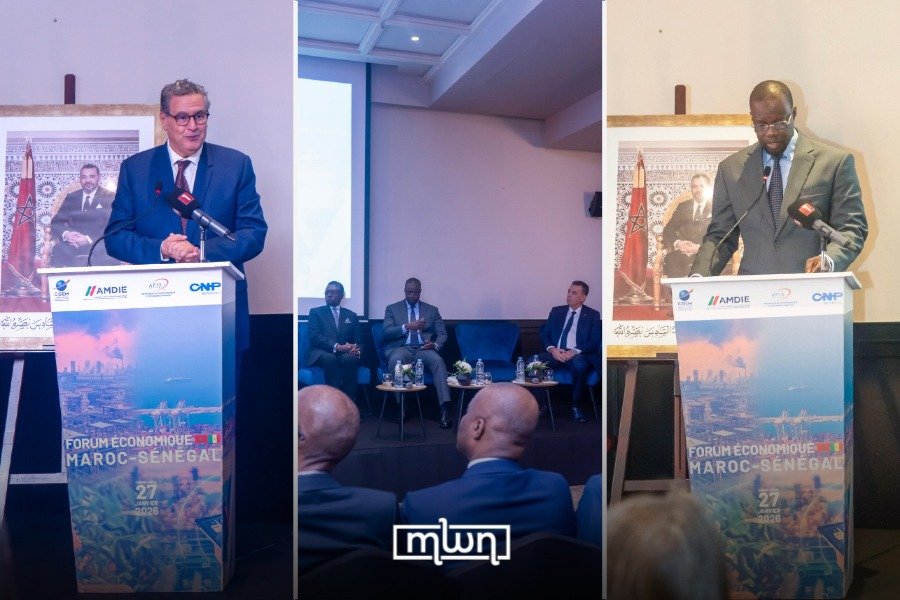
Mohammedia – Government officials and business leaders from Morocco and Senegal met in Casablanca today for the Morocco-Senegal Economic Forum, signaling the depth and solidity of the long-standing ties between the two countries despite the heated aftermath of the just AFCON final.
Organized by the General Confederation of Moroccan Enterprises (CGEM), the forum notably included meetings between the two countries’ High Joint Commission for Cooperation.
It brought together Morocco’s Head of Government, Aziz Akhannouch, and Senegal’s Prime Minister, Ousmane Sonko, senior ministers, investment agencies, and private sector representatives. Discussions focused on bilateral trade, investment cooperation, and project opportunities linked to Senegal’s long-term development plans.
CGEM President Chakib Alj said the participation of the two prime ministers provided a clear political framework for business cooperation.
“For us, as business leaders, this is a clear message: political support is there, and it is essential to stimulate new economic partnerships and encourage investment and co-investment,” he said.
Alj said economic ties had expanded in recent years, with Moroccan exports to Senegal exceeding MAD 4 billion in 2024 and imports from Senegal nearing MAD 600 million ($66 million), according to CGEM.
He also cited the presence of Moroccan companies in Senegal across sectors, including banking, insurance, cement, pharmaceuticals, agro-industry, fertilisers, and real estate.
The forum took place as Senegal seeks to attract foreign investment to support its Vision 2050 development strategy, after Morocco’s Head of Government, Aziz Akhannouch, and Senegalese Prime Minister Ousmane Sonko signed 17 cooperation agreements in Rabat.
Documents presented by Senegal’s investment promotion agency APIX outlined projects identified for the 2025–2029 period, including about $4.3 billion (MAD 40 billion) in fully private investments and roughly (MAD 47.4 billion) representing the private share of public–private partnership projects.
The pipeline covers sectors such as ports and logistics, energy, fertilisers, healthcare, agro-industry, housing, pharmaceuticals, and digital infrastructure.
Private sector and political alignment
Cooperation between Dakar and Rabat has reached an advanced stage, said Pierre Goudiaby Atepa, president of the Senegalese Investors’ Club. He described the agreements signed on Tuesday as the fruit of “almost a joint council of ministers” between Morocco and Senegal.
Senegal views Morocco as a model for economic development and sought to build on that experience to support its own growth, he argued.
Atepa invited Moroccan companies to invest in Senegal, citing tax incentives, planned special economic zones, and opportunities in sectors including banking, agriculture, gas, and logistics.
Senegal positions itself as a gateway to the rest of Africa and is open to partnerships involving Moroccan and international investors, he added.
Morocco’s ambassador to Senegal, Hassan Naciri, said the forum followed meetings of the bilateral joint commission and reflected the broader political relationship between the two countries.
“The meeting confirmed the human, spiritual, and emotional closeness between Moroccans and Senegalese,” he explained.
The diplomat said recent exchanges between senior officials, including between Akhannouch and Sonko and between the two countries’ foreign ministers, had reinforced what he described as a “unique and very special partnership.”
This growing economic cooperation is part of a long-term approach shaped by Morocco’s engagement with Africa, Naciri suggested, stressing: “We are continuing this work as intended by His Majesty the King more than 26 years ago.”
The forum also discussed energy cooperation. Alj referred to the Nigeria-Morocco Atlantic gas pipeline project, which is expected to pass through several West African countries, including Senegal.
The country has recently begun producing oil and gas, and Senegalese officials said in Casablanca that energy projects could support industrial development and regional integration.
Meanwhile, the forum’s organizers presented the high-profile gathering as designed to help businesses identify concrete projects and accelerate existing initiatives rather than announce new agreements.
Moroccan and Senegalese participants concluded the forum by pledging to continue discussions through follow-up meetings between companies and institutions from both countries.
Read also: Morocco Sets the Benchmark for Agriculture, Senegalese Minister Says
