


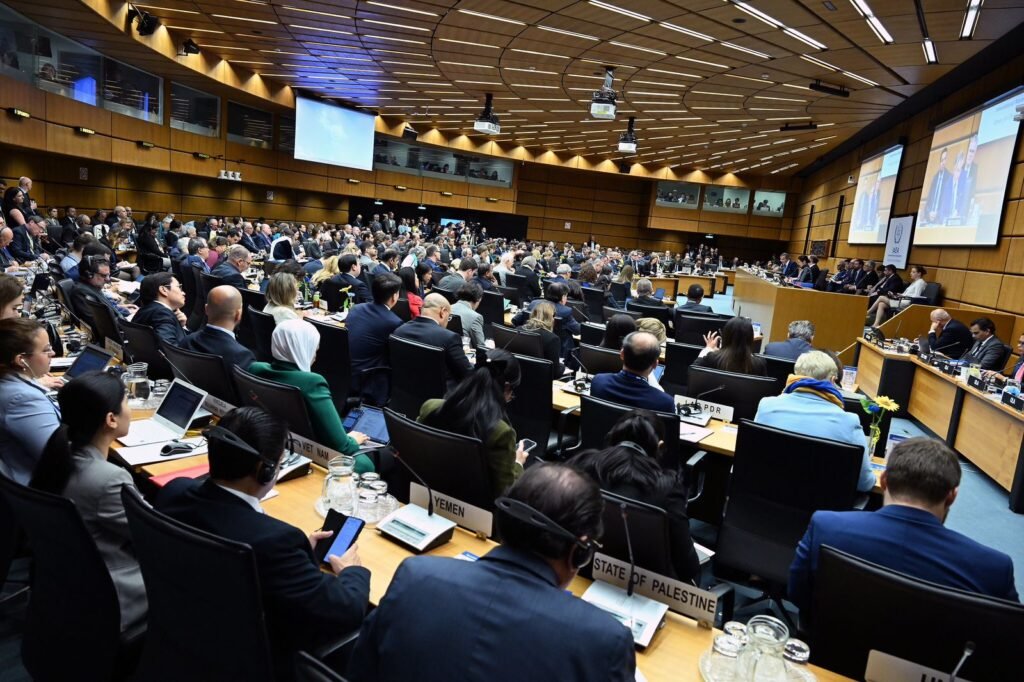
Agadir – Morocco is strengthening its role in supporting nuclear safety, security and the peaceful use of nuclear technology at the International Atomic Energy Agency’s (IAEA) Board of Governors, which is running from March 2 to 6, 2026 in Vienna.
In September 2025, Morocco was elected Vice‑President of the IAEA Board of Governors for the 2025–2026 term, with Ambassador Azzeddine Farhane representing the county in the role. Farhane continues her position representing Morocco in Vienna.
The candidacy, presented on behalf of the Group of 77 and China (Vienna Chapter), received unanimous support from all 134 member states of that group, reflecting broad international confidence in Morocco’s diplomatic engagement.
Serving as Vice‑President of the Board places Morocco in a central position within one of the IAEA’s two principal decision‑making bodies. The Board of Governors is responsible for setting key policies, reviewing agency budgets and programs, authorizing safety standards, and making recommendations to the annual IAEA General Conference.
Morocco’s leadership role this term therefore enhances its capacity to shape discussions on nuclear safety, peaceful applications of nuclear science, and international cooperation.
IAEA and Morocco longstanding partnership
IAEA has always viewed Morocco as a strategic partner in many areas, especially in nuclear science for sustainable development across Africa.
In 2024, The International Atomic Energy Agency (IAEA) and Morocco’s National Centre for Nuclear Energy, Science, and Technology (CNESTEN) signed a renewed agreement to implement two major work plans focusing on water resources, environmental protection, and industrial applications. The agreement is still valid until 2029.
The first work plan aimed to expand the routine use of isotope hydrology tools nationally and regionally, developing agreements with institutes and engaging international networks such as the Global Network of Isotopes in Precipitation (GNIP) and Global Water Analysis Laboratory (GloWAL).
Through this partnership, CNESTEN provided training in analytical methods and geochemical and isotope tools. It also offered analytical services in hydrochemistry and environmental isotopes for IAEA technical cooperation projects in Africa and the Middle East.
The second work plan focused on supporting countries in deploying peaceful nuclear and isotopic applications in industrial settings, including non-destructive testing, radiotracers, and sealed-source applications.
Overall, this initiative aims to enhance global capabilities for cleaner, safer industrial practices and improved process management.
CNESTEN is operating under Morocco’s Ministry of Energy Transition and Sustainable Development. It is recognized as a Regional Center of Excellence by the AFRA agreement.
The center also serves as a training and certification center in non-destructive testing under the Moroccan Confederation of Non-Destructive Testing.