


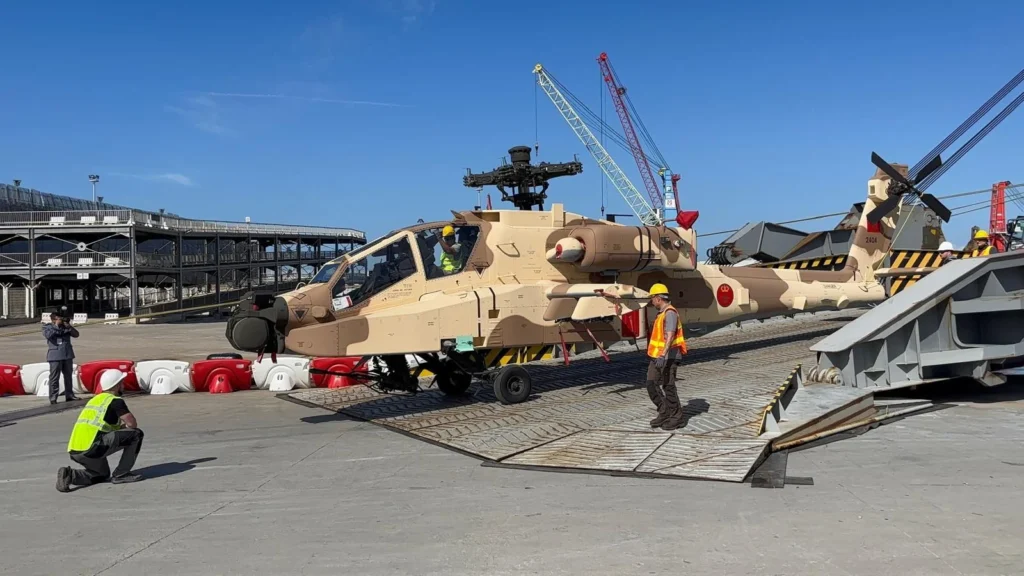
Marrakech – Morocco has become the largest arms importer in Africa, according to new data released today by the Stockholm International Peace Research Institute (SIPRI). The country increased its arms imports by 12% between the 2016-20 and 2021-25 periods, ranking 28th globally with a 1% share of total global arms imports.
The United States supplied 60% of Morocco’s arms imports during 2021-25. Israel was the second largest supplier at 24%, followed by France at 10%. As of the end of 2025, Morocco had pending arms imports from several states, including Spain and the United States.
Long the continent’s dominant arms buyer, Algeria saw its imports collapse by 78% over the same period. The country dropped to 33rd globally with a 0.9% share of global imports. Russia remained Algeria’s top supplier at 39%, followed by China at 27% and Germany at 18%. Algeria’s imports had reached a peak during 2016-20 before the sharp decline.
SIPRI noted that the long-running tensions between Morocco and Algeria remain a major driver of both countries’ arms imports. However, the institute cautioned that Algeria is often secretive about its arms deals. Several unverified reports about arms agreements with Russia during 2021-25 suggest SIPRI’s estimates for Algeria may be on the low side.
Washington was the clear winner of this global reshuffling
Across the African continent, arms imports fell by 41% between the two periods. The main suppliers to the region were the United States at 19%, China at 17%, Russia at 15%, and France at 8.3%.
Sub-Saharan Africa bucked the continental trend, increasing imports by 13% and accounting for 2.2% of total global imports. Nigeria was the largest recipient in sub-Saharan Africa at 16% of subregional imports, followed by Senegal at 8.8% and Mali at 8%. China was the top supplier to sub-Saharan Africa at 22%, followed by Russia at 12% and Türkiye at 11%.
Worldwide, the volume of major arms transferred between states rose by 9.2% between 2016-20 and 2021-25. This was the biggest increase since 2011-15, driven overwhelmingly by surging European demand.
European states more than tripled their arms imports, with the region’s imports jumping 210%. Europe received 33% of all global arms imports, making it the largest recipient region for the first time since the 1960s.
Ukraine alone accounted for 9.7% of all global imports, becoming the world’s top arms recipient. At least 36 states have supplied major arms to Ukraine since Russia’s full-scale invasion in 2022. Poland’s imports surged by 852%, with South Korea supplying 47% and the United States 44%.
The 29 current European NATO member states saw their combined arms imports grow by 143%. The United States supplied 58% of those imports, followed by South Korea at 8.6%, Israel at 7.7%, and France at 7.4%.
The United States further cemented its dominance as the world’s top arms supplier, accounting for 42% of all exports, up from 36% in 2016-20. US arms exports rose 27%, reaching 99 recipient states.
Europe overtook the Middle East as the primary destination for US arms for the first time in two decades, receiving 38% of US exports. Saudi Arabia remained the single largest recipient of US arms at 12%.
France ranked second globally at 9.8%, with exports rising 21%. India received 24% of French arms, followed by Egypt at 11% and Greece at 10%. France’s arms exports within Europe rose more than fivefold.
Russia was the only top-10 supplier whose exports declined, falling 64%. Its global share shrank from 21% to 6.8%. Nearly three-quarters of its remaining exports went to just three states: India at 48%, China at 13%, and Belarus at 13%.
Germany overtook China to become the fourth largest exporter at 5.7%. Almost a quarter of German exports went to Ukraine as aid. Italy saw the sharpest rise among top exporters, with exports surging 157%, pushing it from 10th to 6th place. Over half of Italy’s exports went to the Middle East.
The data pointed to a clear global pattern
Israel ranked as the world’s seventh largest arms exporter with a 4.4% global share, overtaking the United Kingdom for the first time. Its exports grew 56% despite its military operations in Gaza and strikes against targets in Iran, Lebanon, Qatar, Syria, and Yemen. The Israeli arms industry focuses on air defence systems for which there is high global demand.
Asia and Oceania received 31% of global imports despite a 20% drop in volume. India remained the world’s second-largest importer at 8.2%. Russia’s share of Indian imports dropped from 70% in 2011-15 to 40% in 2021-25 as India shifted toward Western suppliers.
Pakistan rose to become the fifth-largest recipient globally, with imports growing by 66%. China supplied 80% of Pakistan’s imports. Japan’s imports rose 76% while China’s fell 72% as it expanded domestic production.
Middle East imports declined 13%. Saudi Arabia, Qatar, and Kuwait remained among the world’s top 10 recipients. The United States supplied more than half of the region’s imports at 54%. Israel continued receiving US and German arms throughout its Gaza offensive, including F-35 combat aircraft, guided bombs, and missiles.
The five largest arms recipients globally in 2021-25 were Ukraine, India, Saudi Arabia, Qatar, and Pakistan. The five largest suppliers were the United States, France, Russia, Germany, and China.
Together, these top five exporters accounted for 70% of all global arms transfers. States in North America and Western Europe combined accounted for 74% of all arms exports, up from 62% in 2016-20.
Read also: Report: Morocco’s ‘Smart Power’ Defense Strategy Outclasses Algeria’s Mass Military Spending