


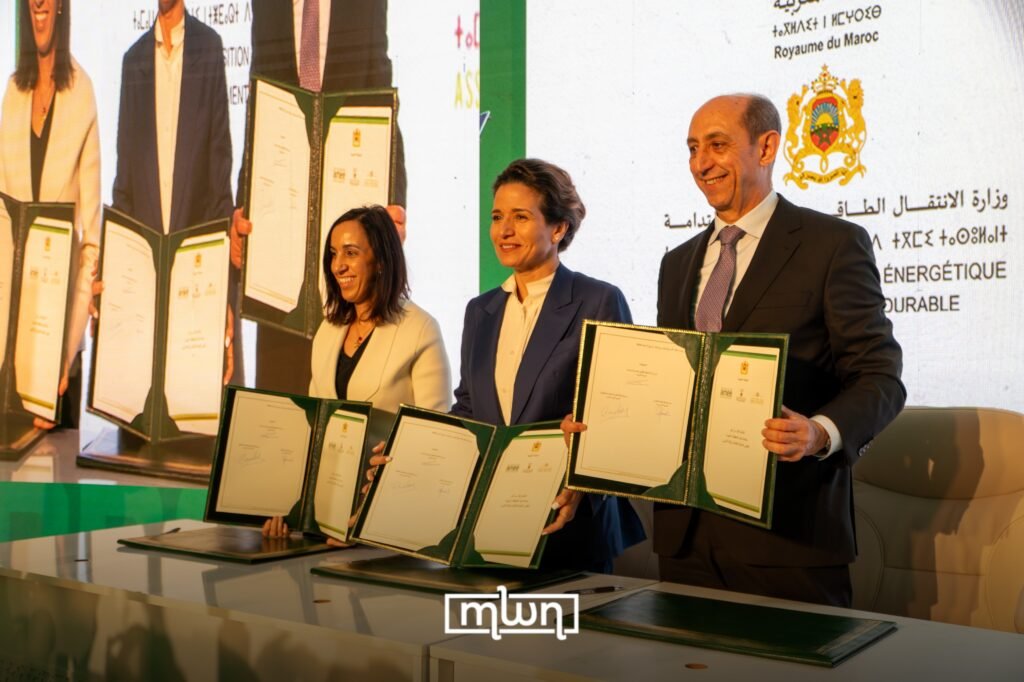
Casablanca – Morocco’s first National Energy Efficiency Day opened in Rabat on Wednesday with a strong focus on regional action, with officials presenting the country’s first Regional Energy Efficiency and Decarbonization Plans and signing a series of partnership agreements meant to turn them into local projects by 2030.
Organized by the Moroccan Agency for Energy Efficiency, AMEE, under the Ministry of Energy Transition and Sustainable Development, the event brought together regional council presidents, walis, ministerial departments, public institutions, local elected officials, and civil society actors.
The day’s program included the presentation of the regional plans, a signing ceremony, and two panels on how to connect the roadmaps to regional development programs, as well as questions of financing and governance.
The plans cover all regions of the kingdom and break down energy consumption by territory and by sector, including transport, buildings, public lighting, industry, and agriculture. Officials said the goal is to give each region a clear digital roadmap showing where energy is consumed, where savings are possible, and which projects should be prioritized through 2030.
According to the figures presented during the event, the regional plans could generate energy savings ranging between 10% and 20%, depending on the region, while cutting carbon dioxide emissions by around 15%. The total investment potential linked to the rollout of these projects was estimated at MAD 48 billion.
Benali calls for faster energy efficiency rollout amid global uncertainty
Speaking on the sidelines of the event, Minister of Energy Transition and Sustainable Development Leïla Benali said the forum comes at a time of geopolitical instability that requires a proactive mobilization of all actors involved in what she described as the second pillar of Morocco’s national energy strategy launched in 2009, namely energy efficiency.
She said current work is focused on deploying mechanisms across transport, buildings, and public administration, while building on measures first developed during the energy disruptions of 2022 and 2023.
Those earlier efforts, she said, helped “change the laws and the mechanisms that will allow us to provide rewards and incentives for citizens and consumers, so that they can adopt a culture of energy efficiency.”
Benali said the objective now is to encourage consumers to actively reduce their own energy use in a way that protects purchasing power and lowers the national energy bill.
“The goal is for the citizen and the consumer to gain a form of sovereignty, becoming the one who actively works to preserve energy, protect purchasing power, and reduce the energy bill,” she said.
Read also: Sound Energy Secures $2.2 Million as Tendrara Gas Project Nears Production
The event saw the signing of agreements, including a framework partnership between the Association of Regions of Morocco, the Ministry of Energy Transition, and AMEE to integrate the regional energy efficiency plans into regional development programs.
Meanwhile, AMEE and the National Agency for Public Facilities, ANEP, signed an agreement to roll out the ASL label, Morocco’s first national benchmark for assessing and classifying public buildings based on sustainability and energy efficiency standards.
These deals are expected to support awareness campaigns, technical training, and the integration of the regional plans into broader regional development programs.
Officials said the next challenge will be moving from planning to execution, with local governments expected to lead implementation on the ground.
Morocco World News is also on X — check out our latest posts now! Get MWN on iOS and Android for instant access to breaking news.