


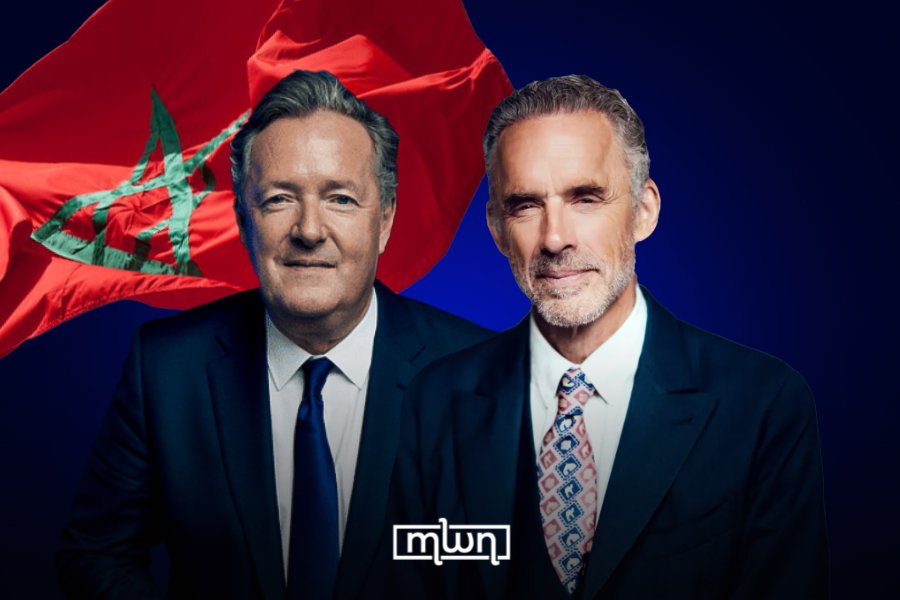
Marrakech – Canadian thinker Jordan Peterson has argued that much of the Muslim-majority world remains trapped in what he bluntly describes as “authoritarian hellholes,” estimating that around 40 of roughly 50 such states lack any meaningful democratic practice.
Speaking on a year-old episode of Piers Morgan Uncensored that has recently been widely reshared on social media, Peterson described the broader political landscape as marked by institutional stagnation, instability, and constrained political participation.
Within this regional context, Peterson pointed to Morocco as a notable exception, alongside Indonesia and Turkey. Crucially, Peterson’s assessment is far from the simplistic idea that a Western outsider’s praise automatically confers legitimacy.
Rather, his remarks were framed as an analytical reading of institutional trajectories, reform paths, and governance outcomes – grounded in comparative political observation rather than cultural endorsement or ideological alignment.
These cases demonstrate the Islamic world is not politically monolithic. Morocco’s experience, in particular, suggests that incremental reform, institutional continuity, and historical awareness can sustain a viable democratic trajectory even within complex regional environments.
🚨جوردان بيترسون لبيرس مورغان: المغرب استثناء ديمقراطي وسط 40 “جحيما استبداديا.
خلال استضافته في برنامج “Piers Morgan Uncensored”، قدم المفكر الكندي الشهير جوردان بيترسون قراءة سوداوية لواقع الأنظمة السياسية في العالم الإسلامي، مشيرا إلى أن 40 من أصل 50 دولة ذات أغلبية مسلمة تعد… pic.twitter.com/t9Kp1UJUZy
— Leɛyun 🇲🇦👑♥️🌹 (@5ersito_) February 1, 2026
Alone among all Arab countries, Morocco’s 2011 protests led to a peaceful, democratic election of an Islamist party to head the government – a “rare success story” of the Arab Spring. This outcome was unique in the Middle East and North Africa, where other nations experienced either violent upheavals or crackdowns.
Indeed, Morocco’s very exceptionalism, in a region marked by violent instability or severe repression, makes it a special case worthy of significant attention. In contrast to many Islamic countries that struggle with a persistent democracy deficit, Morocco has embraced pluralistic politics and gradual reform, carving out a path that leaves little doubt about its democratic credentials.
A cornerstone of Rabat’s democratic trajectory was the enactment of bold constitutional reforms that redistributed power and strengthened elected institutions. Responding to popular demands in 2011, King Mohammed VI introduced a new constitution that imposed real limits on his previously unchecked powers and devolved many authorities to an elected prime minister and parliament.
Notably, the king is now obliged to appoint as prime minister the leader of the party that wins the most seats in parliamentary elections. These changes ensured the holding of regular multiparty elections for Parliament, with the 2011 reforms shifting some authority over government from the monarchy to the elected legislature.
The November 2011 elections, deemed free and fair, ushered in a coalition led for the first time by a formerly opposition Islamist party, the Justice and Development Party (PJD).
This peaceful rotation of power through the ballot box – including the PJD’s later replacement by other parties – indicates that genuine electoral competition and government changeover are now institutionalized norms in Moroccan politics. Such pluralistic politics, enshrined in law and practice, starkly differentiates Morocco from neighboring regimes where rulers cling to power without meaningful elections.
Social reforms, rights, and inclusive governance
Morocco’s claim to democratic status is bolstered by progressive social reforms and constitutional guarantees of rights that are pioneering in the Islamic world. In the wake of terrorist threats and social pressures, King Mohammed VI embarked on an “unprecedented and far-reaching reform” of the country’s personal status code (Moudawana) as early as 2004, dramatically expanding women’s rights and equality in family law.
This move positioned Morocco as an innovative reformer granting women a status and privileges “unique throughout the Arab world,” safeguarded by the new constitution’s provisions. This initiative has since 2024 been witnessing a renewed phase through further legal and institutional updates.
Guaranteeing that no cultural or religious group feels excluded, the 2011 constitution also broke new ground by officially recognizing the Amazigh (Berber) language alongside Arabic, while affirming Morocco’s Islamic, African, Andalusian, Hebrew, and Mediterranean components – an inclusive vision rarely seen in the region and far from symbolic ink on paper.
Morocco remains a reference case in the Arab world for its formal recognition of Jewish citizens. Historically, royal dahirs established Hebrew religious courts (Beth Din) to oversee family law in accordance with Sephardic halacha.
A single Hebrew chamber based in Casablanca currently serves approximately 2,500 Moroccan Jews, making Morocco the only country in the world where a Hebrew judicial chamber renders justice under the Law of Moses for its own citizens.
Furthermore, the constitution enshrines universal democratic values – from freedom of expression and association to protections for religious and ethnic minorities – creating a legal framework for civil liberties.
These reforms and guarantees reflect a commitment to inclusive governance and human rights that reinforces Morocco’s democratic character. While challenges in implementation remain, the very fact that such liberal principles are codified and increasingly practiced sets Morocco far apart from authoritarian neighbors that suppress diversity and dissent.
First in the entire Arab world
A comparative glance across the Middle East and broader Islamic world highlights just how far ahead Morocco is on the democratic spectrum. Most Muslim-majority countries in the Arab region are absolute monarchies or military-dominated republics with little political freedom – for example, Saudi Arabia and Qatar have no elected governments, and Egypt and al-Assad-era Syria have effectively silenced opposition.
By contrast, Morocco has embraced a gradual formula of stability through reform rather than repression, finding stability “through gradual reform” despite lacking the oil wealth that rentier Gulf autocracies use to buy social peace. International democracy indices confirm Morocco’s outlier status.
According to The Economist’s Democracy Index, Morocco is ranked first in the entire Arab world, as one of only two countries in the region (alongside Tunisia) classified not as “authoritarian” but as a hybrid democracy.
In the 2024 index, Morocco placed 91st globally – far ahead of regional peers like Algeria (110th) or Egypt (which remains authoritarian) – reflecting its “advanced regional position” in political openness.
The report notes that representative democracy remains exceedingly rare in the Middle East and North Africa, where most regimes maintain only cosmetic parliaments or outright autocracies, making Morocco’s power-sharing constitutional monarchy a notable exception.
Even other monarchies such as Jordan or Gulf states have not devolved power to elected bodies to the extent Morocco has. This pronounced asymmetry leaves little doubt that the North African kingdom stands virtually alone in pioneering democratic governance in an otherwise undemocratic neighborhood.
‘The Moroccan exception’
Morocco’s experience demonstrates a sophisticated balancing of Islamic tradition, monarchical authority, and democratic practices – a balance that has eluded most of its regional counterparts. The Moroccan monarchy enjoys deep historical and religious legitimacy (the King holds the title “Commander of the Faithful”), which has enabled it to guide democratization without losing stability.
Crucially, Morocco has shown that political Islam can be incorporated into democracy rather than undermining it. The moderate Islamist PJD’s rise to government after 2011 happened through free elections, not violence, and the party in power pursued pragmatic policies respectful of the democratic rules of the game.
Observers noted that Morocco was “alone among Arab countries” in enabling an Islamist opposition to take office through peaceful means, rather than resorting to coups or crackdowns.
This inclusive approach defused extremist pressures and proved that Islamic-oriented parties can evolve within a pluralistic system. Moreover, the monarchy’s embrace of religious toleration and state-guided moderate Islam has undercut radical narratives and provided an ideological umbrella for democratic norms.
In short, Morocco has debunked the notion of an inherent incompatibility between Islam and democracy: its institutions marry a centuries-old Islamic monarchy with elected parliaments, civil society activism, and a liberal constitution. Such a model is virtually unprecedented in the modern Arab world and offers a powerful counterexample to theories of Islamic exceptionalism in democratization.
Another concrete illustration of this democratic latitude is the right of assembly, which allows Moroccans to demonstrate for any cause they wish. A case in point is that since October 7, 2023, Moroccans have held more than 10,000 demonstrations nationwide in solidarity with Palestine and Gaza, openly criticizing Israeli military actions without state prohibition.
The same space for mass mobilization has been systematically blocked elsewhere in the region, including in states whose leaders loudly proclaim support for Palestine. In many cases, this restriction stems less from foreign policy alignment than from regime insecurity – the fear that protests framed around Palestine could rapidly evolve into broader challenges to domestic authority and political irreversibility.
In an Islamic world largely characterized by authoritarian governance, Morocco shines as a convincing testament to democratic possibility. Its mix of gradual political liberalization, power-sharing between a reform-minded monarchy and elected bodies, and respect for diverse social rights has produced a resilient, if imperfect, democracy.
High-level political science analyses often speak of “the Moroccan exception” – a country that defied the fate of its neighbors by choosing consensus and reform over coercion. The success of Morocco’s model, which balances stability with genuine political participation, puts the question beyond dispute that democracy can take root even under a monarchy in the Islamic world.
To be sure, Morocco’s democratic institutions continue to evolve, and the palace retains considerable influence. Yet when compared with the repressive stagnation elsewhere, Morocco’s trajectory is profoundly encouraging. It has fostered competitive elections, alternating governments, and societal freedoms without succumbing to chaos or extremist takeover.
This singular path not only validates Morocco’s democratic character beyond reasonable cavil, but also stands as an exemplar for other Muslim-majority nations seeking to reconcile tradition with modern governance.
In the fullness of time, Morocco’s experience shall endure as solemn proof that democracy, under the guardianship of wise authority and the steady hand of reform, may not only subsist but attain maturity, even in a political order where such governance is all but unknown.
Read also: Democracy: One Coin, Multiple Faces, the West, and the Rest
