


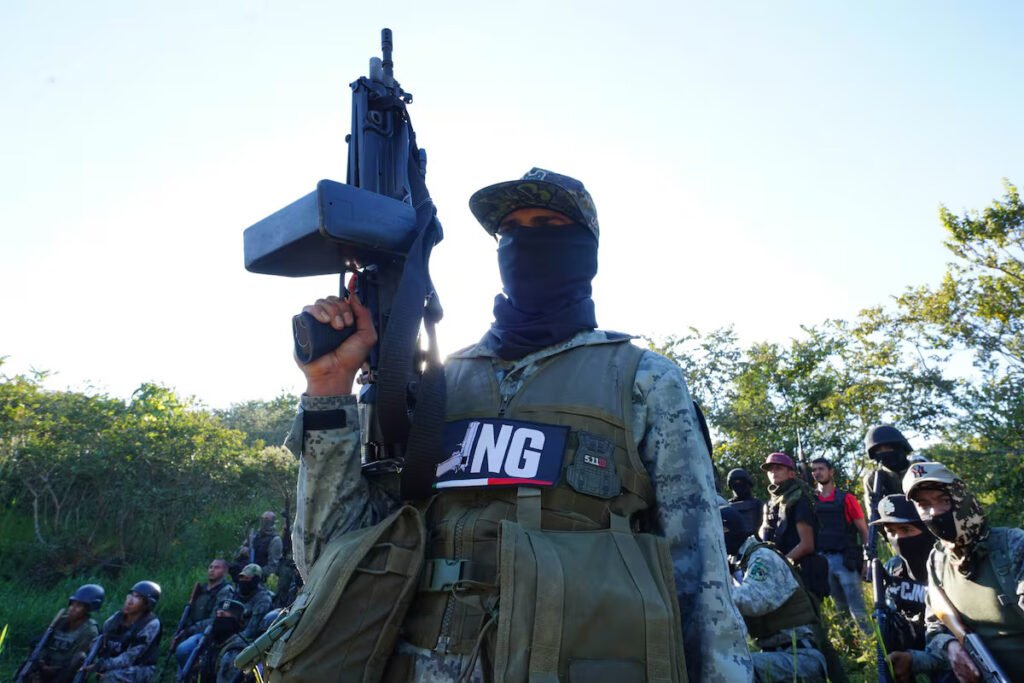
Rabat – Moroccan authorities played a key role in an international operation that led to the extradition of suspects accused of supplying military-grade weapons to one of Mexico’s most violent criminal organizations.
Peter Dimitrov Mirchev, a Bulgarian national, appeared on March 20 before a US federal court in Alexandria, Virginia, facing charges of conspiracy to distribute cocaine and conspiracy to provide weapons, including machine guns, rocket launchers, and sniper rifles, to the Jalisco New Generation Cartel (CJNG).
The case drew attention to cross-continental arms trafficking and its links to global drug networks.
Kenyan national Elisha Odhiambo Asumo, arrested by Moroccan authorities in Casablanca, was extradited to the US on March 11 to face related charges.
Moroccan security services, including the General Directorate of National Security (DGSN) and the General Directorate for Territorial Surveillance (DGST), coordinated with US officials to secure his transfer.
According to the indictment, Mirchev and his accomplices, including Tanzanian national Subiro Osmund Mwapinga and Ugandan national Michael Katungi Mpweire, who remains at large, allegedly conspired since 2022 to supply the CJNG with heavy weaponry.
Prosecutors say the arms were intended to facilitate cocaine shipments into the US, and that the suspects used falsified end-user certificates to disguise the weapons’ true destination.
Court filings say that a test shipment of 50 AK-47 rifles, along with ammunition, was exported from Bulgaria using certificates obtained through Tanzania, with the expectation that the CJNG would receive the weapons.
The network allegedly planned further deliveries, potentially including surface-to-air missiles and advanced anti-aircraft systems, with a total value approaching $58 million.
US authorities pointed to Mirchev’s prior alleged involvement with convicted arms dealer Viktor Bout, raising concerns about his role in global illicit weapons networks.
Mirchev was arrested in Madrid, Spain, while Asumo was apprehended in Casablanca, and Mwapinga was detained in Accra, Ghana. US officials described the coordinated arrests as a testament to international law enforcement cooperation.
If convicted, the defendants face at least 10 years in prison, with potential life sentences.
The case shows a broader US initiative to dismantle criminal networks that link arms trafficking with drug operations, and points to Morocco’s increasing contribution to global security efforts.