


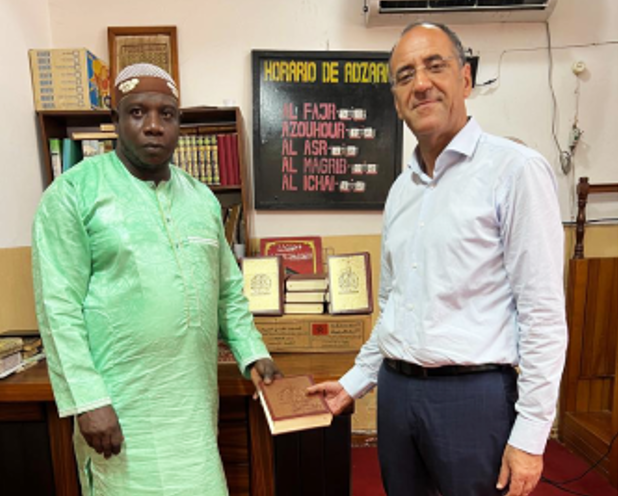
Beni Mellal – Morocco’s Ambassador to Gabon and São-Tomé-and-Príncipe, Abdellah Sbihi, handed over a batch of Quran copies to the São Tomé Mosque on the occasion of Ramadan, in a gesture of solidarity with the country’s Muslim community.
The donation was received by the mosque’s imam in the presence of Wilton da Conceição das Neves, president of the local chapter of the Mohammed VI Foundation for African Ulema, alongside foundation members and religious figures.
Sbihi said the gesture reflects Morocco’s “fraternal relations and spirit of solidarity” between the two countries, adding that the support shows the kingdom’s commitment, under King Mohammed VI, to an Islam of peace and tolerance.
Da Conceição das Neves welcomed the donation as evidence of Morocco’s efforts to promote moderate Islam. He used the occasion to convey the gratitude of São Tomé’s Muslim community to King Mohammed VI in his capacity as Commander of the Faithful (Amir Al Mouminine).
What distinguishes Morocco’s religious model is its grounding in three interlocking traditions: the Maliki school of Islamic jurisprudence, the Ash’ari creed, and Sufism.
This combination, deeply rooted in North and West African history, gives Morocco a doctrinal legitimacy that Gulf-funded Wahhabism – despite its vast financial resources – has struggled to replicate across the Sahel and sub-Saharan Africa.
Morocco’s King also derives religious authority from his Sharifian lineage, tracing descent to the Prophet Muhammad, reinforcing his standing as Amir Al Mouminine across the continent.
The event is part of a broader pattern of Moroccan religious engagement across Africa. The Mohammed VI Foundation for African Ulema, established in June 2015, operates through local chapters in several African countries and serves as a platform for cooperation between Islamic scholars on issues of religious moderation and countering extremism.
Morocco’s religious outreach on the continent combines mosque support, Quran distribution, and imam training programs with its wider diplomatic and economic expansion in Africa. Analysts have long noted that Rabat treats religious cooperation as a complementary pillar of its South-South policy, alongside trade and investment ties.
São Tomé-et-Príncipe, where Muslims represent a small minority, already hosts a Moroccan consulate in Dakhla – one of 22 African diplomatic representations opened in Morocco’s southern provinces since December 2019, reflecting the country’s sustained effort to build continental support for its position on Western Sahara.
