


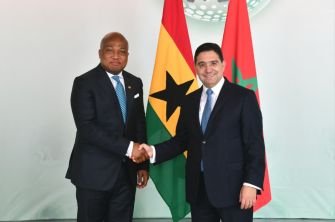
Rabat— Morocco and Ghana reaffirmed their strong diplomatic ties on Thursday as Foreign Minister Nasser Bourita met with his Ghanaian counterpart, Samuel Okudzeto Ablakwa, on the sidelines of the Conference on the Demobilization, Disarmament, and Reintegration of Child Soldiers, held on November 20–21 in Rabat.
During the meeting, Ablakwa commended King Mohammed VI’s leadership and Morocco’s commitment to addressing the recruitment and exploitation of child soldiers, a challenge affecting several regions of Africa. He expressed Ghana’s readiness to support Morocco’s efforts to establish an African framework aimed at curbing this phenomenon and strengthening continental stability.
Both ministers highlighted the deep bonds of solidarity and cooperation linking the two nations, affirming their shared ambition to make Morocco–Ghana cooperation an exemplary model of inter-African partnership based on mutual support and shared values.
The talks also covered ongoing joint initiatives across multiple sectors, with the two sides exploring ways to further deepen bilateral collaboration. This includes preparations for the upcoming second session of the Morocco–Ghana Joint Cooperation Commission, expected to expand cooperation mechanisms between the two countries.
At the regional and international levels, Bourita and Ablakwa noted the strong alignment of their positions on key issues of common interest. They agreed to bolster coordination and mutual support within regional and international organizations to advance shared priorities and reinforce African cooperation.
The relations between the two countries have emerged as a strong example of how African nations can build more dynamic and mutually beneficial partnerships, moving beyond the colonial-era barriers of artificial borders, resource-dependent economies, and linguistic divides.
Over the past decades, the two countries have steadily expanded their trade and economic cooperation. Recognizing the significant room for further growth, Rabat and Accra have introduced a series of measures to reinforce their economic ties. In January 2023, they signed a double taxation agreement designed to prevent the duplication of taxes on commercial and financial assets and to curb tax evasion. The agreement aims to ease bilateral trade by offering clearer rules on the tax obligations governing transactions between the two nations.
