


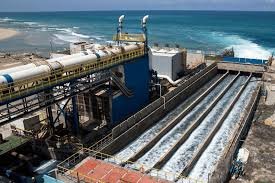
Rabat – Morocco plans to supply 60% of its drinking water from desalinated seawater by 2030, a significant increase from the current 25%, as the country ramps up investment in renewable-powered desalination plants, the Minister of Equipment and Water, Nizar Baraka, announced Thursday at the World Water Congress in Marrakech.
Speaking to Reuters on the sidelines of the event, Baraka said the push for desalination has become essential to secure long-term water supply and safeguard food production, especially after Morocco endured seven consecutive years of drought that have depleted reservoirs and underground water resources.
The country aims to produce 1.7 billion cubic metres of desalinated water annually by 2030, drawing from projects already under construction and new plants for which tenders will be launched next year. The largest facility, with an investment of roughly MAD 10 billion ($1 billion), will be located near Tiznit, 615 km south of Rabat. It will have a capacity of 350 million cubic meters and is intended to supply both urban centers and farmland in Morocco’s agricultural regions.
“Studies are underway as part of preparations for the plant’s tender, which will be announced by mid-next year,” Baraka said.
Additional plants are planned in northern cities such as Nador and Tangier, as well as in Rabat in partnership with French group Veolia, and in Tantan, where the government is also considering a port for green hydrogen and ammonia exports.
Currently, Morocco operates 17 desalination plants producing 345 million cubic meters annually, with four more plants under construction that will add 540 million cubic meters by 2027, including a major facility in Casablanca. All new plants will rely on renewable energy, Baraka noted.
Rising temperatures have exacerbated evaporation in dams, causing the loss of roughly 30% of the country’s surface water. To mitigate this, Morocco has installed floating solar panels on a dam near Tangier, a pilot project Baraka said will be expanded to dams in southern and mountainous regions.
The minister emphasized that these initiatives are critical not only to secure water for Moroccan citizens but also to maintain the country’s position as a leading producer and exporter of fresh produce amid increasing climate pressures.