


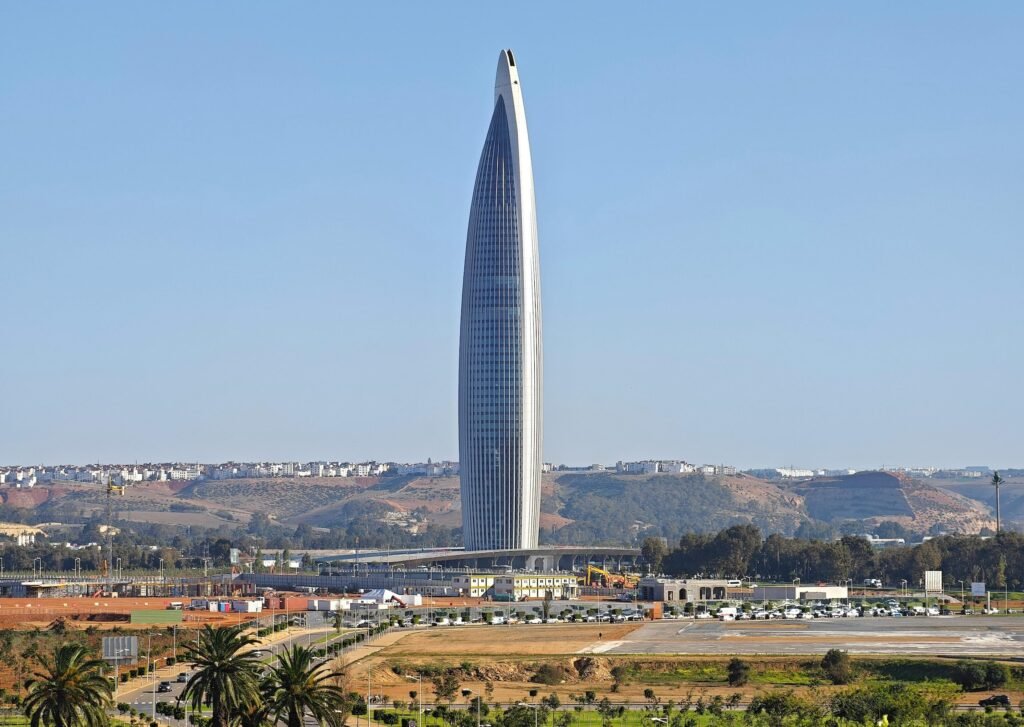
- King Mohammed VI Tower is 250m high
- Cost about $500m
- Hotel, offices and apartments
Morocco has inaugurated one of Africa’s tallest towers with the aim of reinforcing its appeal as a tourism destination.
It is positioning the King Mohammed VI Tower as both a flagship attraction and a symbol of its broader push to draw more visitors, as it boosts investment in tourism and infrastructure ahead of the 2030 Fifa World Cup, which it is co-hosting with Spain and Portugal.
In the first quarter of this year, Morocco received nearly 4.3 million tourists, a year-on-year increase of about 7 percent, despite the impact of the Gulf conflict on regional tourism and aviation.
Last year, the number hit a record high of 19.8 million tourists to turn Morocco into Africa’s top tourism destination by overtaking Egypt, a government website said.
Crown Prince Moulay El Hassan has now opened King Mohammed VI Tower, which rises 250 metres across 55 floors and is equipped with 36 lifts.
“The King Mohammed VI Tower is not merely the tallest skyscraper in North Africa…it is a cultural, tourism and urban manifesto. Its true success will depend on its ability to integrate into the life of Rabat and become a landmark for both its citizens and visitors,” said Spanish architect Rafael de la Hoz, who designed the tower in 2018.
The tower cost about $500 million and is located in Salé, a city adjoining the capital Rabat. Morocco’s general department for national security said the building can be seen from up to 50km away.
The project was launched in the heart of Morocco’s largest development scheme and is part of the broader Bouregreg Valley development programme, itself part of the “Rabat City of Lights, Moroccan Capital of Culture” initiative launched in 2014 under King Mohammed VI.
Belgian construction firm Besix built the tower in a joint venture with Moroccan contractor TGCC under a design and build contract covering engineering, procurement, construction, facades, electromechanical systems, finishes and furniture.
The Bouregreg Valley redevelopment project spans more than 40 sq km along the Bouregreg River between Rabat and its twin city, Salé, according to the Riyadh-based Arab Urban Development Institute.
The project aims to enhance Rabat’s competitiveness by creating new mixed-use developments for living, working and recreation within the Rabat-Salé-Témara metropolitan area.
Further reading:
Further reading:
The King Mohammed VI Tower contains a luxury hotel, offices, residential apartments and, at its summit, a panoramic observation deck.
“With this, Rabat takes a decisive step in consolidating its image as an international metropolis open to tourism, business, and culture,” de la Hoz said.
Yousuf Al-Idrisi, a Moroccan real estate expert, said he believes the tower will boost tourism and spur investments in the area: “Even during its construction stages, there were reports of a sharp rise in the number of tourists to Rabat and nearby areas.
“This is not a mere technological accomplishment. It is a political and economic statement that Morocco is ready to lead urban development in Africa.”