


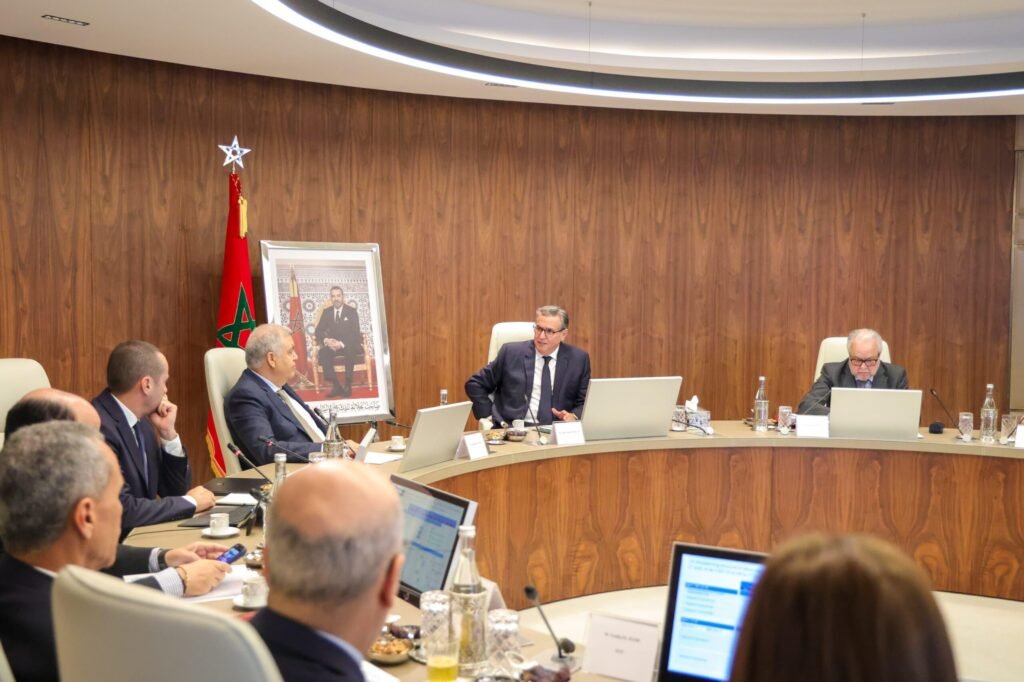
Casablanca – Morocco’s national healthcare reform moved into a new phase today as Head of Government Aziz Akhannouch chaired a steering committee meeting in Rabat to review progress on the country’s large-scale overhaul of the health system, with officials reporting advances in hospitals, primary care, territorial health groups, and digital infrastructure.
In line with royal directives, the meeting focused on building what the government described as an “effective, sustainable, and fair system” that guarantees equal access to quality care for all Moroccans.
Akhannouch opened the session by recalling the central role of territorial health groups, seen as the backbone of regionalized care and better coordination between different levels of treatment. Five directors general have already been appointed to accelerate the rollout.
Officials pointed to the first pilot in the Tangier-Tetouan-Al Hoceima region, where patient intake has increased, medical staffing levels have grown, and coordination between hospitals and local facilities has improved.
The government also said 1,400 primary healthcare centers have already been upgraded, with a second phase now underway. Another 1,600 new centers are planned under a MAD 7 billion program, including 500 scheduled for 2026, with a focus on rural and remote areas.
Read also: Morocco Finishes Upgrade of 1,400 Primary Health Centers Across All Regions
Hospital infrastructure remains another major pillar. 15 hospital projects are due for completion this year, adding nearly 3,000 beds nationwide. At the same time, work is continuing on six university hospital centers backed by more than MAD 20.6 billion in investment and a combined capacity of 3,807 beds.
The Mohammed VI University Hospital Center in Agadir was cited as one of the most advanced examples of Morocco’s next-generation hospital model.
The digital side of the reform is also moving quickly. Authorities said the national health map database is now 95% ready, while a unified digital platform bringing together public and private sector data has been completed ahead of its final deployment stage.
The shared medical record and electronic treatment sheet are also technically ready for gradual rollout in 2026, alongside the expansion of the Rabat-Salé-Kénitra emergency medical assistance model to other regions.
This push fits into a broader momentum seen earlier this year. In January, regional discussions around AI-powered digital health solutions gained visibility through AI Everything MEA’s DigiHealth track. Morocco was also selected in March to host the first GITEX Future Health Africa in Casablanca, a sign of the country’s growing ambition to position itself as a continental healthtech hub.
The meeting notably reviewed the upgraded “Shikaya Santé” complaints platform and the first modules of Morocco’s digital one-stop window for medicines and health products, both meant to reduce delays, improve transparency, and make the system easier to navigate for patients and providers alike.
Morocco World News is also on X — check out our latest posts now! Get MWN on iOS and Android for instant access to breaking news.