


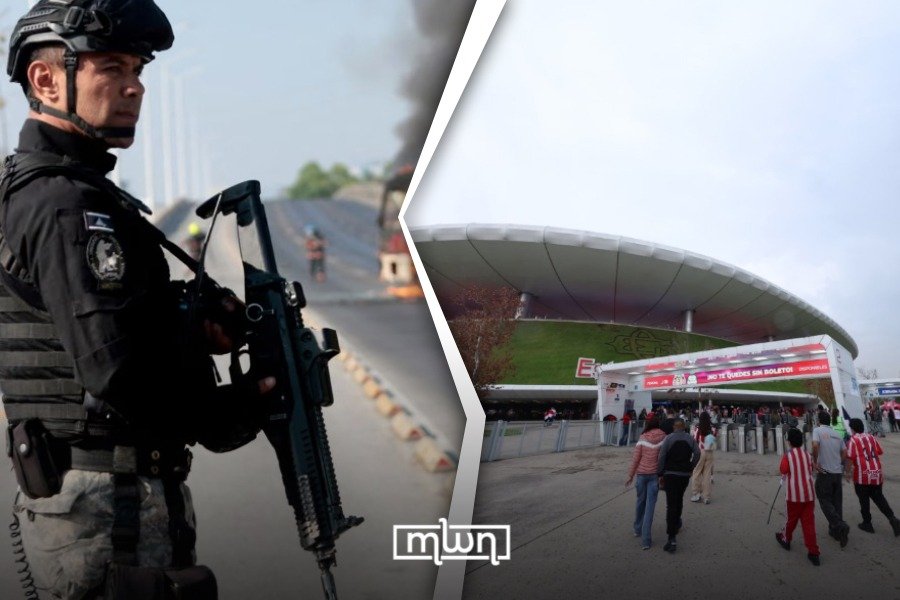
Rabat-Fans are calling for FIFA to ensure safety in Mexico following a wave of violence and unrest across Mexico, particularly in Jalisco state.
This wave of violence comes following a military operation late last month on February 22, in which the leader of the Jalisco New Generation Cartel (CJNG), Nemesio “El Mencho” Cervantes, was fatally wounded. His followers took to the streets in a wave of retaliatory violence, attacking National Guard bases and blocking nearly 100 major roads. At least 74 people were killed in the initial operation and subsequent violence.
Reports state that the majority of the violence had calmed by the next night with the majority of businesses in Guadalajara, the capital of Jalisco, opening on the morning of February 24.
Mexico is set to co-host this year’s FIFA World Cup with Canada and the United States, with thirteen matches scheduled to be played in Mexico across the cities of Guadalajara, Mexico City and Monterrey. In addition, Mexico will host the pre-World Cup playoffs that will determine the last two teams to qualify for the global tournament at the end of March.
President offers ‘every guarantee’
Following last month’s scenes of violence, Mexican government and FIFA officials have sent out statements of reassurance to alarmed locals and global football fans planning to travel to the country.
Jalisco Governor Jesús Pablo Lemu stated that he has spoken with local FIFA officials who have “absolutely no intention of removing any venues from Mexico. The three venues remain completely unchanged.”
Mexican President Claudia Sheinbaum has echoed these upbeat sentiments. There is “no risk” for tournament travelers, she said, stressing there is instead “every guarantee” for Mexico to remain a co-host for the World Cup.
FIFA President Gianni Infantino spoke on the violence from Barranquilla, Colombia, saying: “We are monitoring the situation in Mexico these days, but I want to say from the outset that we have complete confidence in Mexico, in its president, Claudia Sheinbaum, and in the authorities, and we are convinced that everything will go as smoothly as possible.”
In an effort to calm security concerns Mexico released a statement on March 6, announcing the implementation of 100,000 security personnel to protect fans. The expected personnel contains a mix of 20,000 military 55,000 police officers, and members of private security companies. In addition an expected 2,500 military and civilian vehicles, 24 aircraft, anti-drone systems, and dogs trained to detect illegal substances and explosives will be present.
The sharp ramp in military enforcement points to the continued concerning situation on the ground, which local Mexican residents stress must be addressed before considering the safety of future World Cup fans.
As one local told CBC News in an interview, “That is the reality of Jalisco. That is the reality of this country: extreme violence, narcoterrorism, and the institutional inability to safeguard the population.” He continued urging the country to understand the risks, “The World Cup is important. Of course it’s important. What’s not right for the country is forgetting, suppressing memory, suppressing justice. and the truth under the guise of a sporting event.”
International speculation and anxiety
In potential reassurance to officials and fans planning to travel for the World Cup, Mexico played Iceland in the central state of Queretaro on February 25 in a game that proceeded as scheduled despite the violence over the weekend. The match ended in a 4-0 victory for Mexico, and there was no incident.
Yet, as the World Cup approaches, the next several weeks will be important in calming safety concerns for both football fans and ordinary visitors hoping to travel to Mexico.
Despite statements of reassurance from the Mexican government and FIFA officials, fans and several international representatives have called for FIFA to guarantee safety measures are in place during the tournament itself. Christoph Bloß, the German government’s tourism coordinator, emphasized the host nations’ commitment to safety as a vital feature for tournament success while calling on FIFA to ensure security guarantees.
The Portuguese football federation, whose national team is scheduled to play Mexico’s in a friendly match on March 28, has said it is “closely monitoring the delicate situation in Mexico.” However, barring an additional wave of violence it looks like the match will proceed as scheduled.
Jamaica plays New Caledonia in Guadalajara on March 26 in hopes of advancing to play Congo for a slot in the World Cup. Michael Ricketts, president of the Jamaican Soccer Federation, has expressed some concern about Mexico hosting the pre-World Cup playoffs.
“The games are at the end of March, so we still have another month to see what happens; but it is making me very nervous, to be honest,” he stated. “We will be listening out for Concacaf and FIFA to give us instructions [on] whether they are playing the games or whether they are immediately looking for other options.”
Read also: President Sheinbaum, Infantino Reaffirm Confidence in Mexico’s World Cup Hosting
