


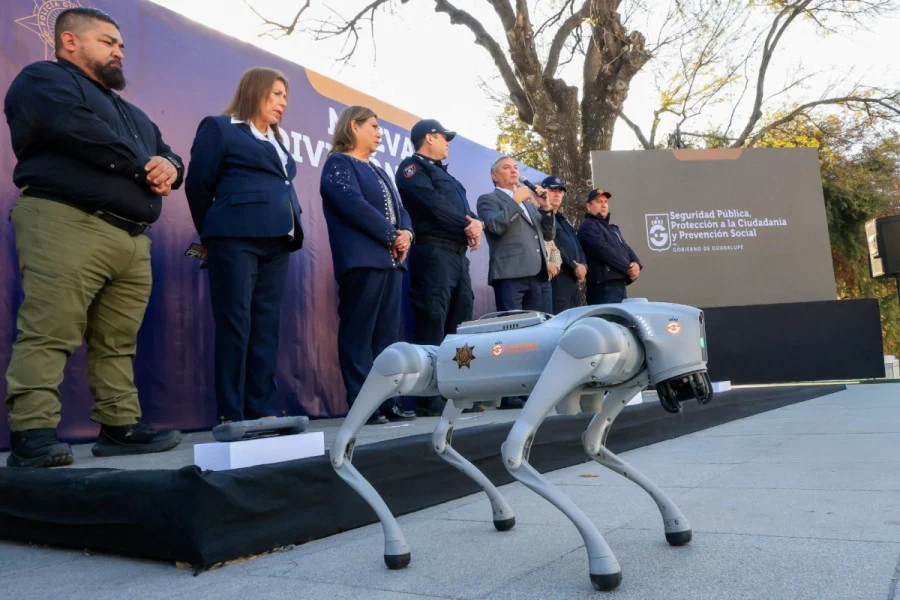
Rabat – Mexican authorities have introduced robot dogs to support police during the 2026 FIFA World Cup. The machines are designed to enter dangerous areas and stream live video to officers, giving them a chance to assess situations before stepping in.
The World Cup will run from June 11 to July 19 across Mexico, the United States, and Canada. One of the host cities in Mexico is Guadalupe, part of the Monterrey metropolitan area. The local council purchased the robot dogs for about 2.5 million pesos, equal to roughly $145,000.
A video released by the municipality shows one of the robots walking on four legs inside an abandoned building. It manages to climb stairs, though not smoothly.
The footage also shows the robot transmitting live images to police officers following behind. In a test scenario, the robot confronted an armed man and ordered him through a loudspeaker to drop his weapon.
Mayor Hector García explained that the purpose of these robots is to protect police officers during initial interventions. He said they will be deployed in situations where there is a high risk of confrontation, helping reduce danger for human officers.
The BBVA Stadium, also known as Estadio Monterrey, will host four matches during the tournament. Security is expected to be a major focus, and the use of robotic technology reflects efforts to combine innovation with public safety.
Beyond Monterrey, Mexican authorities are coordinating with federal forces to secure stadiums in Mexico City, Guadalajara, and other host cities.
Risk assessments have identified crime and cartel activity as potential threats, prompting tighter surveillance, upgraded infrastructure, and closer cooperation with international agencies.
These measures aim to ensure that fans, players, and staff can enjoy the tournament safely.
Canada is also preparing extensive security plans for its host cities, including Toronto and Vancouver. Federal, provincial, and municipal authorities are working together under a national framework to protect stadiums and surrounding areas.
In Vancouver, temporary surveillance cameras are being installed around the stadiums and transit hubs to monitor crowds.
Officials stress that these steps are necessary for public safety, though privacy groups have raised concerns; local businesses near match venues are also being advised to strengthen their own security to handle the influx of visitors.
Together, these measures show how Mexico and Canada are approaching World Cup security with a multi-layered strategy.