



Marrakech – The 22nd Marrakech International Film Festival concluded Saturday night with a spectacular closing ceremony at the Congress Palace, where it was announced that “Promised Sky,” by Franco-Tunisian filmmaker Erige Sehiri, had won the prestigious Golden Star Grand Prize.
The ceremony brought together international film stars, cultural personalities, and media representatives to celebrate nine days of cinema.
Golden Star Winner: ‘Promised Sky’
The jury, presided over by Korean master filmmaker Bong Joon Ho, selected “Promised Sky” from among 13 feature films in official competition for its poetic force and fully engaged artistic vision that dares to see the world differently.
The 93-minute film, supported by the festival’s Atlas Workshops, explores themes of displacement and solidarity through three women’s intersecting lives in contemporary Tunisia.
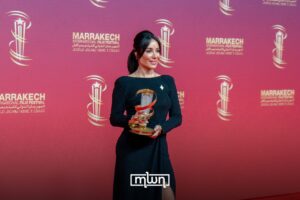
The narrative centers on Marie, an Ivorian pastor and former journalist living in Tunis, who takes in Naney, a young mother seeking a better future, and Jolie, a determined student carrying her family’s hopes from back home.
When the three women rescue Kenza, a 4-year-old survivor of a shipwreck, their refuge transforms into a tender but troubled blended family amid an increasingly concerning social climate.
Director Erige Sehiri, a Franco-Tunisian filmmaker and producer, previously gained recognition with her documentary “La Voie normale,” which examined the daily struggles of Tunisian railway workers. Her debut fiction feature “Sous les figues” was presented at the Directors’ Fortnight in Cannes and represented Tunisia at the Oscars.
Beyond filmmaking, Sehiri co-founded the independent media outlet Inkyfada and the Tunisian NGO Al Khatt, while serving as a founding member of the Rawiyat – Sisters in Film collective supporting female filmmakers from the Arab world and diaspora.
The film was shot in French and Arabic, featuring performances by Aïssa Maïga, Laetitia Ky, Debora Lobe Nanay, Mohamed Grayaa, and Foued Zaazaa. Production companies Maneki Films and Henia Production developed the project, with international sales handled by Luxbox Films and distribution by MAD Distribution.
Jury Prize winners
Two films shared the Jury Prize in recognition of their exploration of memory and historical trauma. “Memory” by Vladlena Sandu presents an autobiographical examination of childhood during the Chechen conflict, while “My Father and Qaddafi” by Jihan K investigates the disappearance of a Libyan opposition leader.
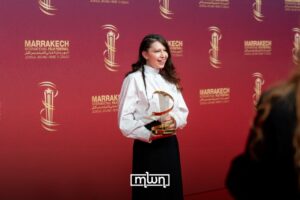
“Memory,” a 98-minute Russian-language hybrid autobiographical film co-produced by France and the Netherlands, retraces director Vladlena Sandu’s childhood move from Crimea to Grozny at age six.
The transition, set against her parents’ divorce and the collapse of the Soviet Union, unfolds just as the Chechen War erupts, exposing her to a world where neighbors are murdered, her family is targeted, and her mother is gravely injured.
Premiering at Venice’s Giornate degli Autori, the film confronts Sandu’s driving question: how can a child break a cycle of violence that shapes identity and silently passes from one generation to the next?
Sandu, who grew up during the war and later fled Russia in 2022, now works in Amsterdam. A VGIK graduate with studies in aesthetics and cultural theory, she continues her artistic exploration of trauma and memory.
In the Netherlands, she created the award-winning performance “The Rainbow Cinema,” inspired by her experience of human trafficking.
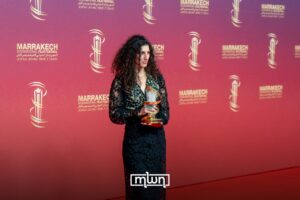
“My Father and Qaddafi” runs 88 minutes and incorporates English, Arabic, and French dialogue.
Director Jihan K, born in exile and raised in Paris while her father led peaceful opposition to Muammar Qaddafi’s brutal regime, reconstructs the figure of Mansur Rashid Kikhia, a human rights lawyer who served as Libya’s foreign minister and UN ambassador before becoming opposition leader.
Kikhia disappeared mysteriously from his Cairo hotel in 1993, with his body discovered 19 years later in a freezer near Gaddafi’s palace. Through family interviews, her father’s colleagues, and historical archives, the filmmaker’s quest for truth transforms into an intimate exploration connecting her to both her father and Libyan identity.
Technical and performance awards
Oscar Hudson received the Best Directing Prize for “Straight Circle,” his debut feature following previous work in music videos and short films.
The 108-minute English-language production, co-produced by the United Kingdom, examines two enemy soldiers stationed at an isolated desert border who gradually lose their grip on reality and forget which side represents their homeland.
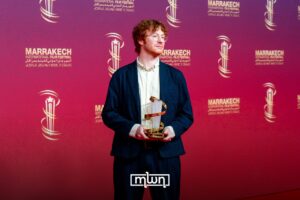
Hudson initially studied social anthropology before transitioning to low-budget music videos in London, where he developed his distinctive visual language combining inventive narrative with dark humor.
His work has earned over a hundred prestigious awards, including a Primetime Emmy, a Grand Prix at Cannes Lions, and the Best Direction prize at the UK Music Video Awards.
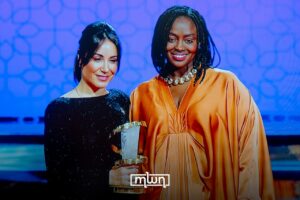
Debora Lobe Naney earned the Best Female Performance award for her role in “Promised Sky,” while Ṣọpẹ́ Dìrísù received the Best Male Performance award for “My Father’s Shadow” by Akinola Davies Jr.
The semi-autobiographical film, shot in Nigerian Pidgin, Yoruba, and English, unfolds over a single day in Lagos during Nigeria’s 1993 electoral crisis, following a father attempting to guide his two young sons through political unrest.
Dìrísù portrays Folarin, an emotionally distant father attempting to reconnect while political turmoil threatens their journey through the sprawling Nigerian capital.
The award adds to Dìrísù’s growing acclaim, following his recent Gotham Award win and the film’s UK Oscar submission for Best International Feature.
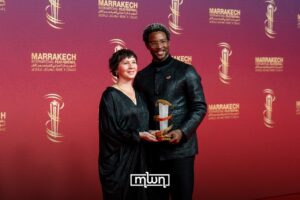
Director Akinola Davies, a BAFTA-nominated filmmaker and Sundance prize winner, serves as artist-in-residence at Somerset House. His work explores community, race, spirituality, identity, and gender through internationally contextualized narratives. His short film “Lizard” won the Grand Jury Prize at Sundance and received a BAFTA nomination for Best British Short Film.
The jury also presented a special mention to actors Elliot Tittensor and Luke Tittensor for their performances in “Straight Circle.” Their performances captured the psychological descent as isolation transforms into an unfathomable nightmare where distinguishing friend from enemy becomes impossible.
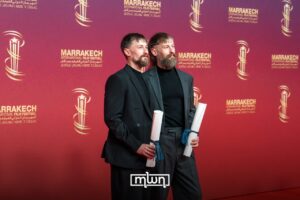
The jury recognized the actors’ ability to convey the absurdity and horror of their characters’ existential crisis in the featureless desert landscape.
Festival overview and cultural impact
The international jury included Brazilian-Algerian director Karim Aïnouz, Moroccan filmmaker Hakim Belabbes, French screenwriter Julia Ducournau, Iranian actor Payman Maadi, American actress Jenna Ortega, Canadian director Celine Song, and Anglo-Argentine actress Anya Taylor-Joy.
This edition honored four major cinema figures: Hussein Fahmi, Jodie Foster, Raouya, and Guillermo del Toro. The festival’s “Conversations” program featured Bong Joon Ho, Guillermo Del Toro, Andrew Dominik, and Laurence Fishburne, establishing Marrakech as a significant venue for industry dialogue and cultural exchange.
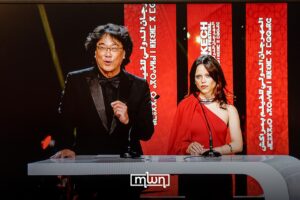
The 22nd edition welcomed 81 films from 30 countries across multiple sections. Beyond the 13 official competition entries, programming included nine gala screenings, 16 tribute films, 19 works in the Horizons section, 15 films in the “11th Continent” program, and seven productions in the Moroccan Cinema Panorama.
Audience engagement reached 47,000 spectators, including 7,000 children and adolescents through the Young Public and Family program. The Atlas Workshops brought together 350 professionals around 28 projects, providing mentorship and development support for emerging regional filmmakers, including the support that helped develop the winning film “Promised Sky.”
The festival wrapped up as a celebration of cinema in all its forms, featuring artistic discoveries, debates, encounters, and the emergence of new talent.
The event reinforced Marrakech’s position as a destination where cinema circulates freely, revealing singular journeys, powerful stories, and committed perspectives nourished by collective energy that continues to bring together those who create films and those who watch them.
