


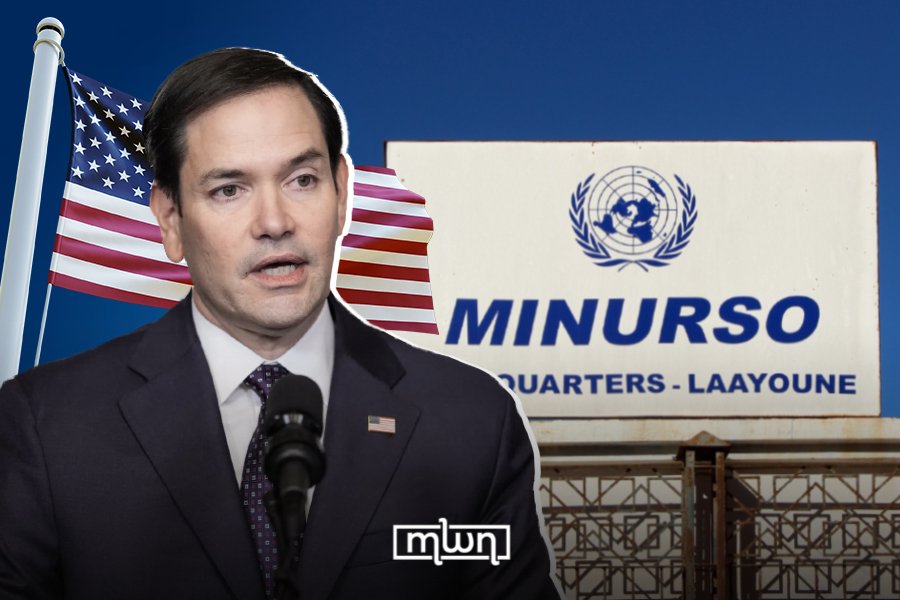
Marrakech – The United States Department of State has formally committed to dismantling what it describes as “costly and ineffective” UN peacekeeping operations worldwide – a policy with direct consequences for the 35-year-old UN Mission for the Referendum in Western Sahara, known as MINURSO.
Secretary of State Marco Rubio laid out the position in the Department’s Agency Strategic Plan for Fiscal Years 2026-2030. The document states that Washington will “lead efforts to wind down costly and ineffective peacekeeping and special political missions around the world.”
It further commits to “promote U.S.-led peace processes” and to “block resolutions that undermine U.S. interests or those of our allies.”
The plan explicitly rejects multilateralism as a default. Washington will engage international organizations “only when it advances America’s national interests” and will “no longer defer to unelected international bureaucrats,” the document adds.
MINURSO was established by UN Security Council Resolution 690 in 1991 with a single mandate: to organize a referendum on Western Sahara’s future status. That referendum was never held – and by 2000, it was clear it never could be.
Faced with a complete deadlock in the voter identification process, then-UN Secretary-General Kofi Annan dissolved MINURSO’s own Identification Commission, the very body tasked with determining who would be eligible to vote. The mission had failed at its only job before the new millennium had even begun.
Considering it “obsolete and dysfunctional,” Atlantic Council senior fellow Sarah Zaaimi wrote in an April 2025 analysis that “the mission failed to deliver on its mandate and only served to maintain a state of paralysis throughout the years.”
She was more direct in her conclusion: “For the past thirty-four years, MINURSO has consistently deceived the Sahrawi people by failing to deliver on its mission,” calling on Washington and transatlantic allies to “defund, dismantle, and terminate it.”
Its purpose was legislated away
The mission’s founding purpose has not merely stalled. It has been formally buried by the very body that created it. When the UN Security Council adopted Resolution 2797 on October 31, 2024, it extended MINURSO’s mandate for only six months and stripped it of any remaining political direction.
The resolution anchored the entire international framework behind Morocco’s autonomy plan as the only realistic path forward, leaving no procedural space, no timeline, and no institutional support for a referendum. The Council that once tasked MINURSO with organizing a popular vote has now, through the same authority, rendered that vote obsolete.
A mission born to deliver a referendum now operates under a mandate that makes one impossible. MINURSO did not outlive its purpose – its purpose was taken from it by the highest diplomatic body on earth.
That political shift translated into direct diplomacy. Talks held in Madrid on February 8-9 and in Washington on February 23-24 brought all four parties to the table – Morocco, Algeria, Mauritania, and the Polisario Front.
Algeria and the Polisario Front – which spent decades rejecting Morocco’s autonomy plan outright and refusing to sit at any table that did not put independence on the agenda – found themselves in Madrid and Washington negotiating the very framework they had long dismissed.
Their presence was not a gesture of goodwill. It was a capitulation to an international reality they could no longer resist. The two parties that had for years blocked, stonewalled, and walked away from any process that did not end in a referendum had run out of options, out of allies, and out of arguments.
MINURSO’s operational decline mirrors its diplomatic irrelevance. Bourita disclosed in a November 1 interview on the Moroccan channel 2M that the mission’s budget had been cut by 22%, a direct consequence of Washington withholding contributions to UN peacekeeping operations. The mission subsequently lost one of its two field helicopters.
In November 2025, MINURSO chief Alexander Ivanko removed four sector and department heads in a sweeping internal restructuring. Informed UN sources described the decision as part of a broader contraction of the mission’s field activities and logistics. A full briefing is expected before Secretary-General António Guterres in April.
The mission ‘perpetuates the problem’
American think tanks had been pushing for this outcome well before Washington made it official policy. Writing in the Washington Examiner in March 2025, American Enterprise Institute (AEI) scholar Michael Rubin pulled no punches.
“The U.S. today recognizes Western Sahara as part of Morocco, thus subsidizing an organization that represents a betrayal of an Abraham Accords participant that constantly has America’s back,” he wrote.
His assessment of MINURSO’s record was equally blunt: “Its goal was simple: Organize a referendum among the territory’s Sahrawi to determine if they wished to join Morocco or establish their own country. Thirty-four years and billions of dollars later, MINURSO has not even conducted a census. It makes excuses, some valid and others not, but time marches on.”
Rubin charged that the Algerian-backed Polisario “will not allow refugees from the camps they control in Algeria’s Tindouf province to travel to Morocco with their families; they hold wives and children as hostages to prevent refugee resettlement,” continuing that “by funding these camps and inflating Polisario legitimacy, the U.N. perpetuates the problem.”
He even ridiculed the mission’s presence on the ground, writing: “Today, the best way to find MINURSO officials in Western Sahara is to visit one of Laayoune or Dakhla’s bars, where MINURSO vehicles are ever-present.”
His recommendation to Guterres was straightforward: “waste no time” in ending “legacy peacekeeping missions that, at best, do nothing and, at worst, preserve and provoke conflict” – and impose a firm rule of “10 years or out, with no extensions.”
With its referendum mandate dead, its budget cut, its staff reduced, and Washington now formally committed to winding down operations of its kind, MINURSO’s room to maneuver shrinks with each passing month.