


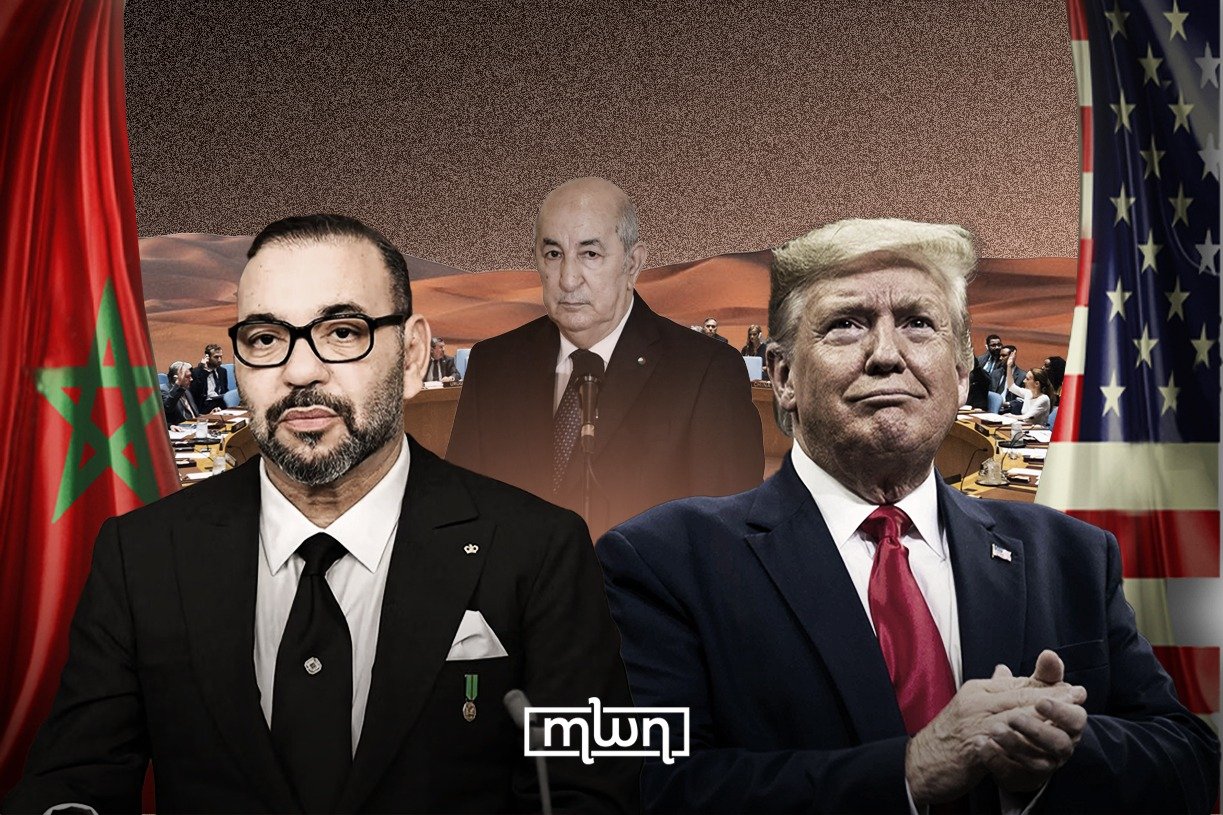
Rabat – Emerging reports from Spain regarding the United States’ sponsorship of the first round of negotiations between the parties to the dispute over the Sahara – namely Morocco, Algeria, the Polisario, and Mauritania – have generated considerable reaction within Morocco’s media sphere and across social media platforms. Naturally, there are two central questions on many minds as they observe – in curiosity and hope – where this round of US-facilitated talks will lead. The first is whether, after a half-century of Algerian maneuvers to sustain the viability of elusive separatist dreams in southern Morocco, Washington will finally succeed in compelling Algiers to engage in serious negotiations to reach a final settlement within the framework set out by Resolution 2797. And the second, inextricably linked to the first, is whether Morocco’s Autonomy Plan will indeed serve as the basis of these talks.
Alongside these two central questions, Moroccan officials and most seasoned observers of the Western Sahara saga are most likely wondering whether, with all the latest developments in the Sahara file having confirmed the depth and irreversibility of Morocco’s momentum, Algeria will once again attempt to buy time by retreating behind the same worn-out narrative it has relied on for the past five decades. That is, instead of genuinely entering these US-moderated talks in good faith, is Algiers actually planning to merely use them as cover while it paves the way for a return to its misleading position of a “concerned neighbor” that is merely seeking to guarantee the “Sahrawi people’s right to self-determination?”
Answering these questions requires neither conjecture nor interpretation. Resolution 2797 was explicit in establishing the autonomy plan under Moroccan sovereignty as the basis for reaching a lasting political solution. Accordingly, the participation of Algeria’s Foreign Minister in the negotiations held in Madrid this past Sunday came as no surprise; it was simply the logical outcome of this framework. From the perspective of the Security Council, Algeria is unequivocally a party to the Sahara dispute. Moreover, Algeria is fully aware that the current U.S. administration is determined to take the initiative and no longer remain hostage to the slow and ineffective bureaucracy of the United Nations in order to close this file. As a result, Algeria had little choice but to acknowledge the new reality and participate in the first round of this new negotiating track.
Resolution 2797 shattered Algerian diplomacy’s comfort zone
Resolution 2797 definitively and irreversibly settled the legal debate surrounding the dispute. Or, as I underscored in my 2024 book about the Sahara dispute, “The Self-determination Delusion,” this resolution was both the inevitable outcome of a political process that began in the Security Council with the adoption of Resolution 2440 in October 2018 and the logical endpoint of the cumulative political breakthroughs Morocco has achieved at the bilateral level over the past two decades. In this sense, Algeria’s mere acquiescence to U.S. pressure and its participation in the last week’s Madrid negotiations already constitutes an implicit acknowledgment that Resolution 2797 represents the most significant diplomatic setback it has suffered since independence in 1962.
To be sure, these resolutely pro-Moriccan breakthroughs began with Washington’s recognition of Morocco’s sovereignty over the Sahara in December 2020, continued with Spain’s and France’s explicit support for the Moroccan position, and culminated in the United Kingdom’s acknowledgment last June that Morocco’s autonomy plan is the sole basis for reaching a final political solution to the Sahara dispute.
It is an open secret that Algeria has invested enormous political, diplomatic, and financial resources over the past six decades to weaken Morocco and prevent it from restoring its sovereignty over the Sahara. Indeed, achieving this strategic objective has been the central compass of Algerian diplomacy for the past five decades. As such, Algeria’s attempt to obstruct the serious and effective launch of negotiations and show resistance to U.S. pressure came as no surprise. In other words, it was hardly surprising that the first meeting, held on Sunday, failed to produce any substantive progress.
While Algeria may in the long-term have no choice but yield to the inevitable, it would be unrealistic to expect the country to openly acknowledge its defeat so early in this newfound political process under the auspices of the US administration. For Algiers, to endorse this new US-imposed approach is akin to accepting the Moroccan autonomy plan as the sole foundation of negotiations to settle the Sahara question. This is why Algeria refused to participate in any commemorative photo following Sunday’s meeting.
Having severed relations with Morocco in great fanfare five years ago, and having repeatedly vowed to uphold its support for the separatist Polisario Front’s independence dreams in southern Morocco, Algeria now finds itself between a rock and a hard place as the US, a strong supporter of the Moroccan stance on the Sahara, looks to force it to sit around the same table as Morocco and discuss the future of the Sahara within autonomy parameters set in Rabat.
Against such a politically charged background for Algerian diplomacy, Algeria’s participation in these negotiations is in and of itself a form of humiliation. And what makes this new, US-imposed phase even more bitter for Algeria is the powerful symbolism of the location where negotiations to resolve the dispute were launched.
Madrid as a paradigm and a heavy historical symbol
It was in Madrid that Mauritania, Morocco, and Spain signed on November 14, 1975 the Madrid Accords to bring the Sahara dispute to a definitive end. Years earlier, the United Nations General Assembly’s adoption of Resolution 2229 had endorsed the principle of self-determination and fundamentally altered the legal trajectory of the dispute. In the aftermath of that momentous decision by the General Assembly,– it was the same Madrid that went on to emerge as the epicenter of Algerian-Spanish maneuvers to obstruct Morocco’s efforts to recover its southern provinces.
So much so that when diplomatic tensions between the late King Hassan II and the Spanish government escalated between July 1974 and November 1975, Madrid was the breeding ground for the final round of maneuvers by Algeria to undermine Morocco’s push to recover its Sahara. With the backing of some influential figures within the Spanish government, Algiers now sought to make the quest to reclaim the southern provinces both a prohibitively costly endeavor for Morocco’s economy and a morale-sapping adventure for Moroccan nationalism. In maneuvering to exact such a steep political and diplomatic price from Morocco, Algiers expected Rabat to follow in Mauritania’s footsteps by relinquishing its sovereignty claims to the Western Sahara region.
Meanwhile, the complicity of powerful Spanish officials who harbored hostility toward Morocco and openly supported the separatist project long championed by Algeria played a decisive role in prolonging the conflict over the Sahara and tilting the political balance in Algeria’s favor for more than three decades.
When Spain attempted to catch Morocco off guard in early July 1974, Algeria and its Spanish allies believed that King Hassan II was on the verge of losing his strategic gamble over the Sahara. Yet with his political acumen, strategic foresight, and diplomatic dexterity, the late monarch ultimately succeeded in upending what I describe in my forthcoming Arabic-language book on the Sahara – scheduled for publication this week – as the unwholy alliance between Algeria and Spain. This was indeed an unnatural alliance of two strange bedfellows – a Western, Christian colonial power and an Arab-Muslim state that itself had previously been subjected to French colonial rule – who only had in common their shared anxiety over the strategic depth that Morocco would command with the recovery of its lost southern provinces.
One of the most consequential steps King Hassan II took in those hotly contested early hours in the Western Sahara saga was the decision to refer the matter of the Sahara conflict to the International Court of Justice. He followed this step by successfully persuading the United Nations General Assembly to adopt Resolution 3292, which effectively buried Spain’s plan to grant the inhabitants of the Sahara the right to self-determination during the first half of 1975. Amid the intense diplomatic tug-of-war that shaped Moroccan-Spanish relations between January and November 1975, a debate gradually took hold within Spain’s political establishment over the sustainability of a continued Spanish presence in the territory. This anxious reassessment of the viability of Spain’s scheme for the Sahara was all the more significant given that Portugal had been forced, in the summer of 1974, to enable its remaining African colonies to exercise their right to self-determination. Clear signs of division emerged within the Spanish government when King Hassan II revived Morocco’s sovereignty claims over Ceuta and Melilla in February of that same year.
From that moment onward, the Spanish government fractured into two distinct camps. The first was led by Prime Minister Arias Navarro, Minister of the Movement, José Solís, and senior figures within the Spanish military establishment, including the Chief of the General Staff. This faction favored a negotiated settlement with Morocco that would allow Rabat to recover sovereignty over the Sahara in exchange for Spain securing security and economic privileges, alongside a Moroccan commitment not to reopen the question of Ceuta and Melilla.
The second camp was led by Foreign Minister Pedro Cortina, Spain’s ambassador to the United Nations Jaime de Piniés, and several senior military officers stationed in the Sahara. As the most significant obstacle to a final Moroccan-Spanish agreement, this camp forcefully defended the thesis of what it termed the “Sahrawi people’s” right to self-determination and independence. To that end, they called for the full implementation of all the resolutions the General Assembly had adopted between 1966 and 1975.
How Algiers reversed the Madrid paradigm
Algeria would shrewdly and deliberately exploit these deep-seated internal divisions throughout the 10 month-period that preceded the Green March. Despite sustained efforts by the U.S. Secretary of State Henry Kissinger, who provided significant support for the Moroccan position, the Moroccan and Spanish governments failed to reach a final agreement to close the dispute. This same division ultimately led King Hassan II to consider organizing the Green March. When, on 16 October 1975, King Hassan II caught the Spanish government off guard by announcing his intention to launch the Green March, Madrid once again sought to revive the very understanding it had attempted to reach throughout that year with Rabat. Pedro Cortina and Jaime de Piniés had repeatedly opposed this route, which eventually derailed and temporarily buried any prospects of understanding between Morocco and Spain.
As he sought to revive this derailed dialogue process, Spanish Prime Minister Arias Navarro dispatched Minister José Solís to Rabat to meet with the Moroccan monarch. Confronted with King Hassan II’s clear expression of frustration over what had by then become unmistakable collusion between senior Spanish officials and Algeria, and faced with the Moroccan monarch’s firm resolve to proceed with the Green March, the Spanish envoy attempted to offer every conceivable assurance that Madrid was prepared to reach a settlement in line with the King’s stated objectives. Solís conditioned this Spanish concession on Morocco’s agreement to cancel or postpone the Green March for roughly two weeks, thereby allowing both governments time to finalize the details of a mutually acceptable accord.
Yet Algerian President Houari Bouemediene intervened at the eleventh hour by making astute use of Foreign Minister Pedro Cortina’s and Ambassador Jaime de Piniés’s categorical opposition to any agreement that would see the Sahara returned to Morocco. The Algerian president thus mobilized all available leverage to sabotage the preliminary understanding that had been reached between King Hassan II and the Spanish prime minister’s personal envoy. Only days after the King’s meeting with José Solís on October 21, Boumediene dispatched a high-level delegation to Madrid with explicit instructions to undermine the tentative accord and pressure the Spanish government, through Pedro Cortina, to cling rigidly, in line with the advisory opinion of the International Court of Justice, to the principle of granting the Sahrawis self-determination and independence.
As a direct result of Algerian pressure and Pedro Cortina’s intransigence, Madrid requested that the United Nations Security Council convene a second and then a third meeting to assess the regional situation in light of King Hassan II’s decision to organize the Green March. The purpose of all these meetings – held on October 20, November 2, and November 6 – was to coerce Morocco into abandoning the Green March by obtaining an explicit Security Council condemnation of the march. Yet to the dismay of the anti-Morocco Algiers-Madrid nexus, and in great part thanks to decisive support from Secretary of State Henry Kissinger, none of the resolutions adopted by the Security Council included language condemning Morocco or obliging it to cancel the Green March.
The Green March gave Morocco crucial breathing room and a chance to fight back
The American position thus proved instrumental in tipping the balance in Morocco’s favor and in ultimately compelling Spain to yield to Moroccan demands. After King Hassan II’s earlier attempts to persuade Madrid of the need for a bilateral settlement safeguarding the interests of both countries had failed, the Green March became the instrument through which Morocco forced Spain to enter direct negotiations with Rabat. And, crucially, it is these negotiations that culminated in the signing of the Madrid Agreement on 14 November 1975.
Had it not been for Algeria’s obstinacy in exploiting Pedro Cortina’s hostility to Morocco, Madrid and Rabat could have concluded a bilateral agreement affirming Moroccan sovereignty over the Sahara before the end of October 1975, rendering the Green March unnecessary. Instead, the Spanish foreign minister’s rigidity and alignment with Algeria’s separatist thesis obstructed any such agreement and ultimately pushed King Hassan II to deploy the Green March as a final lever to compel Spanish compliance.
Although King Hassan II succeeded in achieving the de facto recovery of the Sahara, Algeria subsequently capitalized on the political and media controversy surrounding the Madrid Agreement, as well as on divisions within Spain’s political class. It notably encouraged the post-Franco Spanish government to gradually distance itself from the accord. As a result, Foreign Minister José María de Areilza declared in early 1976 that the decolonization process in the Sahara was incomplete so long as the conditions for enabling the territory’s population to exercise self-determination had not been fulfilled. This was the earliest indication of Spain’s retreat from the spirit of the agreement, and of its alignment with Algeria’s claim that the Madrid Agreement was “null and void.”
To be sure, this was precisely the same narrative Algeria had employed in its communications with the United Nations Secretariat and the Security Council following the signing of the Madrid Agreement, seeking to challenge its legality and legitimacy. And it is indeed this very narrative that Algeria has continued to recycle in recent years.
Nevertheless, despite Spain’s adoption of a discourse that clearly contradicted both the letter and the spirit of the Madrid Agreement, Algeria had not yet succeeded in overturning the balance or forcing Morocco into a defensive position. In order to credibly undermine the legal standing of the Madrid Agreement, Algeria first needed to obtain an official declaration from the Spanish government asserting that the members of the Jemaâa (Assembly of tribal leaders) who attended the meeting of 26 February 1976 – and voted in favor of reintegrating the Sahara into Morocco – were not the legitimate representatives of the territory’s population, and that the Polisario was the sole representative of the so-called “Sahrawi people.”
To this end, Algeria exerted sustained pressure on the Spanish government by weaponizing the issue of separatism in the Canary Islands. It granted political asylum to Antonio Cubillo, the leader of a marginal separatist movement that emerged in the mid-1970s, providing him with extensive media backing by enabling him to broadcast incendiary propaganda on Algerian television and radio. Algeria further leveraged its political influence within the Organization of African Unity to push for Cubillo’s movement to be recognized as an “African liberation movement” and for the Canary Islands to be labeled an “African colony.”
It took Algiers nearly three years of intense pressure and political blackmailing of the government of Spanish Prime Minister Adolfo Suárez, and the ideological sympathy of left-leaning Spanish media toward separatist narratives, to get Spain to announce in the summer of 1979 that the Polisario was the “legitimate representative of the Sahrawi people” and that the Sahara continued to be classified as a “non-self-governing territory.”
This Spanish reversal constituted a decisive turning point that tipped the balance in Algeria’s favor, both at the continental level – within the African Union – and at the United Nations. The most telling indicator of the impact of Spain’s position on the trajectory of the dispute was the sudden surge in international recognition of the self-styled Saharawi Arab Democratic Republic.. By early 1980, more than 40 states had extended recognition to the separatist entity, compared to only 18 prior to the summer of 1979.
This momentum was swiftly reflected at the United Nations. In the autumns of 1979 and 1980, the General Assembly adopted two resolutions that, for the first and only time, described Morocco as an “occupying power” in the Sahara. As Algeria achieved these diplomatic breakthroughs in the early days of the Sahara dispute – deepening Morocco’s international isolation – its leadership never anticipated that the kingdom would gradually pull off the strategic patience, institutional resilience, and political wisdom necessary to withstand these pressures and ultimately achieve a diplomatic remontada. Still more critically, Algiers could not have possibly anticipated that the passage of time would ultimately reverse the balance in Morocco’s favor, allowing Rabat to impose the rules of game.
Algeria failed to anticipate the inevitable it now has to accept
With this long historical context in mind, and contrary to some interpretations, it is clear that Algeria did not participate in last week’s U.S.-sponsored Madrid talks in order to recalibrate the negotiating framework. It did so reluctantly, compelled by the recognition that regional and international power dynamics have fundamentally shifted, and that the prevailing political environment no longer tolerates destabilizing proxy entities such as the Polisario Front. Given that UN Security Council Resolution 2797 has already defined the political parameters of the process, the negotiations ahead will be largely technical in nature. Algeria and the Polisario will seek to extract the maximum possible concessions, while Morocco will remain firm in preserving all matters directly related to its sovereignty over the Sahara.
Having pursued for years a policy of escalation, brinkmanship, and systematic hostility toward Morocco, Algeria now faces the difficult task of preparing its domestic public opinion for a strategic reversal. Algiers may still attempt to drag its feet and considerably delay the timing of the final implementation at hand. But it now knows that it will sooner or later have to come to terms with the incontrovertible reality that the Sahara constitutes an indivisible part of the Kingdom of Morocco. In practice, that means accepting direct negotiations with Morocco, abandoning the separatist thesis, and acknowledging that neither the UN nor the US will support the creation of another failed state in the already hot, fragile Sahelian corridor.
Read also: Western Sahara: What to Expect from the Post-Resolution 2797 Phase
Samir Bennis is the co-founder and publisher of Morocco World News. You can follow him on Twitter @SamirBennis.
